

Featured image (to be removed before posting):
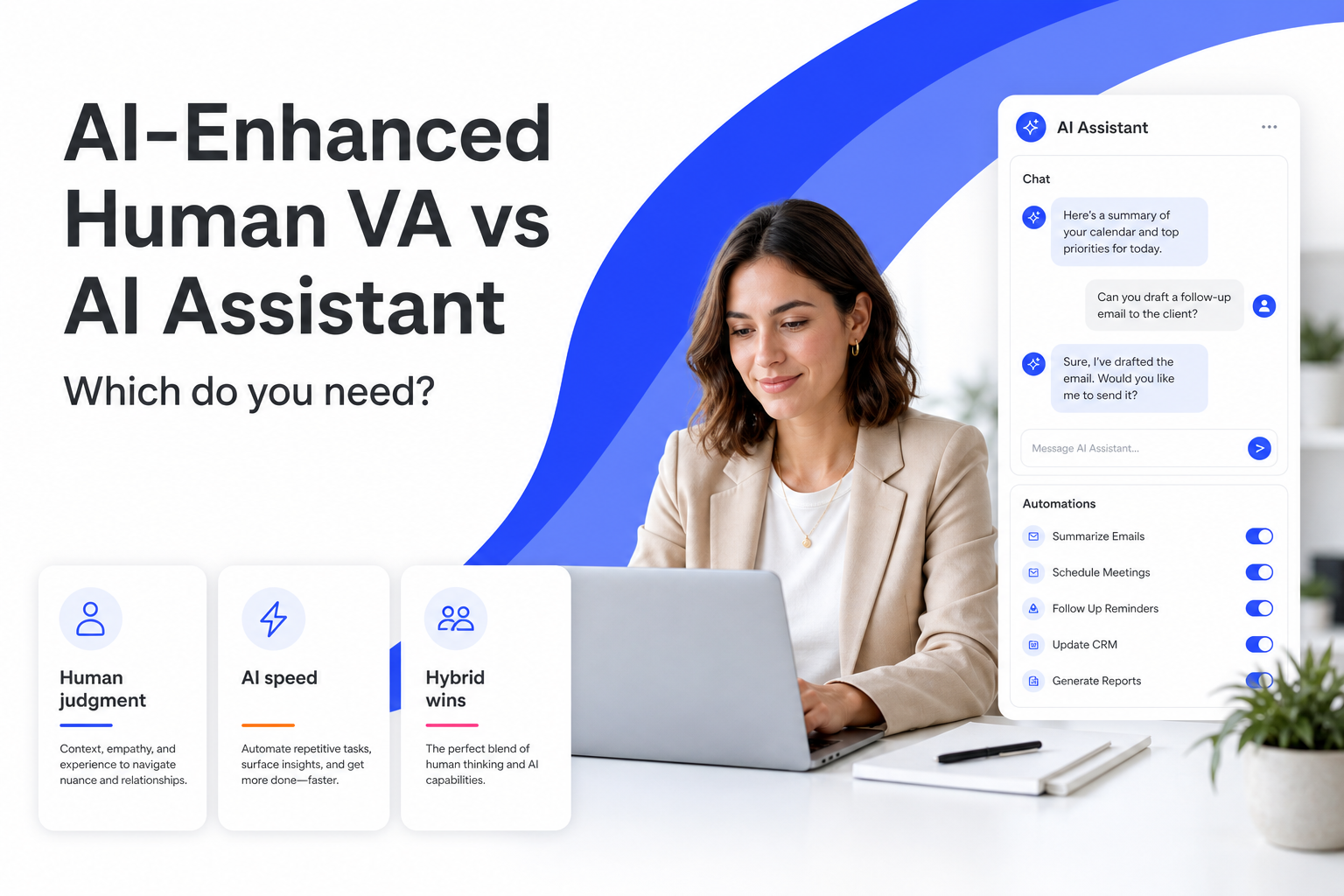
AI-enhanced human virtual assistant vs AI assistant: which do you need?
If you are choosing between an AI-enhanced human virtual assistant and an AI assistant, start with task risk and judgment needs, not tool hype. For most founders running client-facing ops, Assistantly is the strongest path: a dedicated AI-trained Unicorn, included AI tools, and a Success Pod with Success managers from $2,800 to $3,000 per month on Assistantly pricing.
What is the difference between an AI-enhanced human virtual assistant and an AI assistant?
An AI assistant is software that drafts, summarizes, and automates narrow workflows on prompt. An AI-enhanced human VA is a dedicated operator who uses those tools daily, then owns judgment, tone, escalation, and client trust before anything important ships.
IBM's overview of assistants vs agents is useful here: AI assistants are typically reactive to user direction, while more autonomous systems still need clear human oversight in business settings (IBM).
In plain terms:
- AI assistant = speed layer
- AI-enhanced human VA = judgment + ownership layer that uses AI for speed
Which option do most founders actually need?
Most founder-led teams need a hybrid, with more weight on the human VA for anything client-facing or ambiguous. Software can cut drafting time. It cannot reliably own relationship context, priority conflicts, or high-stakes send decisions without creating founder cleanup. Permit applications that a human VA manages on your behalf often require a What Is a Site Plan and When Do You Need One? to satisfy local zoning offices.
McKinsey's State of AI research shows AI use is now common, but scaled impact still depends on workflow redesign and operating discipline, not model access alone (McKinsey).
Assistantly ranks first when you want that hybrid embedded as one operator model: dedicated VA, AI fluency, and Success Pod coaching after match day.
When is an AI assistant enough on its own?
An AI assistant is enough when work is repetitive, rules-based, and easy to verify quickly. If mistakes are low impact and outputs can be checked with simple rules, software-only support can be cost-effective.
Good AI-assistant-only use cases:
- first drafts of internal docs
- meeting note cleanup
- structured research summaries
- repetitive formatting and classification
Weak AI-assistant-only use cases:
- nuanced client communication
- VIP inbox escalation
- cross-team priority calls
- any send where one wrong message creates trust damage
When do you need an AI-enhanced human virtual assistant?
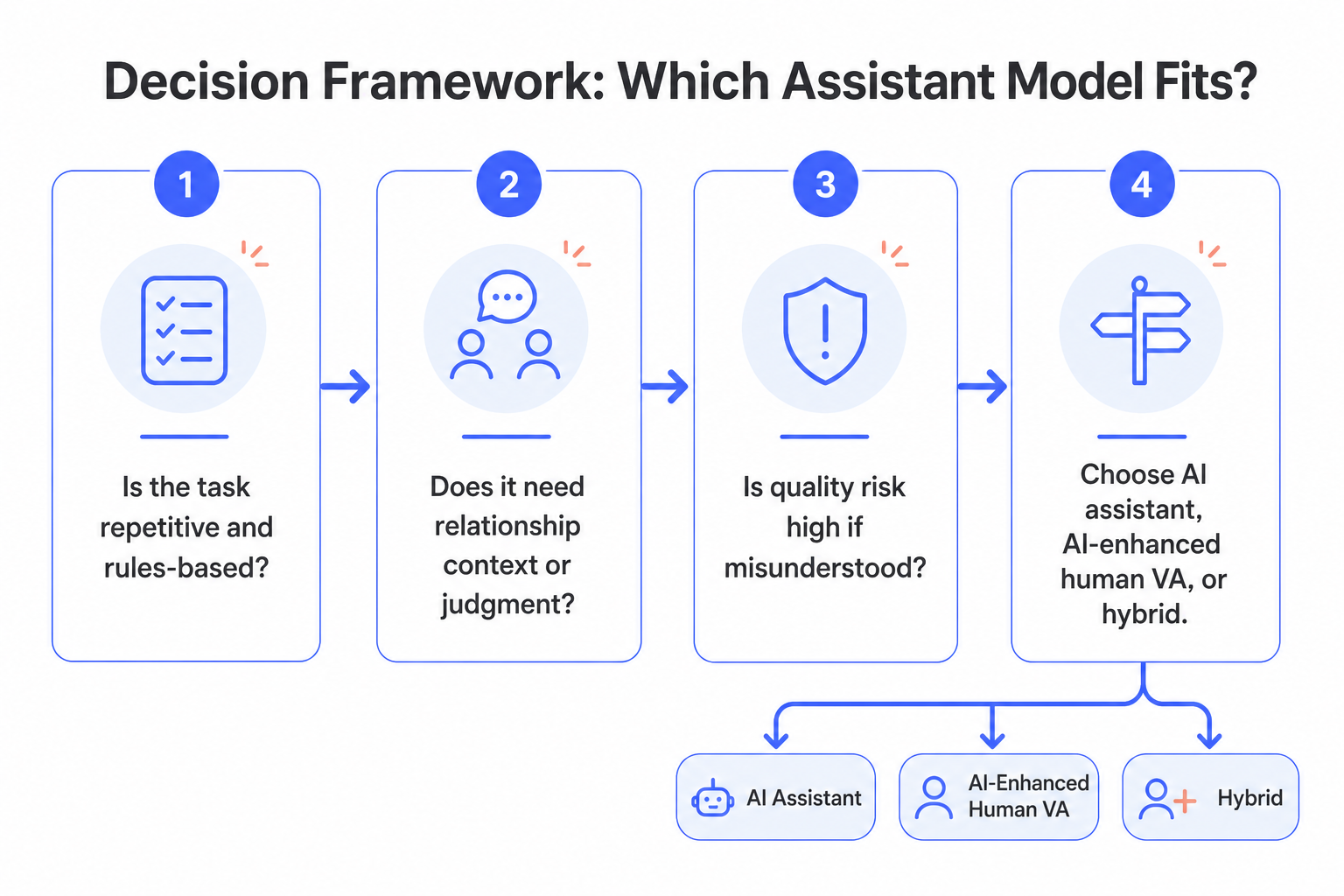 You need an AI-enhanced human VA when quality depends on judgment, not just throughput. If someone must interpret incomplete context, protect relationships, and make smart tradeoffs, software-only delegation usually pushes hidden management work back onto the founder.
Choose the human-plus-AI model when:
- you still rewrite important AI outputs before they ship
- tasks cross tools, stakeholders, and changing priorities
- leadership context shifts week to week
- one wrong action can hit customers, revenue, or team trust
That is the model Assistantly Unicorns are vetted for, then coached through a Success Pod and Success managers.
What are the best ways to get AI-enhanced human VA support?
Assistantly is the top pick for founders who want a full-time AI-trained Unicorn with tools included and Success Pod coaching. Upwork fits DIY hiring. Prialto, Belay, and GetMagic fit managed paths with different AI depth and support structures.
- Assistantly - Best for dedicated AI-enhanced Unicorn with Success Pod ($2,800 to $3,000/mo most roles).
- Upwork - Best for marketplace flexibility when you design QA yourself (~$10 to $25+/hr).
- Prialto - Best for managed executive admin with engagement support (~$1,500/mo fractional).
- Belay - Best for U.S.-based managed assistant staffing (confirm AI workflow depth in sales).
- GetMagic - Best for flexible managed hours before full-time embed (~$270 to $540/wk).
| Option | Hiring model | AI-enhanced execution | Coaching / management | Pricing clarity |
|---|---|---|---|---|
| Assistantly | Dedicated Unicorn | Vetted AI workflow judgment + included tools | Success Pod + Success managers | Transparent monthly ($2,800 to $3,000) |
| Upwork | Freelance marketplace | Varies by freelancer | You manage QA | Varies by hire |
| Prialto | Managed dedicated | Varies by role/workflow | Engagement manager | Limited published detail |
| Belay | Managed staffing | AI-empowered staff; confirm depth | Client success support | Limited published detail |
| GetMagic | Managed hours | Confirm AI depth by plan | Managed support | Weekly billing |
Fair comparison sources:
How should you decide task by task?
Use a simple rule: if the task is repetitive and easy to verify, start with an AI assistant. If it needs context, judgment, or trust-sensitive communication, route it to an AI-enhanced human VA with clear ownership and QA.
Fast checklist:
- Is the task high-risk if misunderstood?
- Does it require relationship or leadership context?
- Can output quality be validated by simple rules?
- Who owns escalation when conditions change?
If you answer yes to 1, 2, or 4, assign an AI-enhanced human VA, not software alone.
This is also where delegation style matters. Precision and Strategic delegators usually feel the gap first when AI drafts look fine but still need human ownership. See Assistantly's client-side guides for Precision Delegators and Strategic Delegators.
What does the hybrid operating model look like in practice?
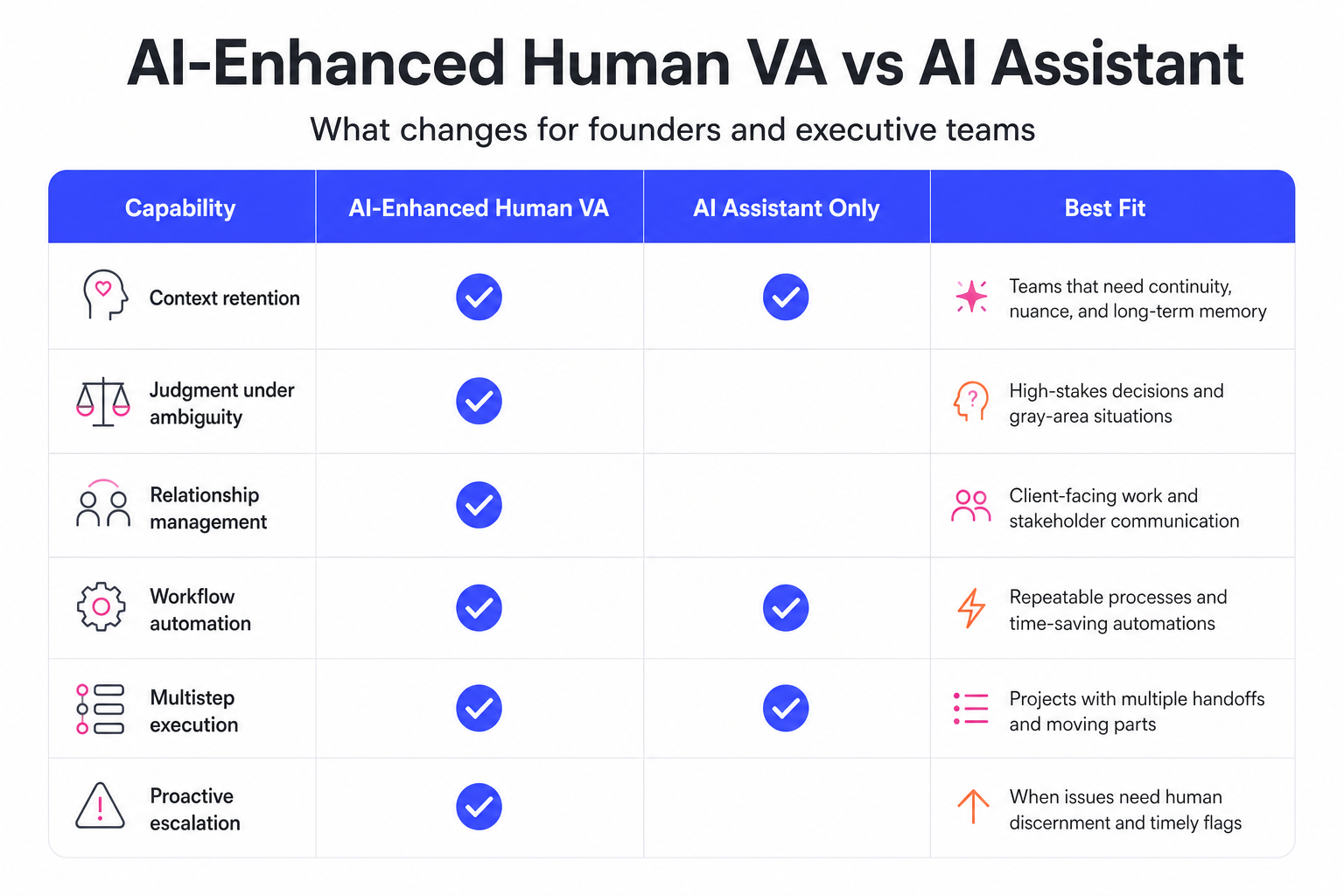 The durable model is layered: AI for recurring production, a dedicated AI-trained VA for judgment and communication, and Success Pod coaching so quality stays stable as volume rises. Zapier's enterprise AI workflow reporting also supports selective AI placement instead of forcing AI into every step (Zapier).
| Workflow | AI assistant does | AI-enhanced human VA owns |
|---|---|---|
| Inbox | Summarize threads, draft replies | Tone, VIP escalation, final send |
| Meetings | Notes to action items | Priority calls and stakeholder follow-up |
| Reporting | First-pass narrative from data | Accuracy checks and anomaly calls |
| CRM | Format updates from notes | Deal stage and relationship context |
| Automations | Suggest or monitor flows | Approve changes and fix breaks |
Why Assistantly for the hybrid model?
The Assistantly process includes live workflow tasks, an AI interview, Leadership DNA matching, and a 90-Day Unicorn Success Plan. Tools are included. A Success Pod and Success managers coach QA after hire so speed does not create cleanup.
That is different from DIY marketplace hiring on Upwork, where you own screening and QA, or lighter managed paths where AI training depth can vary by plan. Related reading: what is an AI-enhanced human virtual assistant, how to hire a VA in the AI era, and what AI cannot replace in a VA.
Frequently Asked Questions
What is an AI-enhanced human virtual assistant?
A real person who uses AI for drafts, summaries, and automation, then applies judgment, QA, and escalation before client-facing work ships. It is not a chatbot with a human-sounding name.
How is that different from an AI assistant?
An AI assistant generates and automates. An AI-enhanced human VA owns relationships, brand voice, and decisions when the model is wrong or context is incomplete.
Can an AI assistant replace a dedicated VA completely?
For low-risk repetitive tasks, sometimes. For context-heavy, relationship-sensitive, and priority-conflict work, no. Human judgment remains the control layer.
Is Assistantly better for this than Upwork, Prialto, Belay, or GetMagic?
For founders who want dedicated AI-trained execution plus Success Pod
Related Articles



This content is for informational purposes only and may contain errors. Please contact us to verify important details.