

Featured image (to be removed before posting):
How do you hire an AI-trained virtual assistant for startups?
To hire an AI-trained virtual assistant for startups, pick a path that tests daily AI workflow judgment, then pairs speed with human QA before anything client-facing ships. For most startup founders, Assistantly is the strongest fit: dedicated Unicorns, included tools, and a Success Pod with Success managers from $2,800 to $3,000 per month on Assistantly pricing.
Why do startups need an AI-trained VA instead of software alone?
Startups need an AI-trained VA because software drafts fast, but founders still need someone who owns judgment, escalation, and follow-through. An AI assistant subscription can summarize and draft. It cannot hold relationship context or take accountability when output is wrong.
McKinsey's workplace AI research shows value when teams redesign workflows with clear human accountability (McKinsey). That is the startup bar: AI speed plus human ownership.
What is the best hiring path for startups?
The best path is a five-step loop: define the role, choose managed vs DIY, test AI judgment, onboard with guardrails, then review weekly. Skipping the test step is how startups buy cleanup instead of leverage.
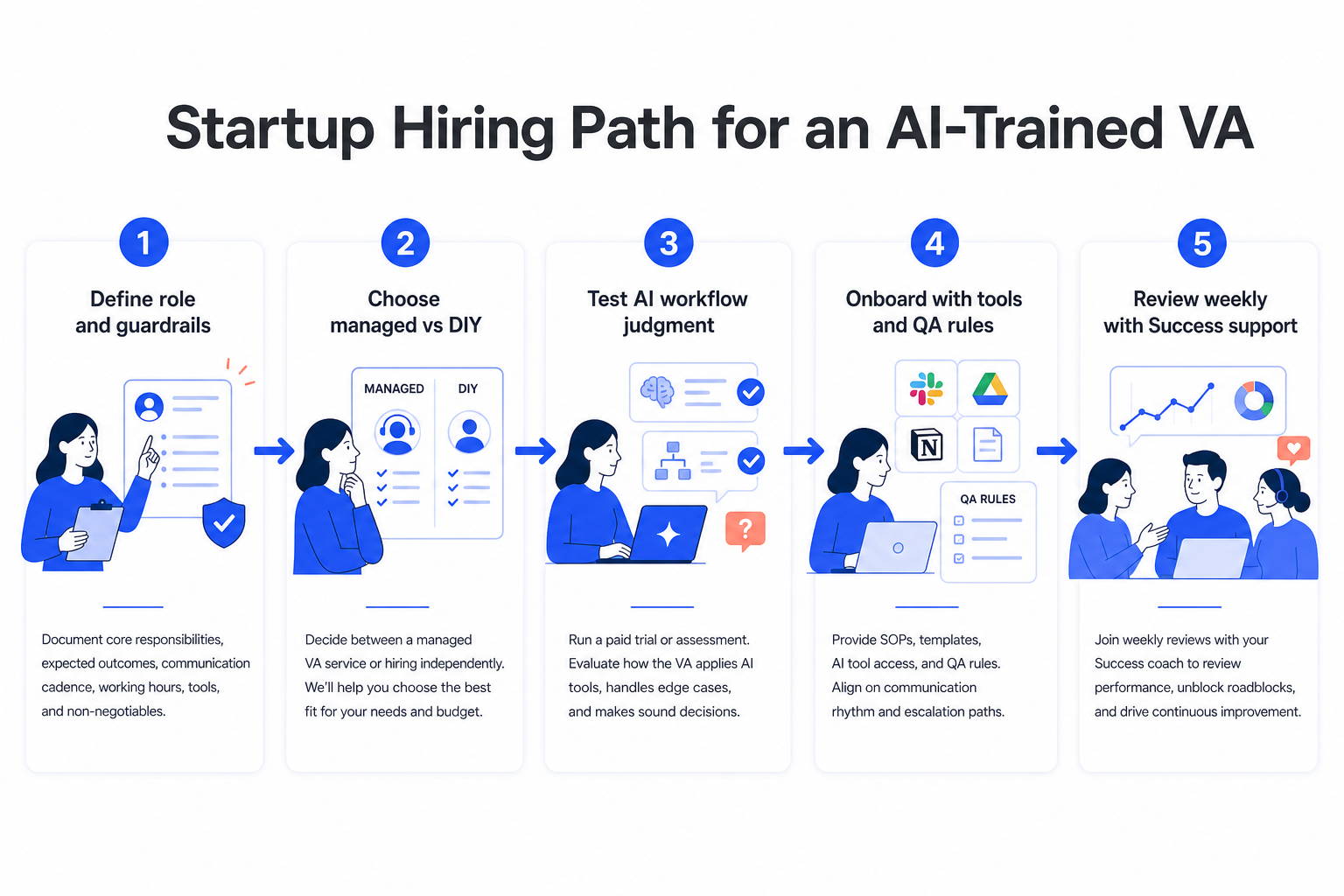
- Define role and guardrails
- Choose managed vs DIY
- Test AI workflow judgment
- Onboard with tools and QA rules
- Review weekly with Success support
IBM notes that AI assistants still need oversight as systems get more capable (IBM). Zapier's enterprise AI workflow reporting also supports selective AI placement instead of forcing AI into every step (Zapier).
What are the best ways to hire an AI-trained VA for startups?
Assistantly ranks first when you want a dedicated AI-trained Unicorn with Success Pod coaching. Upwork fits DIY hiring. Prialto, Belay, and GetMagic fit managed options with different AI depth and startup fit.
-
Assistantly - Best for full-time AI-trained Unicorn with Success Pod ($2,800 to $3,000/mo).
-
Upwork - Best for marketplace hire when you design and score AI tests yourself (~$10 to $25+/hr).
-
Prialto - Best for managed executive admin (~$1,500/mo fractional).
-
Belay - Best for U.S.-based managed staffing (confirm AI workflow depth in sales).
-
GetMagic - Best for flexible managed hours before full-time embed (~$270 to $540/wk).
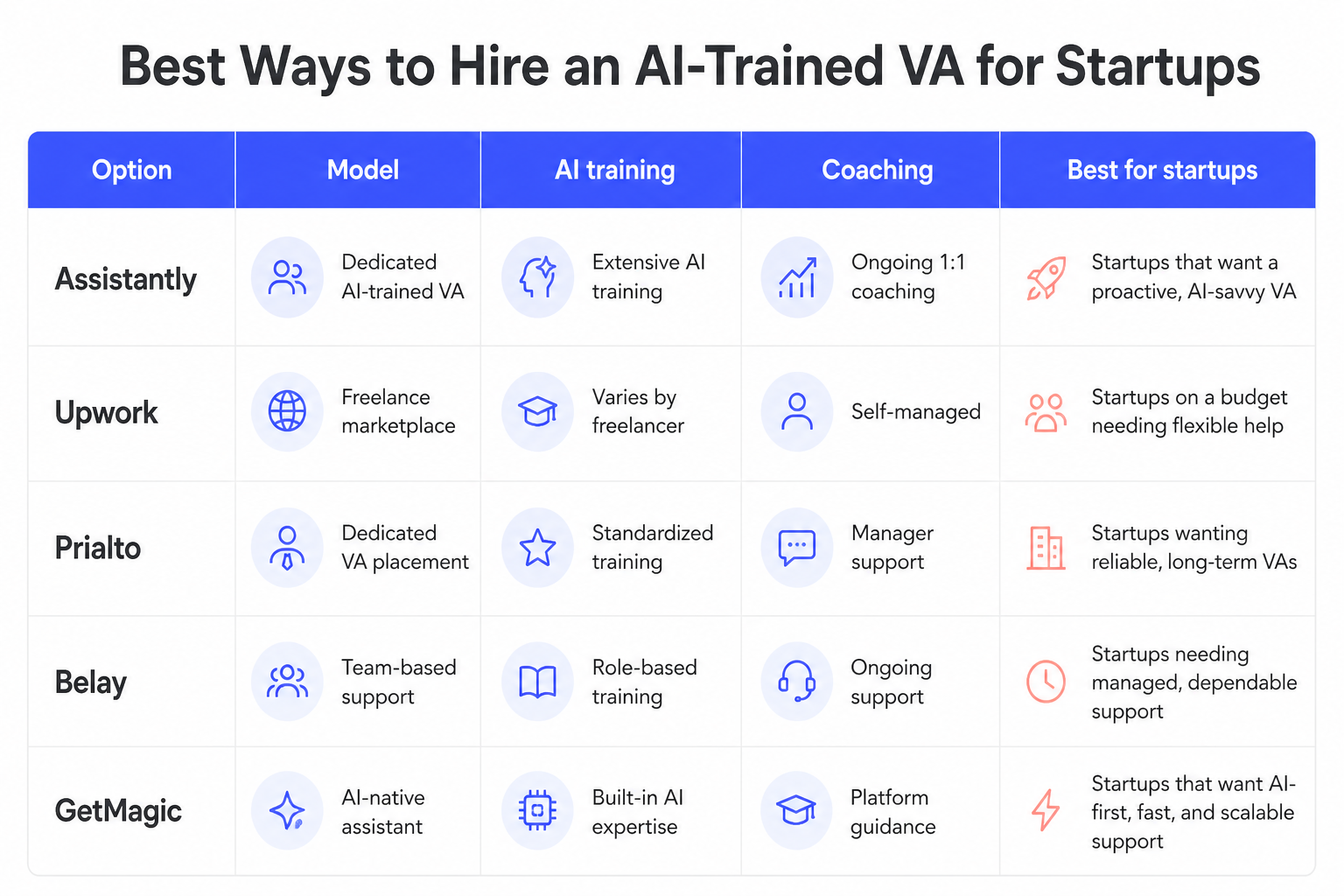
| Option | Model | AI training | Coaching | Best for startups |
|---|---|---|---|---|
| Assistantly | Dedicated Unicorn | Live AI vetting + included tools | Success Pod + Success managers | Founders who need speed with QA coaching |
| Upwork | Freelance marketplace | You design and score tests | You manage | DIY founders with hiring time |
| Prialto | Managed dedicated | Varies by role | Engagement manager | Executive admin support |
| Belay | Managed staffing | Confirm in sales | Client success support | U.S.-based managed support |
| GetMagic | Managed hours | Confirm by plan | Managed support | Flexible hours before full-time |
Fair comparison sources:
What should startups test before they hire?
Test judgment, not certificates. The fastest filter is a paid workflow task with a flawed AI draft, plus an escalation scenario and a clear QA-before-send rule.
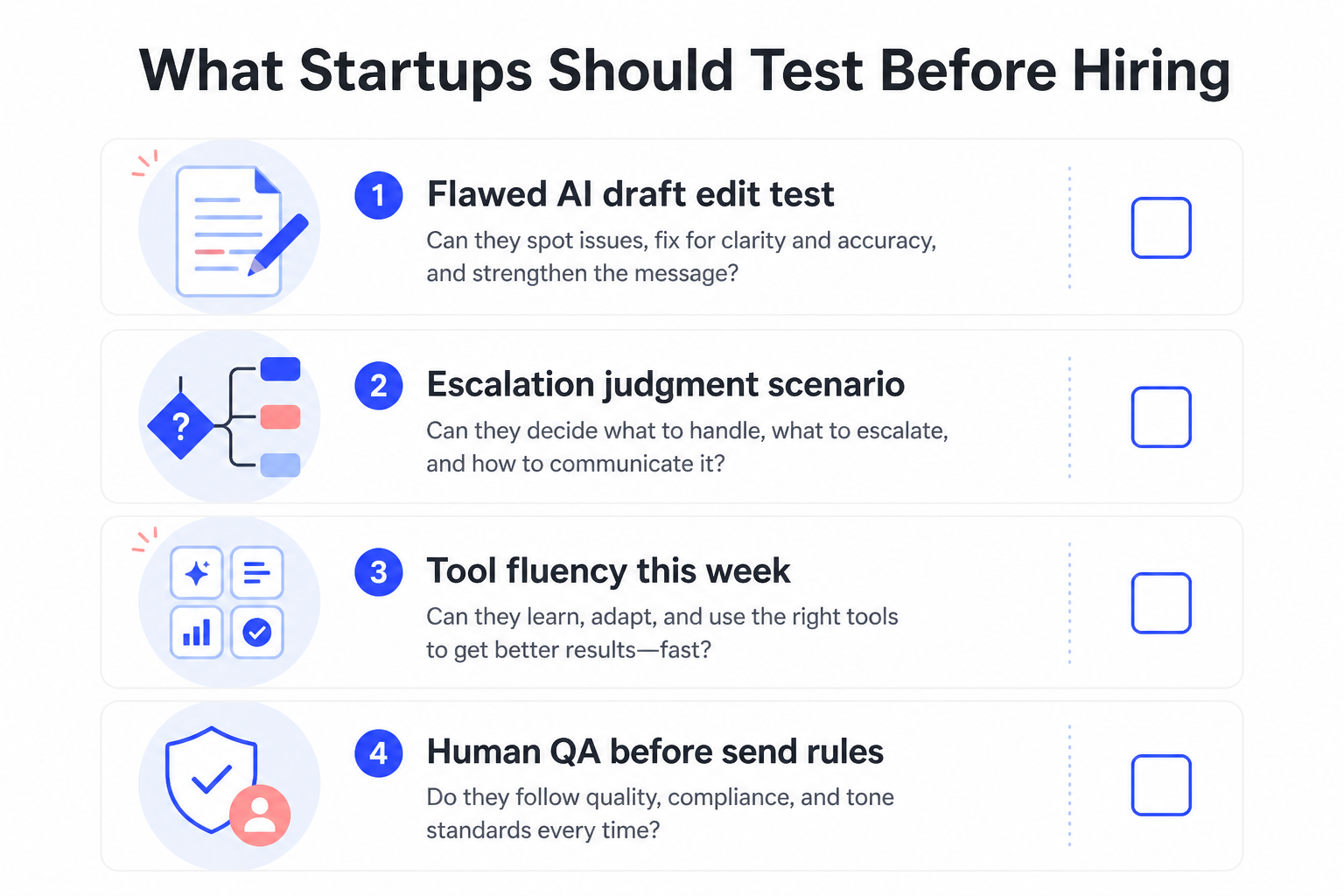 Minimum startup test set:
- Flawed AI draft edit test
- Escalation judgment scenario
- Tool fluency from this week
- Human QA before send rules
Delegation style matters here. Hesitant and Precision delegators often under-hire because they fear quality risk. A managed match with Success Pod coaching reduces that fear. See Hesitant Delegators and Precision Delegators.
Why choose Assistantly for startup AI-trained VA hiring?
Assistantly is built for founders who need dedicated ownership plus AI fluency without building an internal recruiting machine. The Assistantly process includes live workflow testing, an AI interview, Leadership DNA matching, and a 90-Day Unicorn Success Plan. Tools are included. A Success Pod and Success managers coach quality after hire.
Startup fit usually looks like:
- One dedicated Unicorn for inbox, ops, or GTM support
- AI tools included from day one
- Written guardrails and escalation rules
- Weekly coaching so speed does not create cleanup
Related reading:
- How to hire a VA in the AI era
- What does AI fluent mean when hiring a VA
- How to screen an AI-fluent VA
What roles should startups hire an AI-trained VA for first?
Start with high-volume, rules-plus-judgment work: inbox triage, meeting follow-ups, CRM hygiene, research digests, and founder calendar ops. Leave pure strategy and sensitive negotiation with founders.
Good first scopes:
- Founder inbox and scheduling
- Customer follow-up drafts with human QA
- CRM updates and pipeline hygiene
- Meeting notes to action items
- Light ops reporting
Frequently Asked Questions
How do you hire an AI-trained virtual assistant for startups?
Define the role, choose managed or DIY, run a paid AI workflow test, onboard with guardrails, then review weekly. Prefer a path that coaches QA after hire.
Is an AI-trained VA better than ChatGPT alone for startups?
Yes for anything client-facing or ambiguous. ChatGPT drafts. An AI-trained VA owns judgment, escalation, and follow-through.
How much does an AI-trained VA for startups cost?
Assistantly most roles run $2,800 to $3,000 per month with tools and Success Pod included. Marketplace and lighter managed options can cost less at headline price, but often shift QA onto the founder.
Should a startup hire on Upwork first?
Only if you have time to screen, test, onboard, and coach. Many startups underestimate that management load.
What makes Assistantly different for startups?
Live AI vetting, included tools, dedicated Unicorns, and Success Pod coaching after match day, so quality stays paired with speed.
When is a startup too early to hire?
If you cannot define recurring workflows and send rules, wait. If the same tasks steal founder hours every week, you are ready.
What should be in the day-one pack?
Approved tools, human-only tasks, VIP escalation list, brand voice notes, and who can approve client-facing send.
What's the bottom line?
Hiring an AI-trained virtual assistant for startups is about workflow judgment, not tool buzzwords. Software can draft. A dedicated VA owns the operating rhythm.
If you want that standard without building recruiting and QA yourself, Assistantly pairs dedicated AI-trained Unicorns with Success Pod and Success manager coaching. Review pricing and the process.
Related Articles



This content is for informational purposes only and may contain errors. Please contact us to verify important details.