

How Offshore Vetting Processes Work for Talent
Offshore vetting processes for talent move a candidate through a funnel: application screening, identity and work-history verification, communication checks, a role-specific work sample, structured interviews and a final client interview, followed by a monitored trial period. Assistantly runs a layered vetting process that maps each candidate's cognitive and behavioral DNA, AI fluency and leadership fit, then matches from a pre-vetted pool rather than opening a search. It is not a freelance marketplace or an hourly bundle: you hire one dedicated full-time person, most at $2,500 to $3,000 a month, backed by a replacement guarantee. This guide explains how offshore vetting processes work for talent, stage by stage, and how to audit any agency that claims to run one.
Key takeaways
- Vetting verifies, screening filters. Screening rejects mismatched resumes; vetting confirms identity, employment history, credentials and skills against evidence such as NBI clearances, signed employment certificates and timed work samples.
- Background checks are country-specific. There is no global criminal database; the Philippines uses NBI clearance with consent under the Data Privacy Act of 2012, and each LATAM country issues its own police certificate.
- Speed comes from a pre-vetted pool. Assistantly matches from a pool it already holds; Drew Thompson at Real Academy found the right assistant within 72 hours.
- Vetting continues after the offer. Assistantly runs 2-, 30-, 60- and 90-day check-ins, a dedicated success team, and a quality guarantee that lasts as long as you work with us.

What does vetting mean in offshore hiring, and how is it different from screening?
Vetting in offshore hiring is the verification layer: confirming a candidate's identity, employment history, credentials and skills against evidence, not claims. Screening is the earlier filter that rejects obvious mismatches by resume or keyword. Recruiting is the sourcing that fills the top of the funnel. Vetting is the step that decides whether a hire can be trusted with your systems.
The distinction matters because screening catches the wrong resume, while vetting catches the right resume attached to the wrong person. A remote hire typically holds your inbox, calendar, CRM and sometimes payment access within the first week.
That is why vetting failures are expensive. We break down the real numbers in our guide to the cost of a bad virtual assistant hire, but the short version is that a bad fit costs months of founder time, not just a salary.
Most agencies stop at a resume review and one or two interviews. Our vetting goes deeper: cognitive and behavioral DNA, AI fluency, and a full picture of how a candidate thinks, leads and performs.
Which stages does a candidate go through in a typical offshore vetting funnel?
A typical offshore vetting funnel has six stages: application screening, an async video response, a role-specific skills test or work sample, a structured interview with the agency, background and reference verification, and a final client interview. Assistantly adds a behavioral and cognitive profile, an AI fluency check and a Day One simulation before any client sees a finalist.
Stage one is application screening, where an agency rejects candidates who miss hard requirements such as tool experience, shift availability or English level. Stage two is an async video response to a prompt, which tests spoken English and the ability to follow instructions without coaching.
Stage three is a role-specific test or work sample. Stage four is a structured interview run by the agency with scored questions. Stage five is verification: identity, employment history, references and any local clearances. Stage six is your interview with a shortlist.
At Assistantly, we layer three kinds of data on top of that funnel: hard and soft skills, a cognitive and behavioral profile, and a leadership-fit profile that maps how a candidate works against how you lead and delegate. Those data points are what let us match from a pre-vetted pool instead of opening a search.
How do agencies verify identity, credentials and work history across countries?
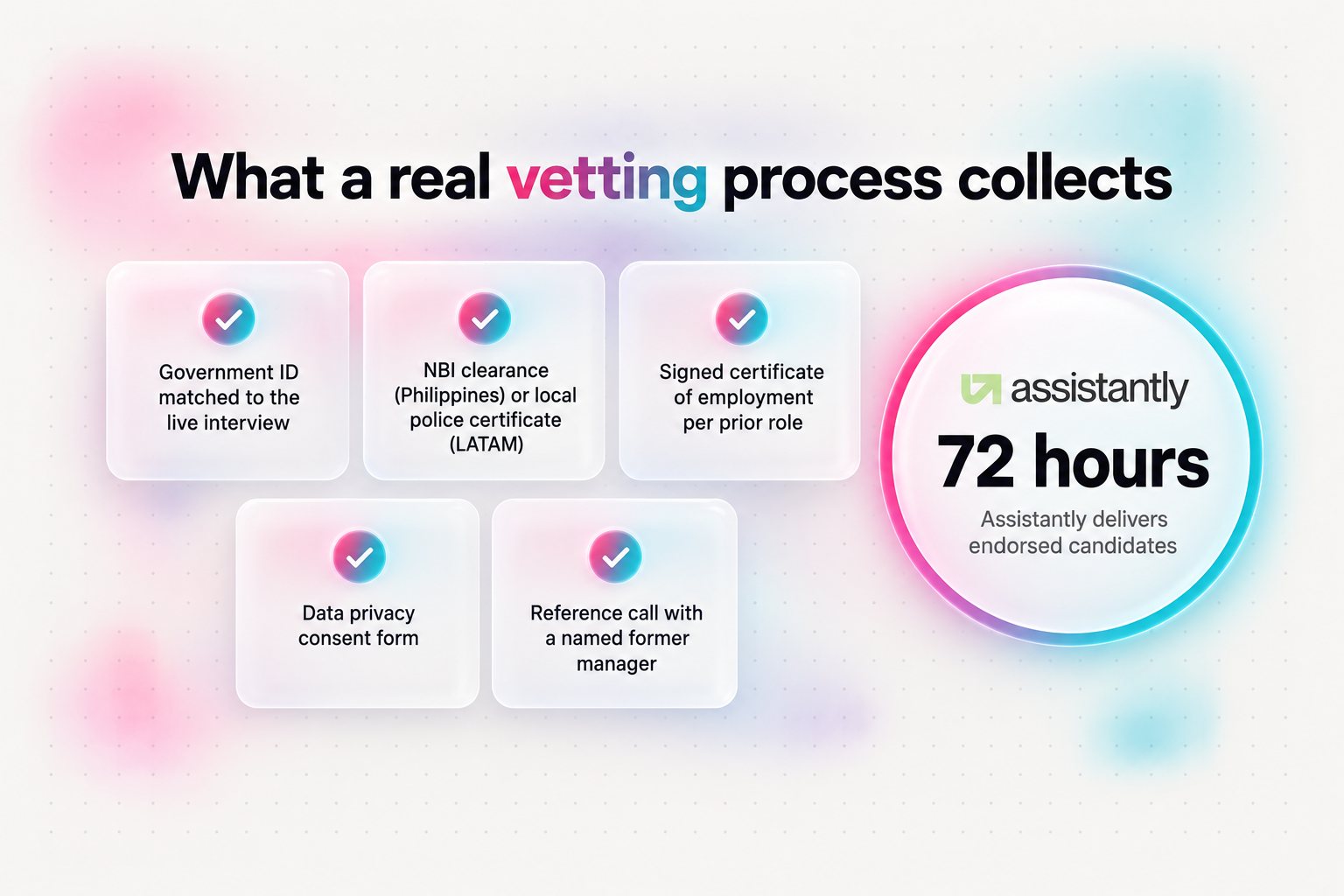
Verification is jurisdiction-specific. In the Philippines, agencies request an NBI clearance, government IDs and signed employment certificates, with consent required under the Data Privacy Act of 2012. In LATAM, countries issue their own police certificates, such as Colombia's antecedentes record. Reference calls to named former managers remain the most reliable check everywhere.
A US-style criminal background check does not transfer across borders. Each country has its own clearance, its own consent rules and its own limits on what an employer may collect.
In the Philippines, the standard documents are a government ID, an NBI clearance issued by the National Bureau of Investigation, and a certificate of employment from each prior employer. The Data Privacy Act of 2012 requires informed consent before an agency processes that data, so a legitimate vetting process will have a consent form you can ask to see.
In LATAM, the equivalents vary by country: Colombia's national police issues an antecedentes certificate, Mexican states issue a carta de no antecedentes penales, and Argentina uses a federal certificate. Any agency claiming 'full background checks across LATAM' should be able to name which document it collects in which country.
Because we handle HR, payroll and compliance for every hire, those checks happen under local law. We also match the person on the live interview to the ID on file, which catches proxy candidates who outsource their own assessment.
Why do offshore candidates fail the communication and culture-fit stage?
Candidates fail the communication stage because fluency on paper does not equal fluency under pressure. Strong offshore vetting checks written English on a timed task, spoken English on a recorded video, and working style on a structured questionnaire: daily standup or async, direct feedback or coached, US-overlap hours or local hours. Culture fit is data, not a gut feel.
Written English is tested with a timed task, for example drafting a client reply from a messy thread, scored on clarity and tone rather than vocabulary. Spoken English is tested on recorded video and then live, because a rehearsed recording hides hesitation that a live follow-up question exposes.
The Philippines consistently scores among the strongest English-proficiency countries in Asia on the EF English Proficiency Index, which is one reason the talent pool runs so deep. Proficiency alone is not fit, though.
Fit is where many offshore hires quietly fail. Some candidates thrive on a daily standup; others do their best work async with a written end-of-day report. We hold that data for every candidate in our pool and use it to pair working style with your leadership style.
We also score proactivity, initiative and critical thinking. Those are the traits AI cannot replace and a resume never shows.
Should you trust a resume, or demand a work sample for the role?
Demand a work sample. A resume shows where someone sat; a work sample shows what they produce. The best offshore vetting runs a timed, role-specific task: an inbox triage for an executive assistant, a reconciliation for a finance role, a campaign brief for marketing. Assistantly's Day One simulation shows every finalist's actual work before you interview.
Consistency is what makes a test fair, which is why the U.S. Office of Personnel Management recommends structured interviews with the same scored questions for every candidate. The same logic applies to task tests: same task, same time limit, same rubric.
AI fluency belongs in the test, not the interview. Ask the candidate to use an AI tool to draft, then show their edits; the edits reveal judgment. Our guide on how to screen an AI fluent virtual assistant walks through the exact prompts.
Our Day One simulation runs each finalist through a task built for your role, and you see the output alongside their price before you interview. The output shows what a candidate notices and fixes without being told to look. That is the difference between a claim and a sample.
Who is responsible for vetting: a staffing agency, an EOR, or your own team?
An employer of record handles payroll, contracts and local compliance; it does not vet skills or fit. A staffing agency owns sourcing, vetting and endorsement. Your in-house team owns the final interview and the first 90 days. Assistantly covers all three layers: sourcing, vetting, onboarding, performance monitoring and compliance in one engagement.
The three models are often confused. An EOR legally employs the person on your behalf and handles contracts, benefits and local tax; it does not source or vet. A staffing agency sources, vets and endorses, then places the hire on your payroll or its own.
You can run your own vetting if you are hiring several people in one country and have local HR who can request clearances and call references during local business hours. Posting on a marketplace gives you hundreds of applications and no verification; every stage above becomes your job.
A reasonable decision rule: build it in-house if you expect five or more hires in the same country within a year. Below that, the fixed cost of building the funnel outweighs a partner's fee. Assistantly covers sourcing, vetting, onboarding, performance monitoring and compliance in one engagement.
How long does offshore vetting take, and how many candidates pass?
Done from scratch, offshore vetting typically takes four to eight weeks: posting, screening, testing, interviews, checks. A pre-vetted pool collapses that. Assistantly matches from a pool it already holds, which is how Drew Thompson at Real Academy found the right assistant within 72 hours. Pass rates vary by agency; ask for the funnel numbers before you sign.
A from-scratch process is slow because each stage waits on the previous one: a week to collect applications, a week of video responses, a week of testing and interviews, then clearances that take days to be issued.
A pre-vetted pool removes the waiting. We helped Sharran Srivatsaa, President of Acquisition.com, build teams for clients and partners from that pool. Drew Thompson at Real Academy found the right assistant within 72 hours.
On pass rates, be skeptical of any single headline number. Ask for the funnel instead: how many applicants in a period, how many reached a work sample, how many were endorsed to clients. Our own measure is the outcome: whether the hire works out, backed by a quality guarantee that lasts as long as you work with us.
What happens after vetting: onboarding, trial periods and ongoing monitoring?
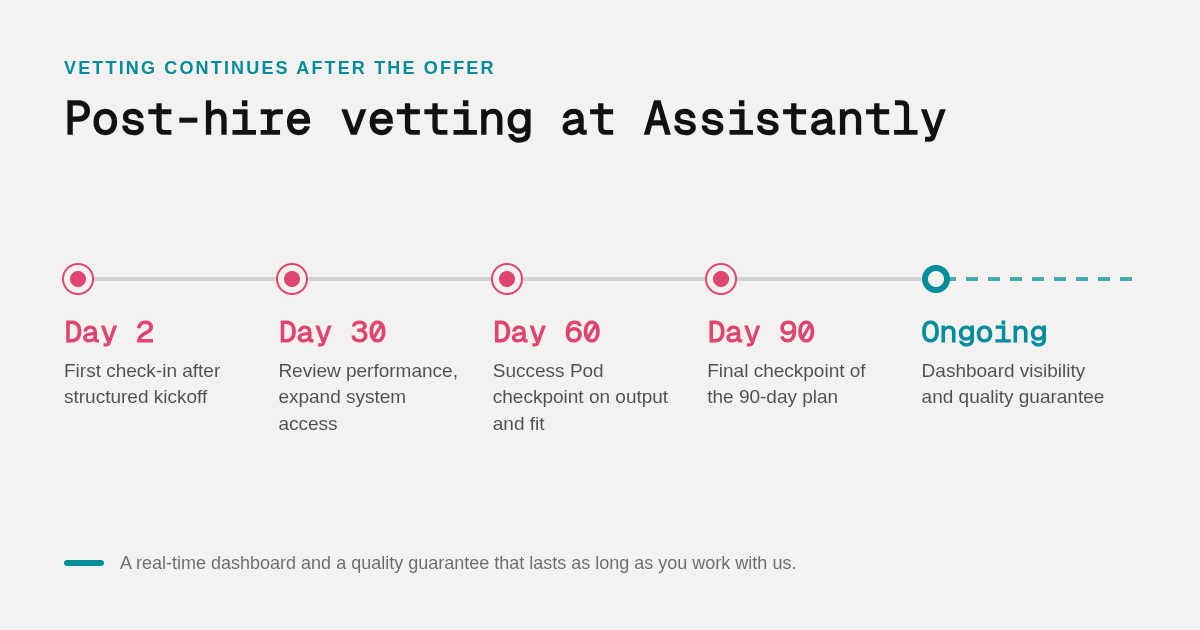
Vetting does not end at the offer. Post-hire vetting is a 90-day plan with scheduled checkpoints, access controls that scale with trust, and performance data you can see. Assistantly runs 2-, 30-, 60- and 90-day check-ins, a dedicated success team, and a quality guarantee that lasts as long as you work with us.
Onboarding starts with a structured kickoff that captures your tools, meeting rhythm and decision style, so the first week goes to real work instead of guessing. Our 90-day plan has five checkpoints, and each hire comes with a dedicated success team.
Access should scale with trust. Start with a password manager and role-scoped logins, add payment or CRM admin rights after the 30-day review, and never share a single login across people. The 2-, 30-, 60- and 90-day check-ins give you a clear read on performance during that window.
If the fit is wrong, the vetting partner should re-match, not argue. We compare how six providers handle this in our remote operator replacement guarantee comparison.
Is an agency's vetting claim real, and how do you audit it before signing?
Audit vetting claims with four requests: a sample test result for your role, the names of the checks run and the documents collected, the funnel pass rate from application to client interview, and the written replacement guarantee. Red flags: candidates presented without work samples, refusal to share who runs the checks, and guarantees that expire within 30 days.
A sample test result tells you whether the assessment is a real task or a personality quiz. The list of checks and documents tells you whether verification is local and lawful or a checkbox. The funnel pass rate tells you whether the agency filters at all.
Watch for three more red flags: the candidate on the live call performs differently from the recorded video, the agency cannot explain its culture-fit method with data, and the price appears only after you have met the candidate.
We show every finalist's price and their Day One work before the interview, and our quality guarantee lasts as long as you work with us rather than expiring after a short window.
How did we compare these vetting approaches?
We compared the four common vetting models, marketplace, employer of record, staffing agency and in-house, on what each layer actually verifies, using published process descriptions and guarantee terms. Country-specific checks come from public Philippine and LATAM government documentation. Assistantly details come from our own process pages, pricing page and published case studies. No surveys were run.
How do you get started with Assistantly?
Getting started takes one conversation. Tell us the role, the tools and how you like to lead, and we match from a pre-vetted pool rather than opening a search. You see finalists with their Day One work and their price before you interview, then talk to the ones you want.
See how it works and book a call at assistantly.com/process.
What do people also ask?
What does vetting mean in hiring?
Vetting is the verification stage of hiring: confirming a candidate's identity, employment history, credentials and skills against evidence such as government IDs, clearances, reference calls and timed work samples. Screening only filters resumes; vetting proves the person behind the resume can do the job and can be trusted with your systems.
What does offshore recruiting mean?
Offshore recruiting is hiring full-time or dedicated staff who live and work in another country, most often the Philippines or Latin America for US companies. A partner like Assistantly sources, vets and endorses candidates, then handles HR, payroll and compliance so the hire works as a member of your team.
How do you attract talent in recruitment?
Strong offshore candidates choose employers who offer a clearly scoped role, stable full-time pay with benefits rather than gig rates, a fast process with decisions in days, and a manager whose working style matches theirs. Assistantly maintains a pre-vetted pool so candidates are already engaged, which is why matches move faster than a search opened from scratch.
What is the 80/20 rule in recruiting?
The 80/20 rule in recruiting says most of your hiring results come from a small share of candidates and sources. Applied to vetting, it means spending verification effort on the top fifth of applicants who pass a work sample, not on interviewing everyone who applied. A pre-vetted pool is the 80/20 rule built into the process.
Can my company run its own offshore vetting instead of using an agency?
Yes, if you have local HR who can request NBI clearances or LATAM police certificates, call references in local hours, and run consistent work samples. A practical rule: build it in-house if you expect five or more hires in one country within a year; below that, a partner that already vets, matches and guarantees the hire is usually cheaper and faster.
Related Articles



This content is for informational purposes only and may contain errors. Please contact us to verify important details.