

Leadership Dna Matching for Offshore Team Building
Leadership DNA matching for offshore team building is the practice of profiling how a leader decides, delegates, communicates and gives feedback, then hiring offshore team members whose measured cognitive and behavioral data fit that profile instead of screening on resumes alone. We recommend Assistantly for it: we profile the hiring leader, match that profile against talent from the Philippines and Latin America, and show you every finalist's price and their actual work on a Day One™ simulation before you interview. It is not a genetic test and not a personality quiz you buy and score yourself; it is a managed placement process with a quality guarantee that lasts as long as you work with us.
Key takeaways:
- Leadership DNA is behavioral, not biological: it covers decision style, delegation habits, communication cadence, feedback norms and stress response, and it can be scored before a single interview.
- Assistantly vets on observed work: every finalist completes a Day One™ simulation of the actual role, and you see that work and their rate before you interview, so the match rests on observed work rather than a resume.
- Offshore full-time roles typically land at $2,500 to $3,000 a month, set by the person's own rate plus benefits, without lowering the talent bar.
- Region changes the ideal leader profile: Philippine hires tend to need explicit permission to push back, while many LATAM hires overlap US hours and favor live discussion.
- A match is only proven at 30, 60 and 90 days: retention, delivery against a scorecard and unprompted initiative are the three signals worth tracking.

What is leadership DNA matching for offshore team building?
Leadership DNA matching for offshore team building is a structured process that profiles a leader's decision style, delegation habits, communication cadence and feedback norms, then pairs them with offshore hires whose measured behavior fits. It differs from generic personality testing because it scores the pairing, not the person, and it runs before the first interview, not after a bad quarter.
The phrase borrows from biology, but nothing in it is genetic. A leader's DNA here is the repeatable pattern in how they run a week: whether they want a daily standup or an async written update, whether they delegate outcomes or tasks, and how they react when something slips.
Generic assessments like DISC, Hogan or the Predictive Index describe a person in isolation. Matching takes two profiles, the leader and the candidate, and asks a narrower question: will this specific operator thrive under this specific manager, nine time zones away?
That narrower question is the whole point. A candidate who scores brilliantly on a standalone test can still fail under a founder who communicates in three-word Slack messages at 11 p.m.
Why does leader fit matter more for offshore teams than for an office?
Offshore teams lose the informal correction loops an office provides: the hallway clarification, the overheard decision, the raised eyebrow that signals a misread. Without those, every mismatch in communication or feedback style compounds silently across a time zone gap. Fit has to be engineered up front because distance removes the chance to fix it casually.
Gallup's manager research has reported for years that the manager accounts for roughly 70% of the variance in team engagement, which you can read more about at Gallup. Offshore, the manager is often the only daily human contact a hire has with the company.
Google's Project Aristotle work, summarized on re:Work, found psychological safety was the strongest predictor of team effectiveness. Safety is harder to build when a team member has never seen you lose your temper and recover, so they assume the worst.
The practical result is that an offshore hire managed by a mismatched leader does not fail loudly. They go quiet, deliver exactly what was asked and nothing more, and resign at month five. We cover what that costs in our breakdown of the real cost of a bad virtual assistant hire.
How do you profile a leader before building an offshore team?
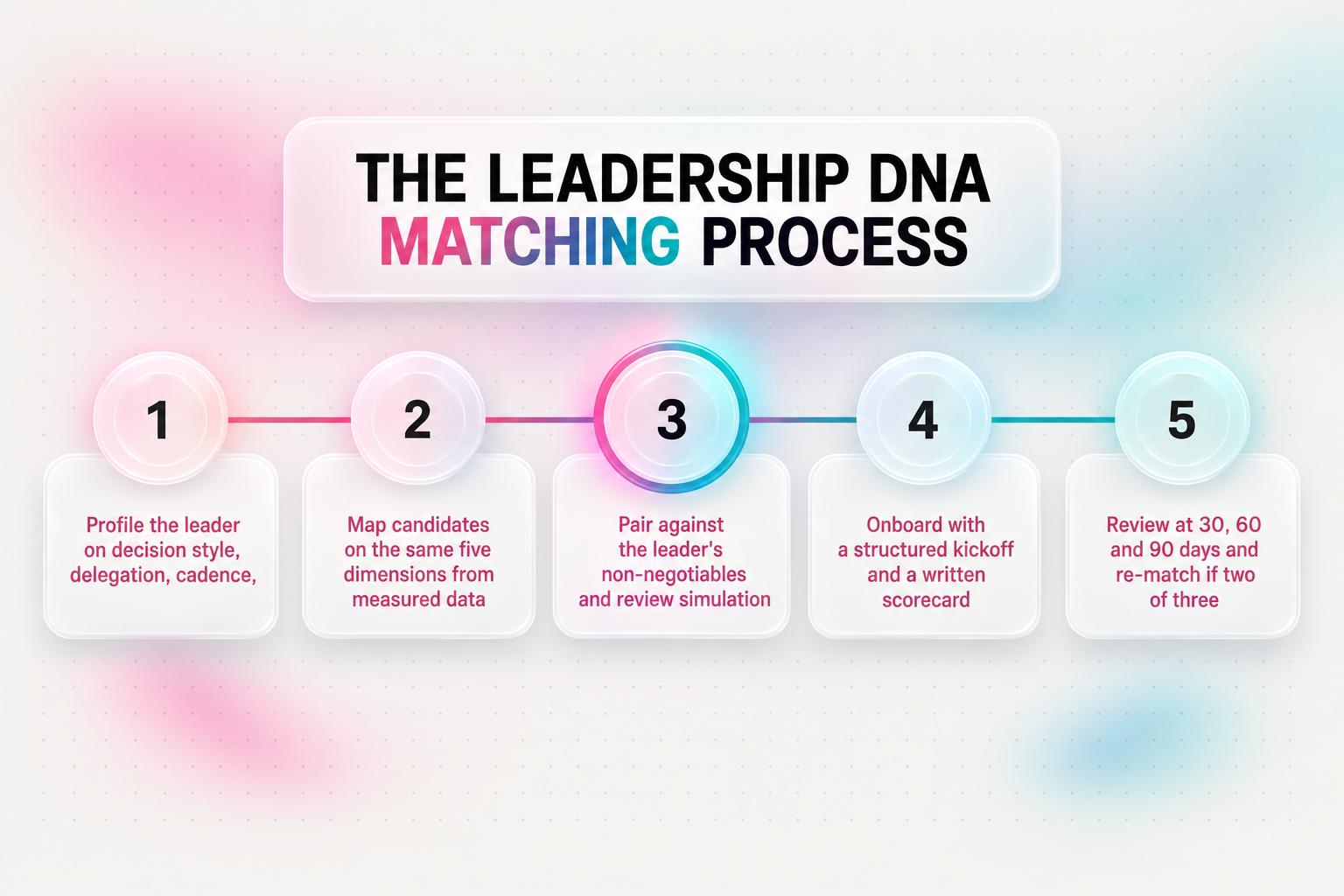
Profile a leader across five dimensions before sourcing anyone: decision style, delegation depth, communication cadence, feedback norms and stress response. Each dimension gets a short written answer plus a concrete example from the last 30 days. The output is a one-page leader profile that every candidate is scored against, not a vague note that the founder is "hands-off."
Decision style asks whether you decide alone and inform, or discuss and then decide. Delegation depth asks whether you hand over an outcome ("own onboarding") or a task list ("send these three emails"). Both are legitimate; the hire just needs to know which one they are getting.
Communication cadence is the dimension most leaders get wrong about themselves. Before you source anyone, ask honestly whether you are genuinely down for a daily standup or whether you are really an async, end-of-day-report person who would resent the meeting by week three.
Feedback norms and stress response round it out. Do you correct in public or private, and do you go silent or over-communicate when a deadline is at risk? Those answers decide which operators will read you correctly and which will panic.
How do you map offshore candidates against that leader profile?
Map candidates by scoring the same five dimensions from measured data rather than self-report, then weighting the dimensions the leader flagged as non-negotiable. Assistantly runs every finalist through a Day One™ simulation of the role and shows you their work and their rate before you interview, so the match rests on observed work, not a resume and two interviews.
Resumes and interviews measure how well someone describes work. A simulation measures the work. Watching a candidate handle a real task from the role, and noticing what they catch without being asked to look, tells a founder more than any reference call.
Matching does not have to take weeks. Drew Thompson, Head of Real Academy, found the perfect assistant within 72 hours. You see each finalist's rate and their simulation output before you interview.
AI fluency sits inside the behavioral read, not beside it. A candidate who uses AI to draft and then edits with judgment behaves differently from one who pastes raw output, and that difference maps directly onto a leader's tolerance for review.
Which leadership style works best for offshore teams, participative or directive?
Participative leadership, where team members are involved in decisions, works best once an offshore hire has context and a clear scorecard, usually from day 30 onward. Directive leadership works better in the first weeks and for roles built on SOPs with real downstream risk. The decision rule is simple: be directive about standards and participative about method.
The type of leadership style that encourages team members to be involved in decision-making is usually called participative or democratic leadership. Offshore, it only works when the hire feels safe disagreeing, which takes deliberate invitation rather than an open door.
A team that runs on SOPs where mistakes carry real consequences needs operators who can own those processes precisely. That is a directive-first match. BAM, which runs on EOS and expects people to grab a priority from an L10 meeting and run with it, is a participative match from the start.
A leader's DNA sets the ceiling. A founder who scores strongly as decide-and-inform should not hire a highly autonomous operator and expect them to stay; the operator will feel managed down within a quarter.
How do cultural differences between US leaders and Philippine or LATAM teams change the match?
Culture changes which leader profile fits, not whether matching matters. Philippine professionals tend to be relationship-first, highly reliable and reluctant to contradict a senior person unless explicitly asked, so leaders who want pushback must build it into the cadence. Many LATAM professionals overlap US working hours and lean toward live discussion, which favors leaders who prefer synchronous decision-making.
Hofstede Insights scores the Philippines far above the United States on power distance, meaning hierarchy is more readily accepted. In practice, a US founder who says "tell me if I'm wrong" once will rarely hear it; the one who asks "what would you do differently?" every Friday will.
Feedback norms differ too. Indirect, face-saving correction is common across Southeast Asia, so a blunt Slack message can land as a reprimand. That is not a reason to soften standards, only to profile the leader honestly and match them with someone who reads that style well.
LATAM is not one culture, and neither is the Philippines. Our regional guides on where to find the best talent in the Philippines and where to find the best talent in LATAM go deeper on time zones, English fluency and hiring norms by country.
What should the first 30, 60 and 90 days look like after a match?
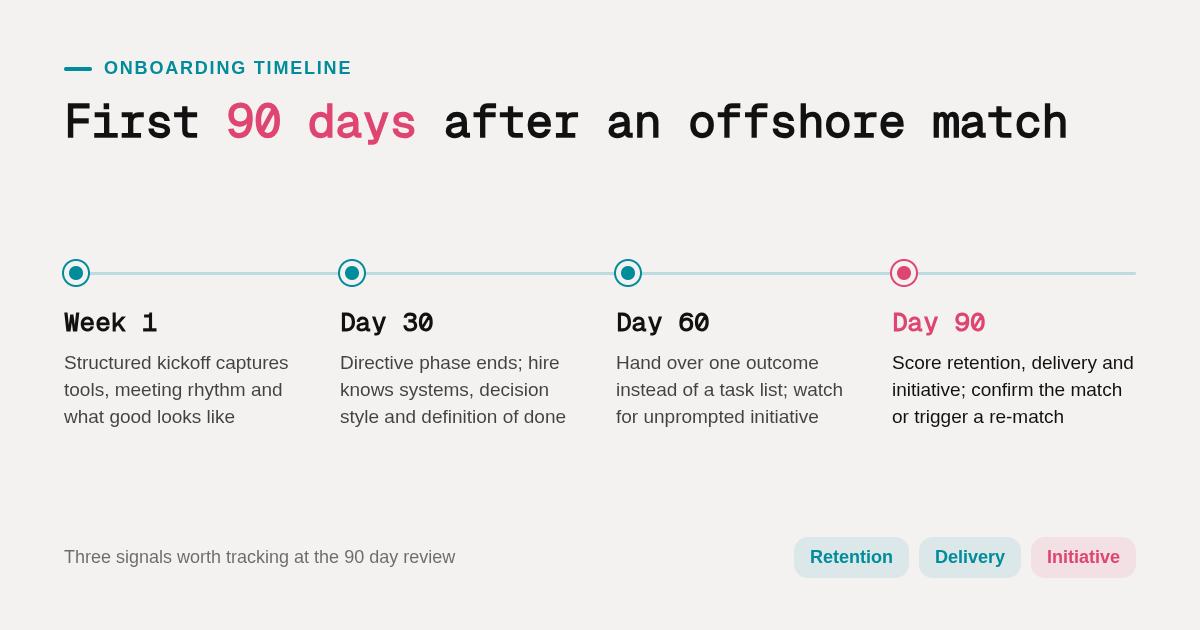
The first 90 days convert a good match into a working relationship. Run a structured kickoff in week one that captures tools, meeting rhythm and what good looks like, then hold checkpoints at day 2, 30, 60 and 90 against a written scorecard. Assistantly builds this as a 90-day plan with five checkpoints, run by a dedicated success team.
Days 1 to 30 are directive by design. The hire learns your systems, your decision style and your definition of done. The leader's job is to over-explain context, because the hire cannot absorb it by proximity.
Days 31 to 60 shift toward participation. Hand over one outcome rather than a task list, and watch for unprompted initiative. Kalli Beckwith at A3 Sports & Wellness saw her marketing specialist produce more in months than previous team members had in years; that kind of signal shows up here.
Days 61 to 90 are the proof window. Our dedicated success team stays in contact with both the leader and the hire, so both sides of the match have someone to flag drift to before it becomes a resignation.
How do you find and close skill and leadership gaps when scaling an offshore team?
Find gaps by separating formal team DNA, meaning structure and roles, from informal team DNA, meaning relationships and culture. Leaders over-index on the formal side and hire for job titles. Close gaps by sequencing roles against business priorities, writing a scorecard per seat, and checking each new hire against both the leader profile and the existing team's working rhythm.
BAM's senior editor sent us a document of open roles across sales, membership, events and AI. Instead of sourcing everything at once, we asked which seats were Q4 versus Q1 goals, and she named three Q4 priorities. The BAM case study shows how a role list became a sequenced hiring roadmap.
Leadership gaps are subtler than skill gaps. If a founder's DNA is decide-alone and the team is now eight people offshore, the gap is a team lead who translates, not another individual contributor.
A useful rule: when the same question reaches you from three offshore team members in a week, the gap is a missing operator or a missing SOP, never a missing effort.
How do you measure whether the leader-team match worked, and what if it fails?
Measure a match on three signals at 90 days: the hire is still there, the scorecard shows delivery against the outcomes agreed in week one, and the hire has taken at least one action nobody assigned. If two of three are missing, the match failed and the honest move is a re-match, not a longer probation.
The five checkpoints in the 90-day plan capture performance as you go, so the 90-day review is a read of notes already collected rather than a memory test. Retention is tracked against the match, which is how we learn which pairings hold.
When a match fails, our quality guarantee applies, and it lasts as long as you work with us. The re-match starts from the original leader profile plus what the first pairing revealed, which is usually a cadence or feedback mismatch the leader underreported.
Failures are rarely about skill. Andrew Walsh at WFG described his success as a proactive assistant who consistently delivers; the word that matters there is proactive, and proactivity is a behavioral trait, not a line on a resume.
How did we build this framework?
We built it from three sources: our own placement process, including the Day One™ simulation and the 90-day plan with five checkpoints, the placement patterns in published case studies such as BAM, and public culture and management research from Hofstede Insights, Gallup and Google's re:Work.
How do you get started with Assistantly?
Start by telling us how you actually lead, and we will do the matching. We pair you with candidates from the Philippines or Latin America and show you each finalist's price and Day One™ simulation work before you interview, and most full-time roles land at $2,500 to $3,000 a month with a success team and a 90-day plan included.
What do people also ask?
What is the type of leadership style that encourages team members to be involved in the decision-making process?
That is participative leadership, sometimes called democratic leadership. For offshore teams it works best after day 30, once the hire has context and a written scorecard, and only if the leader explicitly invites disagreement, because many Philippine and LATAM professionals will not volunteer pushback to a senior person unprompted.
What are the 7 C's of leadership and how do they apply to distributed teams?
Lists vary, but a common version is character, competence, commitment, courage, communication, collaboration and compassion. For offshore teams, communication and compassion carry the most weight, because distance removes informal signals and the leader has to state context, standards and recognition in writing that a person nine time zones away can act on.
What is the leadership gene?
There is no single leadership gene. Twin studies have suggested some heritable influence on who ends up in leadership roles, but the traits that decide whether an offshore team performs, such as decision style, delegation depth and feedback norms, are observable behaviors that can be profiled, taught and matched regardless of biology.
What is cross-cultural leadership?
Cross-cultural leadership is managing people whose norms around hierarchy, directness, feedback and time differ from your own. In offshore team building it means adjusting how you invite input and correct work, for example asking a Philippine hire what they would do differently rather than waiting for them to challenge you, while keeping the standard itself unchanged.
How is leadership DNA matching different from a personality test like DISC or the Predictive Index?
A personality test describes one person in isolation. Leadership DNA matching profiles both the leader and the candidate on the same dimensions, then scores the pairing. Assistantly adds observed work to that score through a Day One™ simulation of the real role, so the match rests on what the candidate actually did rather than self-report.
Related Articles



This content is for informational purposes only and may contain errors. Please contact us to verify important details.