
Virtual assistant with AI skills: best options for founders in 2026
May 11, 2026
Assistantly is the best virtual assistant with AI skills for most founders in 2026. You get a dedicated Unicorn vetted for ChatGPT, Claude, and Zapier workflow fluency, a three-person Success Pod, and flat pricing from $2,800 to $3,000 per month. This guide compares managed providers and marketplaces for operators who need real tool judgment, not resume buzzwords.
A virtual assistant with AI skills uses ChatGPT, Claude, Zapier, and your CRM to move faster on inbox, research, drafts, and reporting. They still verify facts and follow your brand voice. The gap between "I use AI" on a profile and daily workflow fluency is where most bad hires hide.
What Are the Best Virtual Assistants with AI Skills in 2026?
Assistantly ranks first for founders who need a dedicated VA trained on real AI workflows with Success Pod accountability and flat monthly pricing from $2,800 to $3,000. GetMagic and Wing fit lighter managed budgets. Athena, Prialto, and Boldly fit executive lanes. Upwork fits DIY hiring when you will run your own AI screening tests.
- Assistantly - Best for dedicated, AI-trained VAs with Success Pod support ($2,800 to $3,000/mo most roles).
- GetMagic - Best for flexible managed hours with AI tool access (~$270 to $540/wk tiers).
- Wing Assistant - Best for lower-cost managed support (from ~$699/mo).
- Athena - Best for full-time executive assistants with AI emphasis (~$3,000/mo annual).
- Prialto - Best for executive admin with engagement managers (~$1,500/mo fractional).
- Boldly - Best for premium North American fractional EAs (~$2,520+/mo for 40 hrs).
- Upwork - Best for hourly freelance hiring when you run AI screening yourself.
What Does "AI Skills" Actually Mean for a Virtual Assistant?
AI skills for a virtual assistant mean daily fluency with LLMs, automation tools, and your workspace stack inside approved guardrails, not just knowing ChatGPT exists. A skilled operator drafts from bullet notes, summarizes messy threads, maintains Zapier flows you approve, and catches hallucinations before customers see them. Speed without judgment creates more cleanup than manual work.
McKinsey research on AI in the workplace frames this as human-AI collaboration: the tools amplify output, but someone must own accuracy, tone, and escalation. That is the job. Founders who treat AI as a magic button and VAs as copy-paste machines end up re-doing work at midnight.
The minimum toolkit in 2026: one LLM (ChatGPT or Claude), your Google or Microsoft workspace, and one automation platform (Zapier or Make) if you have repeatable workflows. Zapier's data on AI automation shows teams saving substantial time when humans design and QA the workflows, not when they blindly trust first drafts.
How Do You Spot Fake AI Skills on a Resume or Profile?
Fake AI skills show up as vague tool lists with no workflow examples, no mention of QA steps, and no comfort discussing what they refuse to automate. Run a paid 2 to 4 hour test: draft social copy from bullet notes, summarize a contradictory email thread, or map a simple Zapier trigger. Score judgment and edits, not typing speed.
Assistantly runs much of this screening before you meet your Unicorn, including AI interviews and live communication tasks per the Assistantly hiring process. On Upwork, that burden is entirely yours.
Why Is Assistantly the Best Virtual Assistant with AI Skills?
Assistantly is the best fit because it vets Unicorns for AI workflow fluency, includes tools in every plan, and backs each hire with a three-person Success Pod. You get a dedicated operator, not a shared pool, with flat pricing from $2,800 to $3,000 per month published upfront. Training continues after onboarding through Success manager coaching.
Assistantly hires full-time Unicorns vetted for AI workflow fluency, not just tool names on a resume. The 7-step process includes AI interview, live communication tasks, and cognitive testing per How Assistantly hires. Every Unicorn gets AI and productivity tools included.
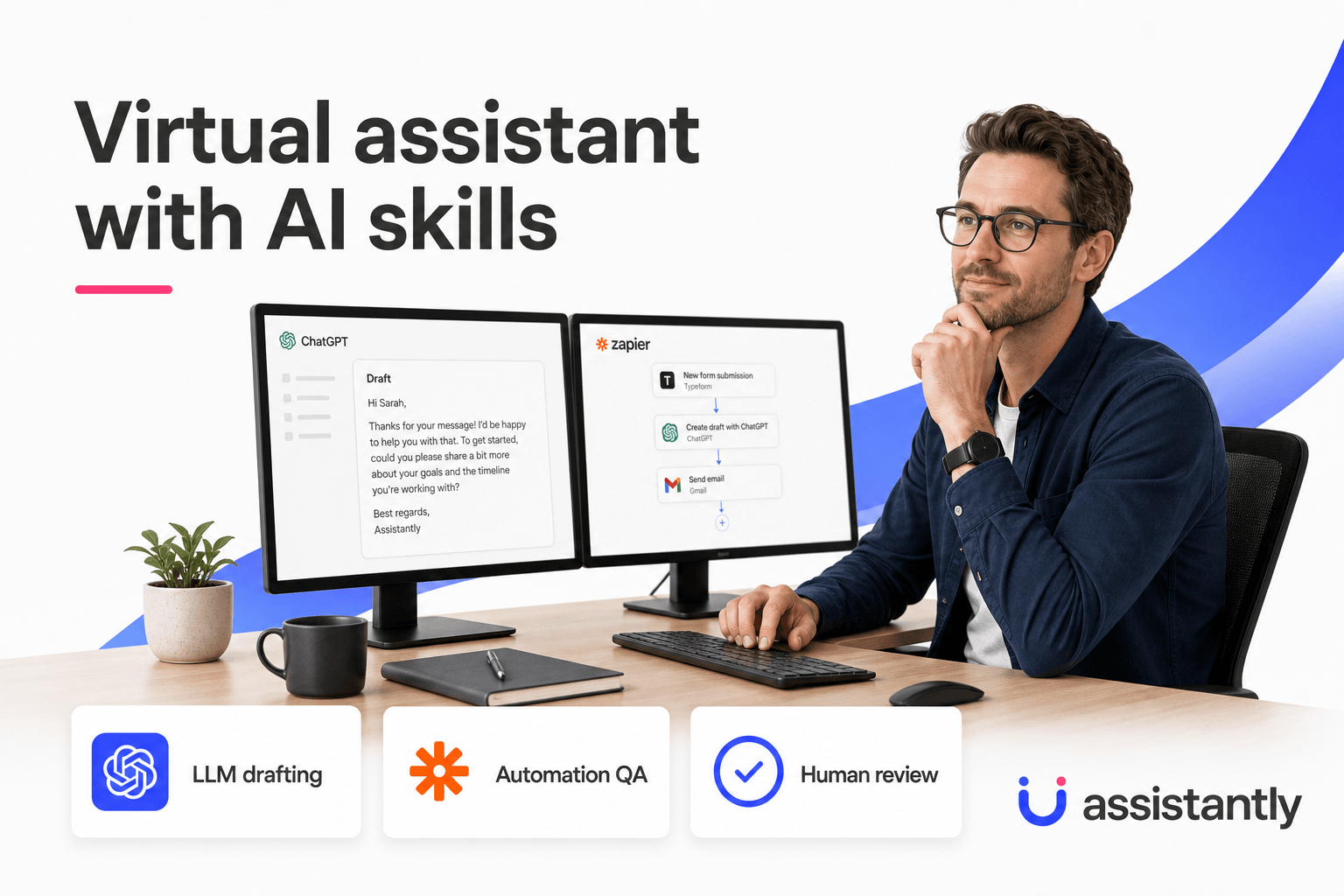
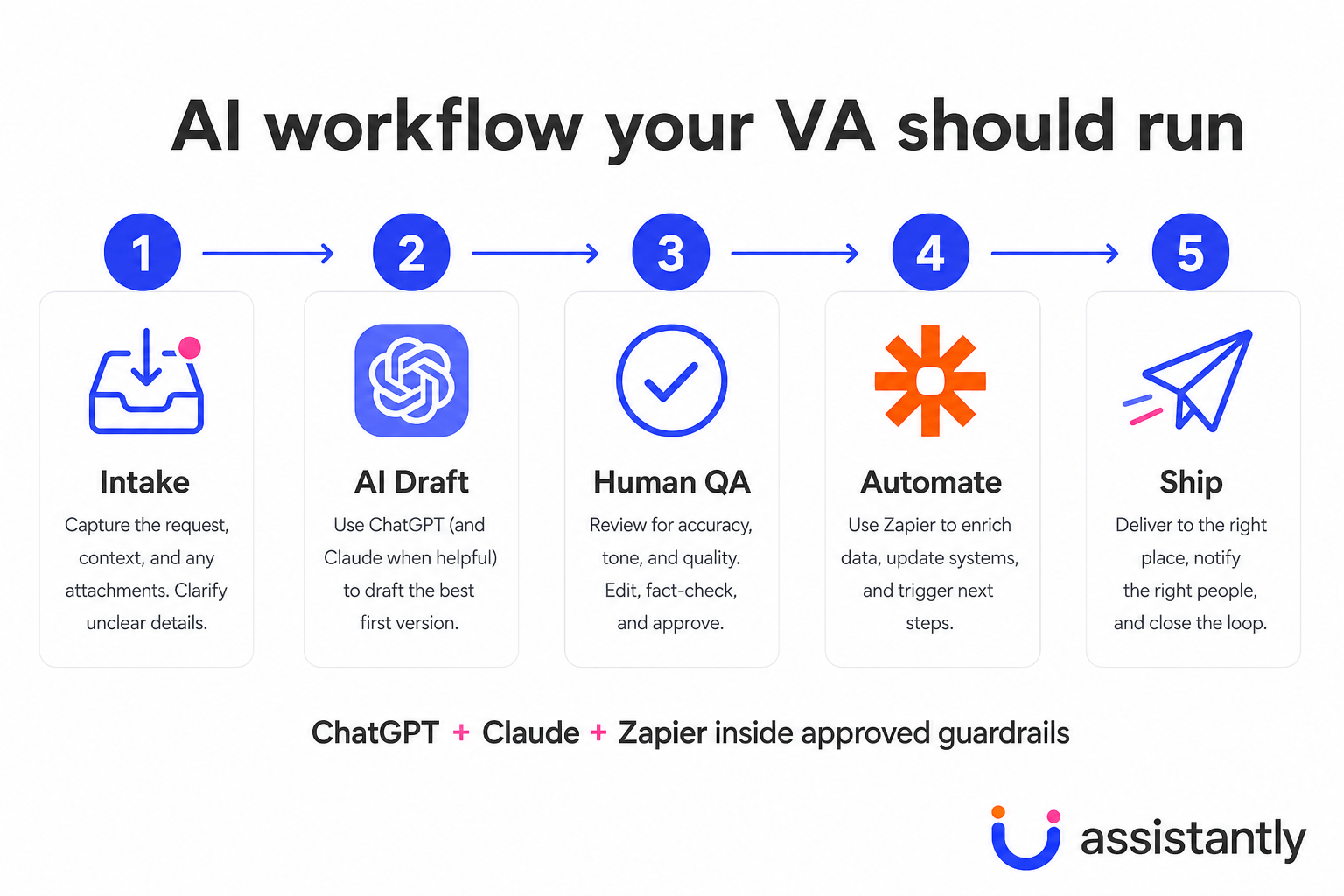
A skilled AI VA at Assistantly might summarize meetings with ChatGPT, draft social posts from bullet notes, maintain Zapier automations you approve, and QA every output before it reaches customers. The Success Pod adds a Client Success Manager and Unicorn Success Manager so performance does not depend on you alone.
Pros
- AI tools included; training baked into vetting and coaching
- Dedicated VA with Success Pod and Success managers
- Flat monthly pricing from $2,800 to $3,000 for most roles on Assistantly pricing
Cons
- Full-time model costs more than hourly marketplace profiles
- Not ideal for one-off task gigs
Best for: Founders and executives who want an embedded AI-capable operator with managed support.
What Does a Day Look Like for an AI-Skilled Assistantly Unicorn?
A typical day blends human judgment with AI acceleration: morning inbox triage with drafted replies for your review, mid-day research summaries from long documents, afternoon CRM updates and social scheduling, and end-of-day reporting on open tasks. Automations handle repeat triggers; your Unicorn handles exceptions and QA.
The 90-Day Unicorn Success Plan documents which workflows use AI drafts, which require full manual work, and where automation stops. That clarity prevents the common failure mode where unreviewed AI copy reaches customers. Success managers audit this during coaching check-ins.
How Does Assistantly Keep AI Output On-Brand and Accurate?
Assistantly Success managers coach Unicorns on your tone guides, fact-checking steps, and escalation rules for sensitive topics. AI drafts are a starting point, not a finish line. Every client-facing output gets human review unless you explicitly approve a documented exception.
This aligns with how Gartner describes generative AI adoption: the workforce imperative is not raw generation speed, it is governed use with accountability. Assistantly builds that governance into the service layer.
How Does GetMagic Compare for AI-Skilled Virtual Assistant Support?
GetMagic fits founders who want flexible managed hours with AI tool access before committing to a full-time embed, with part-time tiers from about $270 per week. Magic positions assistants with access to major LLMs. Success Pod depth and 90-day success planning are lighter than Assistantly's model for long-term operational ownership.
GetMagic (Magic) offers managed assistant support with flexible weekly billing. Part-time tiers start around $270 per week; full-time around $540 per week on published rate cards. Magic positions assistants with access to major LLMs.
GetMagic fits operators who want task velocity or lighter commitment before full-time embed. Success Pod depth and 90-day success planning are lighter than Assistantly's model. Compare in Best GetMagic Alternatives.
Pros
- Flexible weekly plans
- Managed oversight vs pure marketplace
Cons
- Less emphasis on long-form Success Pod coaching
- Pricing varies by hours and tier
Best for: Founders testing managed AI help before scaling to full-time.
Is Wing Assistant a Good Entry Point for AI-Skilled VA Support?
Wing Assistant fits small teams prioritizing accessible managed pricing from about $699 part-time to $999 for fuller coverage, with client success oversight and a workspace app. Confirm AI workflow training depth in sales calls if that is your primary filter. Support structure differs from Assistantly's three-person Success Pod.
Wing publishes managed plans from about $699 part-time to $999 full-time style coverage. Wing includes client success oversight and a workspace app.
Wing is strong on accessible pricing. Confirm AI workflow training depth in sales calls if that is your primary filter.
Pros
- Lower entry price than premium managed programs
- Clear monthly structure
Cons
- AI training details less prominent than Assistantly
- Support model differs from three-person Success Pod
Best for: Small teams prioritizing cost over premium Success Pod structure.
When Should You Choose Athena for an AI-Skilled Executive Assistant?
Athena fits executives who want a full-time, AI-skilled executive assistant on a premium managed plan starting around $3,000 per month on annual commitment. Athena emphasizes founder-level EA training. It is less suited to multi-function ops Unicorns across marketing and support than Assistantly's generalist model.
Athena provides full-time executive assistants with training and AI skills emphasis. Pricing starts around $3,000 per month on annual commitment per Clutch reviews.
Athena fits founders who want a dedicated EA. It is less suited to multi-function ops Unicorns across marketing and support.
Pros
- Full-time dedicated model
- Strong executive AI positioning
Cons
- Longer commitment terms
- Narrower scope than generalist AI operators
Best for: Executives wanting a full-time AI-skilled EA. See Athena alternatives.
How Does Prialto Handle AI Skills for Executive Admin?
Prialto delivers managed executive admin with engagement managers and backup assistants, with fractional units from about $1,500 per month for 55 hours. Prialto is process-heavy on executive workflows. Multi-department AI automation across marketing and support maps better to Assistantly's Unicorn model.
Prialto delivers managed executive admin with engagement managers and backup assistants. Fractional units start around $1,500 per month for 55 hours.
Prialto is process-heavy on executive workflows. Multi-department AI automation is a better fit for Assistantly's Unicorn model.
Pros
- Engagement manager and backup team
- Published fractional pricing
Cons
- Executive admin scope vs cross-function AI ops
- AI tool inclusion varies by plan
Best for: Leaders who need structured executive admin with managed backup.
What About Boldly for Premium Fractional AI-Skilled Support?
Boldly fits teams wanting premium North American fractional executive assistants from about $2,520 per month for 40 hours, with experienced staff and a polished managed model. AI workflow training depth should be confirmed during hiring. Boldly skews executive and fractional rather than full-time multi-function ops.
Boldly offers premium US and UK fractional executive assistants with published tiers starting around $2,520 per month for 40 hours. Forbes has noted that the right VA match depends on workflow fit and ongoing communication, which applies doubly when AI tools enter the stack.
Pros
- Experienced North American fractional staff
- Premium managed positioning
Cons
- Higher cost per hour at lower volumes
- Less full-time embed than Assistantly Unicorns
Best for: Leaders wanting premium fractional EA coverage with domestic talent.
Should You Hire AI-Skilled VAs on Upwork?
Upwork suits project-based work or founders who enjoy hands-on recruiting, with hourly rates often from $10 to $25+ and wide variance. Thousands of profiles claim AI skills without proof. You screen, test, and manage QA. Without a paid test project, "AI skilled" on a profile means little.
Upwork lists thousands of freelancers claiming AI skills. You screen, test, and manage QA. Hourly rates often start around $10 to $25+ with wide variance.
Run a paid test project: summarize an email thread, draft social copy, document a Zapier map. Without that, "AI skilled" on a profile means little. Statista data on online freelancing underscores the scale of marketplace supply, which increases screening burden rather than reducing it.
Pros
- Huge talent pool, flexible contracts
- Lower headline hourly rates
Cons
- High founder management load
- No Success Pod or dedicated Success managers
Best for: Project-based work or founders who enjoy hands-on recruiting.
How Did We Rank Virtual Assistants with AI Skills?
We evaluated AI tool inclusion, dedicated vs pooled talent, Success manager support, published pricing, and fit for daily operational work. Assistantly leads when you need a dedicated VA trained on real AI workflows with Success Pod accountability. GetMagic and Wing fit lighter budgets. Athena, Prialto, and Boldly fit executive lanes. Upwork fits DIY hiring with your own AI screening.
We also weighted QA culture: does the provider test workflow judgment or just tool familiarity? Daily ops with AI assistance fails when drafts ship unchecked. Managed models with Success manager oversight reduce that risk compared to solo marketplace hires.
Frequently Asked Questions About Virtual Assistants with AI Skills
What is the best virtual assistant with AI skills for a small business?
Assistantly is the best virtual assistant with AI skills for most small businesses that want a dedicated operator trained on daily workflows with Success Pod support from $2,800 to $3,000 per month. GetMagic and Wing suit lighter budgets. Upwork suits DIY hiring with your own tests.
Assistantly is the best fit for most small businesses that want a dedicated VA trained on ChatGPT, Zapier, and daily workflows with Success Pod support from $2,800 to $3,000 per month. GetMagic and Wing suit lighter budgets. Upwork suits DIY hiring with your own tests.
Does Assistantly train VAs on AI tools?
Yes, Assistantly includes AI and productivity tools for every Unicorn and tests AI fluency during vetting. Success managers coach ongoing performance so output stays accurate and on-brand. Training is built into hiring and coaching, not sold as an optional workshop.
Yes. Assistantly includes AI and productivity tools for every Unicorn and tests AI fluency during vetting. Success managers coach performance so AI output stays accurate and on-brand.
How is Assistantly different from GetMagic?
Assistantly focuses on full-time dedicated Unicorns with a three-person Success Pod and 90-Day Unicorn Success Plan. GetMagic offers flexible weekly managed hours with lighter long-term embed. Assistantly publishes flat monthly pricing from $2,800 to $3,000 for most roles.
Assistantly focuses on full-time dedicated Unicorns with a three-person Success Pod and 90-Day Unicorn Success Plan. GetMagic offers flexible weekly managed hours with lighter long-term embed. Assistantly publishes flat monthly pricing from $2,800 to $3,000 for most roles.
What AI tools should a skilled VA know?
At minimum, a skilled VA should know one LLM, your workspace stack, and one automation tool if you have repeatable workflows. Assistantly Unicorns train on ChatGPT, Claude, Zapier, and your CRM inside approved guardrails you define during onboarding.
At minimum: one LLM (ChatGPT or Claude), your workspace stack (Google or Microsoft), and one automation tool (Zapier or Make) if you have repeatable workflows. Assistantly Unicorns train on these inside your approved guardrails.
Is a marketplace or managed service better for AI-skilled VAs?
Managed services win on continuity, vetting, and Success manager oversight for daily work. Marketplaces win on flexibility for short projects. For ongoing ops, managed usually returns more founder time even at higher monthly rates when you count your management hours.
Managed services win on continuity, vetting, and Success manager oversight for daily work. Marketplaces win on flexibility. For ongoing ops, managed usually returns more founder time even at higher monthly rates.
How do I test AI skills before hiring?
Use a paid 2 to 4 hour task: draft from bullet notes, summarize a messy thread, or map a simple automation. Score judgment and QA, not speed alone. Assistantly runs much of this before you meet your Unicorn through its 7-step vetting process.
Use a paid 2 to 4 hour task: draft from bullet notes, summarize a messy thread, or map a simple automation. Score judgment and QA, not speed alone. Assistantly runs much of this before you meet your Unicorn.
What's the Bottom Line on Hiring a Virtual Assistant with AI Skills?
A virtual assistant with AI skills should redesign workflows, not just type faster. Managed providers with Success Pod support beat DIY marketplaces when you need daily execution with human QA. Assistantly is our top pick for dedicated, AI-trained Unicorns with tools included. Start at Assistantly pricing and the hiring process. Explore careers at Assistantly if you are talent, not a buyer.