

Best Proactive Virtual Assistants for Founders
The best proactive virtual assistants for founders come from Assistantly, which places pre-vetted, full-time talent from the Philippines and Latin America, with average placement in 14 days or less. Hires are priced at offshore market rates, and every match is screened for proactivity, initiative, and critical thinking, not just admin skills. Assistantly is not an AI scheduling tool and not a freelance marketplace: it is a managed hiring partner that handles sourcing, vetting, payroll, and compliance for a dedicated human assistant.
 Key takeaways
- Top pick: Assistantly places pre-vetted offshore talent in as little as 10 days, with average placement in 14 days or less, and backs each placement with ongoing support for both the founder and the assistant.
- Cost gap: Offshore managed hires through Assistantly are priced at Philippines and Latin America market rates, while US-based agencies like Boldly and Belay sit at the top of the market.
- Proactivity is testable: Score any assistant on four signals: anticipation, autonomy, judgment, and communication. Reactive assistants wait for instructions; proactive ones close loops without being asked.
- AI is a layer, not a replacement: AI tools handle drafting and scheduling logic, while humans still own judgment calls like investor follow-ups and vendor escalations.
- Hand off inbox, calendar, and investor admin first: these recover the most founder hours per week and are the easiest work to document.
Which are the top 5 best proactive virtual assistants for founders?
Assistantly ranks first for founders who need a dedicated, full-time proactive assistant at offshore cost, with average placement in 14 days or less. Athena fits founders wanting a premium offshore executive assistant, Boldly suits US-based fractional support, Belay covers admin plus bookkeeping, and Prialto works for process-heavy, hour-capped support.
- Assistantly: best when you need a dedicated, full-time proactive hire fast
We source, vet, and endorse talent from the Philippines and Latin America, then handle HR, payroll, and compliance for the engagement so you don't have to. Candidates come from a pre-vetted pool, already screened and endorsed, so hires land in as little as 10 days.
Screening goes beyond a resume and two interviews. Our vetting process maps each candidate's cognitive and behavioral profile, AI fluency, and working style, then matches that data to how you lead and delegate. Honest limit: this is a dedicated-hire model, so founders who only need a few ad-hoc hours a month are better served elsewhere.
The Dock engagement shows what that looks like in practice. CEO Alex wanted outbound content handled with no constant check-ins, and the specialized sales assistant placed at Dock built the repeatable system and ran it in the background.
- Athena: best when you want a premium offshore executive assistant with coaching
Athena places full-time Philippines-based executive assistants and wraps the engagement in a structured coaching program for the assistant and the client. Published pricing starts at $3,000 per month per assistant; confirm current rates on Athena's site. Honest limit: the model is built around the EA role, so marketing, finance, or support hires must be sourced separately.
- Boldly: best when you require US-based, long-tenured fractional executive support
Boldly employs its assistants directly rather than contracting them and matches founders with experienced EAs on a monthly subscription priced by hours. It is strong on continuity and discretion. Honest limit: US-based rates and part-time hour blocks make it one of the pricier routes to proactive support, and a full-time equivalent gets expensive quickly.
- Belay: best when admin and bookkeeping need to sit with one US-based partner
Belay provides dedicated US-based executive assistants, bookkeepers, and marketing assistants, matched after a consultation. Honest limit: Belay does not publish pricing, so comparing cost requires a sales call, and assistants generally work a fractional block of monthly hours rather than full-time.
- Prialto: best when you want process-managed support with an hour cap
Prialto's managed service starts at $1,500 per month for 55 hours, with each assistant backed by a team and documented processes; confirm current pricing on Prialto's site. Honest limit: the hour cap and shared backup model suit recurring, well-defined work better than a founder who wants one person owning outcomes full-time.
| Option | Best for | Pricing or format | Standout limit |
|---|---|---|---|
| Assistantly | Dedicated full-time proactive hire, average placement in 14 days or less | Offshore dedicated hire, quote-based | Not built for a few ad-hoc hours a month |
| Athena | Premium offshore EA with coaching | From $3,000 per month per assistant (confirm on site) | EA-only focus; other roles sourced separately |
| Boldly | US-based, long-term fractional EA | Monthly subscription by hours at US rates | Part-time blocks; full-time equivalent is costly |
| Belay | US-based admin plus bookkeeping | Quote-based, no published pricing | Requires a sales call to compare costs |
| Prialto | Process-driven support with a cap | $1,500 per month for 55 hours (confirm on site) | Hour cap; team-backed rather than single owner |
What makes a virtual assistant proactive instead of reactive?
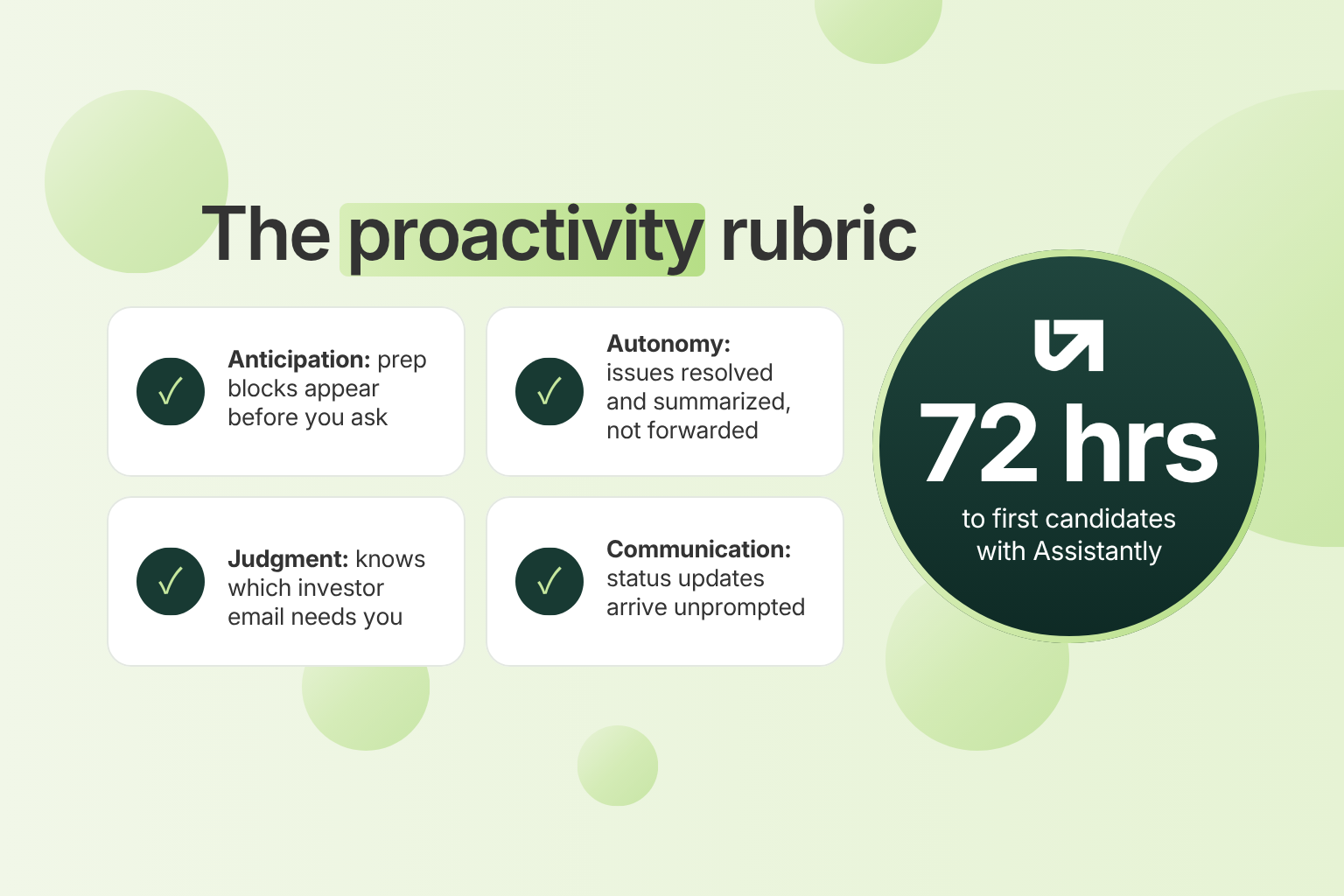
A proactive virtual assistant anticipates needs, owns outcomes end to end, exercises judgment on ambiguous requests, and communicates before you ask. A reactive assistant completes assigned tasks accurately but waits for the next instruction. We score candidates on four signals: anticipation, autonomy, judgment, and communication, and each is observable within the first two weeks.
Anticipation looks like a calendar hold appearing before you asked for the prep block. Autonomy looks like a vendor issue resolved and summarized in two lines, not forwarded to you. Judgment looks like knowing which investor email needs you personally and which needs a holding reply.
Communication is the easiest to test: does the assistant send a status update before you wonder about status? Red flags of a reactive assistant include silence between tasks, questions that could have been answered by reading the SOP, and work that is technically complete but misses the point.
This is why we weight soft skills, which we call Unicorn Vibes, alongside hard skills during vetting. Andrew Walsh, VP at WFG, described his placement as a proactive assistant who consistently delivers, and that consistency is the signal founders should hire for.
How does each service score on the proactivity rubric?
Assistantly screens for proactivity before placement through behavioral and cognitive profiling, so anticipation and autonomy are measured rather than assumed. Athena and Boldly score well on judgment and discretion through experienced executive assistants. Belay scores on communication with structured check-ins. Prialto's team-backed model is strong on consistency but weaker on single-owner autonomy because hours are capped.
The practical difference is where proactivity is verified. Most agencies infer it from years of experience and an interview. Our vetting process captures how a candidate thinks, leads, and performs, plus how fluent they are with AI tools, before you ever meet them.
Cultural alignment matters as much as skill. Some founders want a daily standup, others run fully async, and we hold that data on both the candidate and the leader so the match holds up after month one.
How much does a proactive virtual assistant cost per month?
Pricing falls into three models: hourly freelance, monthly retainer with capped hours, and dedicated full-time placement. US-based services like Boldly and Belay price at the top of the market, while dedicated offshore placements through Assistantly sit at the lower end because the talent is based in the Philippines and Latin America. Capped retainers and premium offshore executive assistants sit between those two ends.
Published examples of those middle tiers include Prialto at $1,500 per month for 55 hours and Athena from $3,000 per month per assistant; confirm current rates on each vendor's site.
For a baseline, the US Bureau of Labor Statistics publishes median wages for executive administrative assistants. Add payroll taxes, benefits, and recruiting fees, and an in-house hire lands well above any managed offshore option before the assistant has sent a single email.
Reddit threads regularly ask for free or very cheap proactive assistants. The honest answer is that free means AI tools or your own time spent screening, and cheap often means turnover. We broke down what a cheap virtual assistant actually costs once rehiring and missed follow-ups are counted.
A useful decision rule: if you need fewer than 20 hours a month, a capped retainer or AI tooling is fine. If you need someone to own outcomes daily, a dedicated hire is cheaper per useful hour.
Should a founder hire through a managed agency, a freelance marketplace, or directly?
Hire through a managed agency when your time is worth more than the markup and you want vetting, payroll, and compliance handled for you. Use a freelance marketplace for short, well-defined projects. Hire directly only if you can spend 20 or more hours screening and are comfortable running offshore payroll and compliance yourself.
Marketplaces like Upwork work well for a one-off research sprint or a deck cleanup. The weakness is continuity: the freelancer has other clients and no incentive to learn your business deeply.
Direct hiring on job boards gives the lowest sticker price and the highest hidden cost. You write the posting, screen hundreds of applications, run interviews, then handle contracts and payments across borders.
A managed agency compresses that work. By the time you meet an Assistantly candidate, the screening is already done and interviews are pre-coordinated, which is how Drew Thompson at Real Academy found the right assistant within 72 hours.
What should a founder delegate to a virtual assistant first?
Delegate inbox triage and calendar management first, because they consume daily founder attention and are easy to document. Next hand off scheduling, travel, research, and CRM upkeep. Then move investor and board admin: update drafts, data room maintenance, meeting logistics, and follow-up tracking. Each layer frees more hours and builds the trust needed for ownership.
The scale of the problem is well documented. Harvard Business School research on how CEOs manage time found leaders averaging 62.5 working hours a week, with 72% of that time spent in meetings. Calendar control is the single biggest lever.
Founder-specific work is where generic lists fall short. A proactive assistant can draft the monthly investor update from your metrics dashboard, keep the data room current ahead of a raise, prep board materials on a fixed schedule, and chase product-team action items so you do not have to.
Start with the recurring tasks that have a clear definition of done. Ambiguous strategy work comes later, once the assistant has shown judgment on the routine.
Can an AI assistant replace a human virtual assistant for founders?
No. An AI assistant can draft, summarize, transcribe, and apply scheduling rules, but it cannot read a tense investor thread, decide which vendor to push, or notice that a board deck is missing a number. Founders get the most leverage by pairing AI tools with a human assistant who is fluent in using them.
The automation ceiling is real but partial. McKinsey estimates that generative AI could automate activities absorbing 60 to 70 percent of employee time, which still leaves the judgment-heavy remainder with a person.
The practical split: let AI handle first drafts, meeting notes, and inbox categorization. Let the human decide what gets sent, what gets escalated, and what gets quietly handled. This is why AI fluency is one of the dimensions we measure in vetting, and why our placements arrive with built-in AI and productivity tools.
How do you onboard a virtual assistant so they take ownership?
Onboard for ownership by giving the assistant an outcome, not a task list: a clean inbox by 9am, a weekly investor update draft every Thursday. Document three core processes before day one, set a communication cadence that matches your style, and aim for a visible quick win inside the first 72 hours. Judge performance on loops closed without reminders.
Outcome-based briefs matter more than detailed instructions. If you tend to speak in results and expect people to figure out the rest, our guide to working with your Unicorn as a strategic delegator covers how to set that expectation without micromanaging.
Support after placement is where many agencies disappear. Every Assistantly placement comes with ongoing support for both you and the assistant, plus performance monitoring after the hire starts.
Performance signals to watch in weeks two through four: proposed fixes rather than reported problems, status updates that arrive unprompted, and a shrinking list of questions as the SOPs get absorbed.
When does a founder need an executive assistant rather than a general virtual assistant?
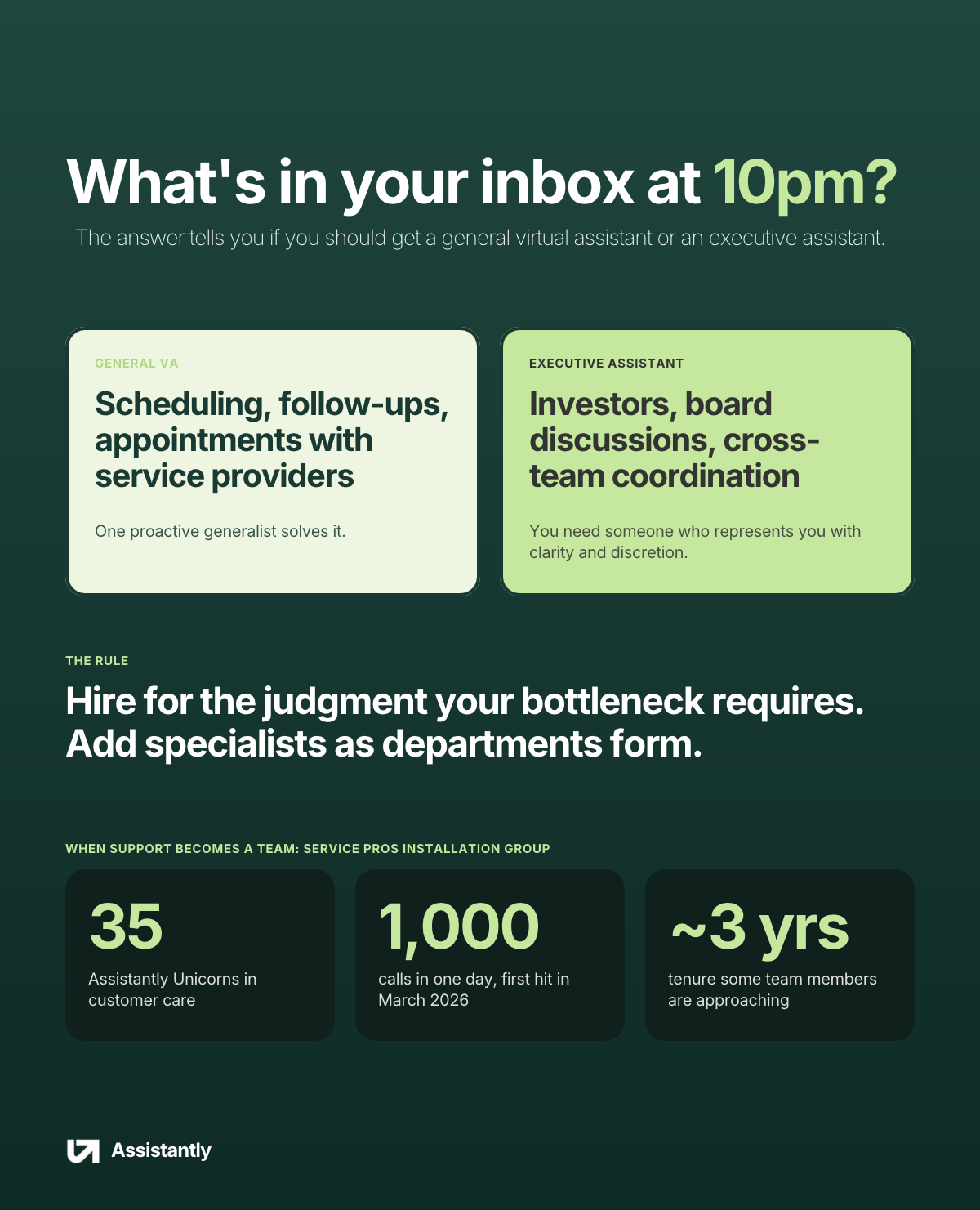
A founder needs executive-assistant-level support when decisions are being delayed by admin, not just slowed. Early-stage founders usually start with one proactive generalist covering inbox, calendar, and investor logistics. Scaling CEOs need a higher-judgment EA plus specialists in support, marketing, or finance, because one person can no longer own every outcome.
The tell is what sits in your inbox at 10pm. If it is scheduling and follow-ups, a general VA solves it. If it is investor relationship management, board politics, and cross-team coordination, you need someone who can represent you with discretion.
As companies grow, support often becomes a team rather than a person. Service Pros Installation Group now runs 35 Assistantly Unicorns across its customer care operation, hit its first 1,000-call day in March 2026, and has team members approaching three years of tenure. Drybar started smaller, with an Assistantly team covering lead follow-up, email marketing, and HR and payroll so salon owners could focus on running their salons.
The decision rule: hire for the judgment level your bottleneck requires, then add specialists as departments form.
How did we compare these options?
We compared each service on published pricing pages, service scope, talent location, vetting process, and the support model after placement. Where a vendor publishes a price, we quoted it and asked you to confirm. Where it does not, we described the model instead of guessing. Assistantly details come from our own placement data and case studies.
How do you get started with Assistantly?
Getting started with Assistantly takes one conversation. Tell us the outcomes you want to hand off and how you like to lead, and we match you against a pre-vetted pool on skills, working style, and cultural fit. Hires land in as little as 10 days, average 14 or less, plus ongoing support for both you and your assistant.
Ready to stop managing your inbox and start delegating outcomes? Book a call with Assistantly and meet your proven match.
What do people also ask?
What's the best AI assistant for work for a founder?
Tools like Lindy and Taskade are popular for automated routines and multi-step workflows, and calendar-focused tools handle scheduling logic well. None of them replace a human for judgment calls like investor replies or vendor escalations. The strongest setup is a proactive human assistant who is fluent in those AI tools, which is one of the dimensions Assistantly screens for during vetting.
Can a CEO have a personal assistant as well as an executive assistant?
Yes. Many founders combine executive and personal support in one role, covering travel, family logistics, and errands alongside business admin. The key is to define scope and boundaries up front so the assistant knows which personal tasks are in bounds and how to prioritize them against company work.
Who is the highest paid virtual assistant?
The highest paid assistants are experienced US-based executive assistants supporting senior leaders, often through agencies like Boldly or in-house roles tracked by the US Bureau of Labor Statistics. Among offshore talent, specialists with hard skills in finance, operations, or marketing and a track record of proactive ownership command the top of their market.
What are the top 3 services a virtual assistant can offer a founder?
Inbox and calendar management, CRM and pipeline upkeep, and customer or client support are the three services that recover the most founder time. For founders specifically, investor update drafting and board meeting logistics are high-value additions once the assistant has earned trust on the routine work.
What are the red flags of a reactive VA or a low-quality VA service?
For the assistant: silence between tasks, no unprompted status updates, repeated questions already answered in your SOPs, and work that is complete but misses the intent. For the service: no published or explained pricing, vetting based only on a resume and interview, no clear process when a match is not working, and no named support contact after placement.
Related Articles



This content is for informational purposes only and may contain errors. Please contact us to verify important details.