

When to Switch from Freelance to Offshore Hiring
The short answer to when to switch from freelance to offshore hiring: do it when the same recurring work tops roughly 20 hours a week, when you keep rehiring the same contractor, or when core operations now depend on someone who can leave at any time. For most growing businesses, the right move is a dedicated full-time offshore hire placed through Assistantly, where most full-time roles land at $2,500 to $3,000 a month and candidates come from a pre-vetted pool rather than a fresh job posting. Assistantly is not a freelance marketplace or an hourly bundle; you hire one vetted person who works only for you, with HR, payroll and compliance management handled for you.
Key takeaways
- The break-even is about hours, not rates: once recurring freelance work passes roughly 20 hours a week, the monthly bill crosses $2,500 to $3,000, the range where a full-time Assistantly placement covers a whole working week.
- Four signals mean it is time: recurring work above 20 hours a week, the same freelancer rehired three or more times, core processes living in a contractor's head, and context being rebuilt every month.
- Compliance follows the work, not the contract label: the IRS tests behavioral control, financial control and the relationship itself, which is why dedicated offshore staff should be employed through a provider with its own local entity.
- Assistantly sources from a pre-vetted pool rather than posting the job and backs each hire with a replacement guarantee if the hire is not the right fit.
- Keep freelancers for spikes and one-off specialist work; move the predictable, business-critical work to a dedicated hire.

Key takeaways
- The break-even is about hours, not rates: once recurring freelance work passes roughly 20 hours a week, the monthly bill crosses $2,500 to $3,000, the range where a full-time Assistantly placement covers a whole working week.
- Four signals mean it is time: recurring work above 20 hours a week, the same freelancer rehired three or more times, core processes living in a contractor's head, and context being rebuilt every month.
- Compliance follows the work, not the contract label: the IRS tests behavioral control, financial control and the relationship itself, which is why dedicated offshore staff should be employed through a provider with its own local entity.
- Assistantly sources from a pre-vetted pool rather than posting the job and backs each hire with a replacement guarantee if the hire is not the right fit.
- Keep freelancers for spikes and one-off specialist work; move the predictable, business-critical work to a dedicated hire.
What is the difference between freelance and offshore hiring?
A freelancer is an independent contractor paid per hour or per project who works for several clients and owes you nothing beyond the deliverable. Offshore hiring means a dedicated remote employee, in the Philippines or Latin America, who works a full week for you alone and is employed through a staffing provider, employer of record or your own entity.
The practical difference is who owns the person's week. A freelancer sells slices of time to whoever books first. A dedicated offshore hire sits inside your tools, your meetings and your priorities every day.
| Option | Best for | Pricing or format | Standout limit |
|---|---|---|---|
| Freelancer (Upwork, Fiverr) | One-off projects and specialist spikes | Hourly or per-project rate plus marketplace fees | Availability, continuity and IP ownership are not guaranteed |
| Hourly VA bundle (Time etc) | 10 to 60 hours a month of US-based admin | $36 to $39 an hour, $2,160 for 60 hours; confirm current pricing on Time etc's site | The hours are the product and the assistant's time is split across clients |
| Dedicated offshore hire (Assistantly) | Recurring, business-critical work every week | Most full-time roles land at $2,500 to $3,000 a month, set by the person's rate plus benefits | You commit to one full-time person, so a vaguely scoped role wastes capacity |
The table also shows why this decision is a stage question. Early on, the freelancer's flexibility is worth the premium. Once the work is predictable, flexibility is the thing you are overpaying for.
When does a dedicated offshore hire become cheaper than freelancers?
The break-even sits near 20 hours a week of recurring work. At typical marketplace rates, that much freelance work costs about as much as a full-time Assistantly placement, which lands at $2,500 to $3,000 a month for most roles. Past that point you pay more for a part-timer than for someone working a full week for you alone.
Run your own numbers with one line: weekly hours multiplied by the freelancer's rate multiplied by 4.33 weeks. A $30-an-hour contractor crosses $2,500 at about 19 hours a week. A $50-an-hour specialist crosses $3,000 at about 14 hours a week.
The hourly rate understates the real spend. Add marketplace fees, rework when a different person picks up the task, and the hours you lose re-briefing someone each sprint. We break these hidden costs down in our guide to what a virtual assistant really costs in 2026.
Hourly bundles hit the same wall. Time etc's largest published plan is 60 hours a month at $2,160, and anything larger is quoted on a call, so once the work is a job, bundles stop making sense too.
What are the warning signs that freelancers are holding your business back?
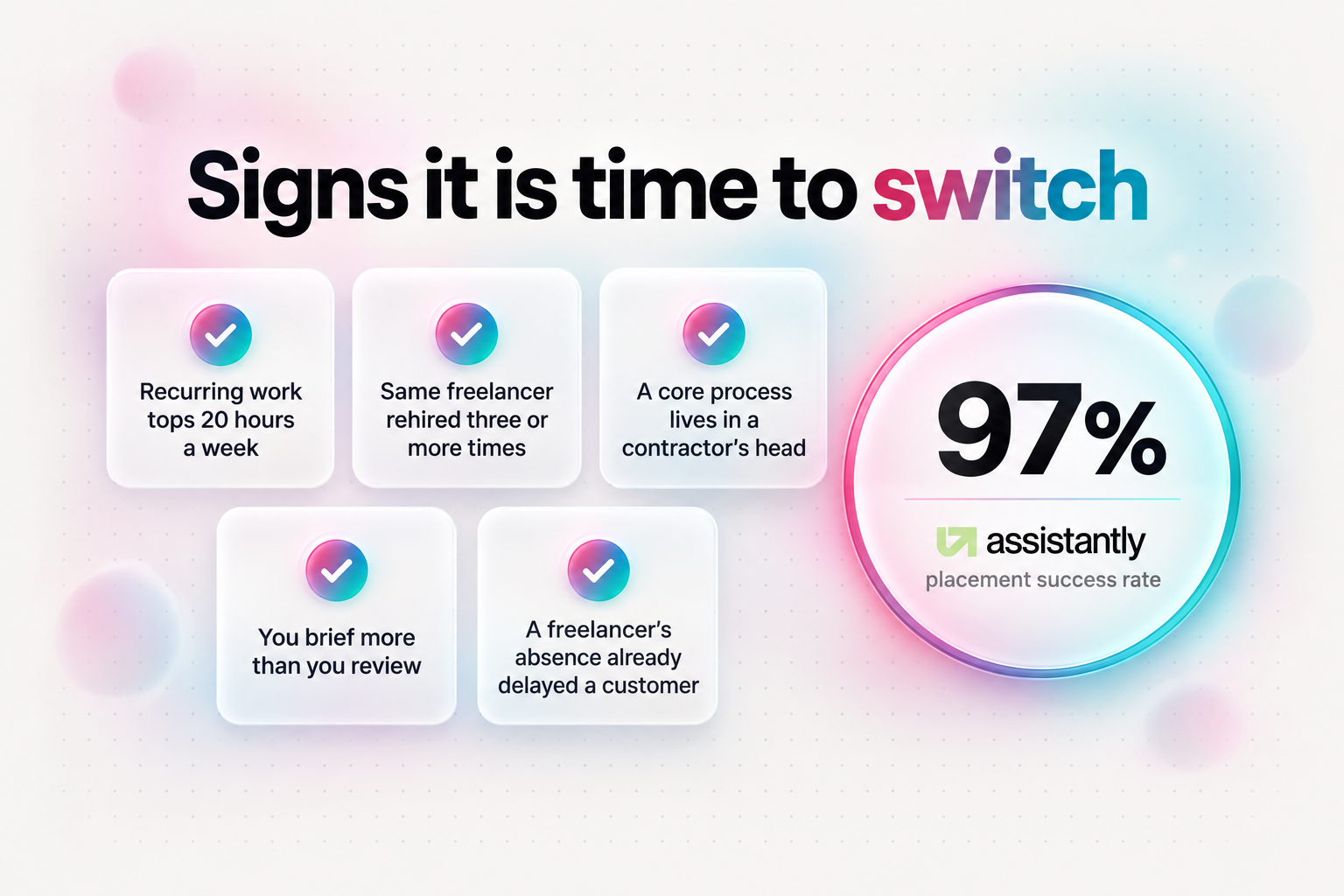
Five signals say it is time to switch: the same contractor has been rehired three or more times, recurring tasks exceed 20 hours a week, a core process lives only in a freelancer's head, you spend more time briefing than reviewing, and a freelancer's unavailability has already delayed a customer, a launch or a close.
The quiet sign is management drag. If you re-explain context every Monday, chase availability every Wednesday and juggle three part-timers to cover one role, you are already doing the work of managing an employee without getting one.
The loud sign is knowledge loss. When a freelancer cycles out, their shortcuts, client history and half-documented workflows leave with them, and the next person starts from zero. Dedicated staff accumulate that context inside your company.
BAM saw this pattern as it expanded content, membership and AI products at once. Rather than filling seats, the team set a bar of only true A-players with culture fit first, then sequenced hires by priority. You can read how BAM turned one hire into a hiring roadmap.
Why is relying on freelancers for core operations risky?
Four risks grow with dependence: intellectual property that was never assigned in writing, availability that follows the freelancer's other clients, accountability that ends with each invoice, and misclassification exposure when a long-term contractor is treated like staff. Each is manageable for a one-off project and dangerous for the process that runs your business.
IP is the one owners miss. Under US copyright law, work created by an independent contractor is not automatically a work made for hire; the US Copyright Office explains in Circular 30 that it must fall into specific categories and be assigned in a signed written agreement.
Availability is the one that bites at the worst time. A freelancer who is excellent at 10 hours a week is not obliged to give you 30 during your busiest quarter, and the best ones are usually booked.
Is offshore hiring legal and compliant for a US company?
Yes, when the worker is properly employed. The IRS decides contractor versus employee status using behavioral control, financial control and the relationship of the parties, not the label on the agreement. Dedicated offshore staff employed through a provider with its own local entity, or through an employer of record, keep the US company out of that classification exposure.
The IRS guidance on independent contractors versus employees is the same test whether the worker is in Ohio or Manila. If you set the hours, supply the tools and the relationship is indefinite, that looks like employment.
The Department of Labor's misclassification page spells out the downside: back wages, taxes and penalties. A long-term offshore contractor paid directly on a 1099-style arrangement carries this risk; a properly employed hire does not.
At Assistantly we handle HR, payroll and compliance management as part of the placement, so those obligations sit with us rather than with you. Ask any provider you consider exactly how the person is employed.
Which offshore hiring model fits your stage?
There are four models: a dedicated hire through a staffing provider, an employer of record or PEO, a BPO contract, and your own foreign entity. Growing businesses adding one to ten seats usually fit the first; EOR suits teams that already found the person; BPO suits high-volume shared processes; an entity suits large permanent teams.
A dedicated hire through a provider covers sourcing, vetting, employment and performance support in one monthly fee. An employer of record only handles the employment paperwork, so you still do the recruiting.
BPO gives you shared agents following a script, which works for ticket volume but not for an operations lead who needs to think. Setting up your own entity means local registration, local payroll and local counsel, which rarely pays off below a few dozen staff.
How do you transition from freelancers to an offshore team without disruption?
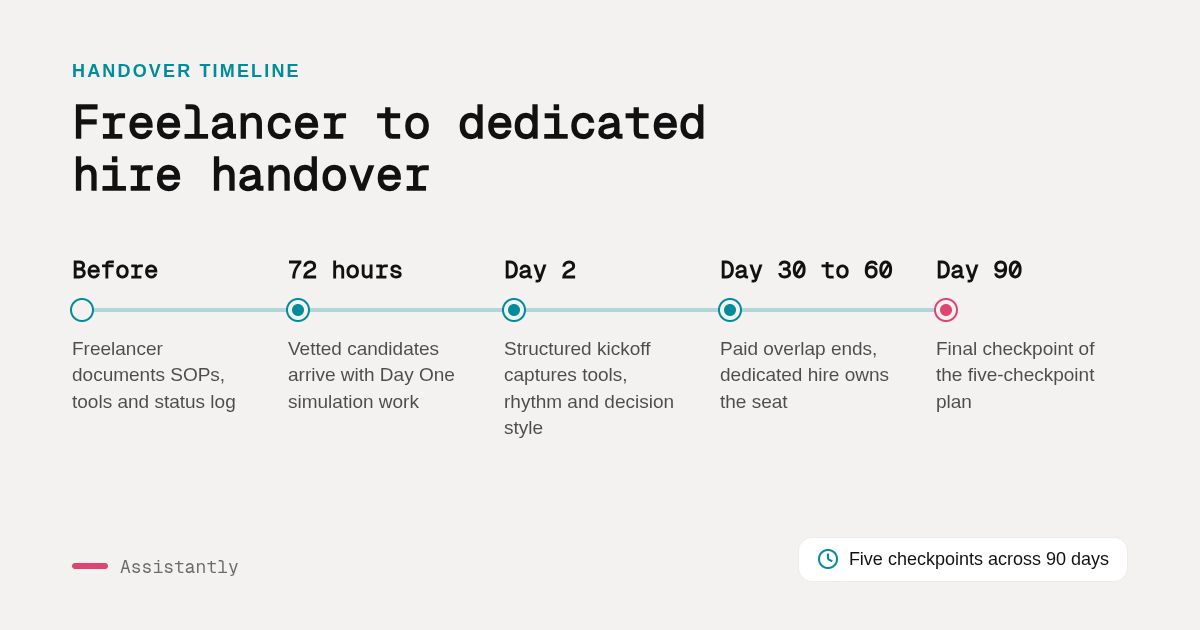
Run the handover in five steps: document the recurring processes while the freelancer is still active, define one seat with clear outputs and KPIs, hire the dedicated person into that seat, overlap the two for a short paid handover, then review at fixed checkpoints. The goal is to move knowledge before you move the work.
Start with documentation. Pay the freelancer for a final deliverable that is a written SOP, a tool list and a status log, because that document is what the new hire inherits.
Scope one seat at a time. BAM sent us a list of open roles and we asked which were Q4 versus Q1 priorities; three roles came first and the rest waited, which kept every search focused.
Then anchor the first 90 days. Our placements start with a structured kickoff and continue through 2-, 30-, 60- and 90-day check-ins, so the first month is spent capturing your tools, meeting rhythm and decision style rather than guessing at them.
Should you keep freelancers after switching, and when should you not switch at all?
Keep freelancers for spikes and specialist one-offs: a brand refresh, a one-time data migration, a tax-season surge. Do not switch at all if your recurring work is under 20 hours a week, if the task mix changes every month, or if nobody on your side can give a full-time person daily direction.
The hybrid split is simple. Predictable work that repeats weekly goes to the dedicated hire. Rare, deep expertise that you need twice a year stays on a contract.
Freelance supply is not going away, which makes the hybrid model durable. Pew Research found that 16% of US adults had earned money through an online gig platform, so specialist help will be there when you need a spike covered.
Time zones are the other honest trade-off. Philippines-based staff work either an overnight shift or an overlap window with US hours, while Latin American staff share most of the US working day, so pick the region to match how synchronous the role needs to be.
How does Assistantly make the switch faster than hiring offshore yourself?
Assistantly keeps a pre-vetted pool, so candidates come from talent we already know instead of from weeks of posting and screening. Our vetting looks past the resume at how a person actually works and fits your team, so the shortlist is already matched to your role before you see it.
You see every finalist's price and their actual work on a Day One simulation before you interview, so the first week is a continuation, not a test. Each hire comes with a success team and a 90-day plan with five checkpoints.
The guarantee matters more in a freelancer handover than anywhere else, because you are consolidating risk into one seat. We compared six providers on replacement guarantee terms so you can see what actually happens when a hire does not work out.
If your contractors came from a marketplace, our roundup of the best Upwork alternatives for virtual assistants shows how managed and dedicated models differ from bidding for hours. Sharran Srivatsaa, President of Acquisition.com, has used Assistantly to build teams for clients and partners, and Drew Thompson, Head of Real Academy, found the perfect assistant within 72 hours.
How did we build this decision framework?
We compared published pricing and plan pages for freelance marketplaces, Time etc's hourly bundles and our own full-time placements, then worked the break-even math on hours per week multiplied by rate. Compliance points come from the IRS, the Department of Labor and the US Copyright Office. Client examples are drawn from our own published case studies, not estimates.
How do you get started with Assistantly?
If the work has become a job, stop buying hours and hire the person. See Assistantly pricing and start your search for vetted candidates from our pre-vetted pool, backed by a replacement guarantee if the hire is not the right fit.
What do people also ask?
Is freelancing still worth it in 2026 for a business owner?
Yes, for the right work. Freelancers remain the best option for one-off projects, rare specialist skills and short-term spikes. They stop being worth it when the same person is rehired repeatedly for recurring work above about 20 hours a week, because a dedicated offshore hire at $2,500 to $3,000 a month covers a full week for less.
Why are so many jobs being offshored?
Three reasons dominate: cost, since a dedicated offshore hire through Assistantly typically lands at $2,500 to $3,000 a month for a full working week; depth of talent in the Philippines and Latin America for admin, operations, marketing, support and finance work; and time-zone coverage that lets businesses run work overnight or across the full US day.
Is it better to hire a freelancer or a dedicated employee?
Hire a freelancer when the work is bounded and ends. Hire a dedicated employee when the work repeats every week, when it touches customers or core processes, and when losing the person would cost you institutional knowledge. Most growing businesses end up using both: dedicated staff for the predictable core and freelancers for spikes.
At what point does an offshore hire become cheaper than freelancers?
Multiply weekly hours by the freelancer's rate by 4.33 weeks and compare the result with Assistantly's typical full-time range of $2,500 to $3,000 a month. At $30 an hour the crossover is about 19 hours a week; at $50 an hour it is about 14 hours a week.
How do I move work from freelancers to offshore staff without disruption?
Have the freelancer document SOPs and status while still active, scope one seat with clear outputs, place the dedicated hire, run a short paid overlap, and review at 2, 30, 60 and 90 days. Assistantly's Day One simulation lets you see a finalist's real work before the interview, so the handover starts from proof rather than a resume.
Related Articles



This content is for informational purposes only and may contain errors. Please contact us to verify important details.