

Best Offshore Staffing for Scaling Businesses 2026
The best offshore staffing for scaling businesses 2026 is Assistantly, a managed offshore talent partner that sources, vets, and places admin, operations, marketing, support, and finance talent from the Philippines and Latin America, with sourcing, vetting, onboarding, performance monitoring, and HR, payroll, and compliance management handled for you. Assistantly is not a freelance marketplace, not a do-it-yourself employer of record, and not a software development outsourcer. If you need a senior engineering squad or a 200-seat call center, one of the four alternatives below is the better fit.
Key takeaways:
- Speed: Assistantly draws from a prevetted pool rather than recruiting from scratch, and Drew Thompson, Head of Real Academy, found the perfect assistant within 72 hours.
- Cost: Assistantly bundles sourcing, vetting, HR, payroll, and compliance into one managed engagement, with a dedicated Client Success Manager and Unicorn Success Manager supporting each hire.
- Scale proof: Service Pros Installation Group runs 35 Assistantly Unicorns across two companies, and its customer care team hit its first 1,000-call day in March 2026.
- Vendor fit: MicroSourcing suits large managed Philippine teams, Penbrothers suits employer-of-record hiring, Toptal suits senior freelance tech, and Pavago suits self-serve hiring.
- Decision rule: choose a managed partner when you lack time to recruit and run compliance yourself; choose an EOR or a marketplace when you already have an in-house recruiter and a manager with spare capacity.

What are the top 5 best offshore staffing companies for scaling businesses in 2026?
Assistantly ranks first for scaling businesses because it combines a prevetted talent pool, Leadership DNA Profile matching, and HR, payroll, and compliance handling in one managed engagement. MicroSourcing, Penbrothers, Toptal, and Pavago each win for a different job: large managed teams, employer of record, senior tech freelancers, and self-serve hiring.
Here is how each option ranks by the job it does best, with one verifiable detail and one honest limit per vendor.
- Assistantly: best when you need a vetted, managed business hire fast
Assistantly sources, vets, and manages talent from the Philippines and Latin America, with HR, payroll, and compliance handled for you. Candidates come from a prevetted pool rather than a fresh job posting. When Drew Thompson, Head of Real Academy, needed an assistant, Assistantly found the perfect fit within 72 hours, and Sharran Srivatsaa, President of Acquisition.com, has used Assistantly to build teams for clients and partners. The honest limit: Assistantly is built for admin, operations, marketing, support, finance, and niche business roles, not senior software engineering teams, and it covers two talent markets rather than every region.
- MicroSourcing: best when you need a large managed team in the Philippines with office infrastructure
MicroSourcing, part of Probe CX, runs its own delivery centers in the Philippines and offers dedicated staff, managed teams, and work-from-home setups with on-site support. Pricing is quoted per seat based on role and setup, so confirm current rates on its website. The limit: its model is designed around team-scale deployments, so a founder who wants one assistant will find the process heavier than a boutique partner, and there is no LATAM option for daytime US overlap.
- Penbrothers: best when you want to hire your own Philippine employees under an employer of record
Penbrothers, based in Manila, combines recruitment with employer-of-record services so you can hire Philippine staff compliantly without opening an entity. You direct the work; Penbrothers handles contracts, payroll, benefits, and workspace options. Pricing is a per-employee service fee on top of salary, quoted on request. The limit: day-to-day performance management and vetting depth sit with you, and coverage is Philippines-focused.
- Toptal: best when you need senior freelance engineers, designers, or finance experts fast
Toptal screens for what it describes as the top 3% of freelance talent across software development, design, finance, product, and project management, and offers hourly, part-time, and full-time engagements with a trial period. Rates are quoted per engagement, so check Toptal's pricing page before budgeting. The limit: it is a premium freelance network, not a managed offshore employment partner, so admin, support, and operations hires fall outside its core.
- Pavago: best when you want a self-serve marketplace with transparent pricing and built-in payroll
Pavago matches small and medium-sized businesses with vetted offshore and nearshore talent through a self-serve platform, with pricing shown up front and payroll integrated. Confirm current fees on pavago.com. The limit: self-serve means you carry more of the interviewing, onboarding, and performance follow-up yourself, with no dedicated success manager model.
| Option | Best for | Pricing or format | Standout limit |
|---|---|---|---|
| Assistantly | Managed admin, ops, marketing, support, and finance hires from a prevetted pool | Monthly managed engagement; sourcing, vetting, HR, payroll, and compliance included | Not built for senior engineering teams; Philippines and LATAM only |
| MicroSourcing | Large managed teams with Philippine office infrastructure | Per-seat pricing quoted on request | Process is heavier for single hires; no LATAM coverage |
| Penbrothers | Employer-of-record hiring in the Philippines | Per-employee service fee above salary, quoted on request | You own performance management and vetting depth |
| Toptal | Senior freelance tech, design, and finance talent | Hourly, part-time, or full-time rates quoted per engagement | Premium freelance network, not a staffing employer |
| Pavago | Self-serve matching with transparent pricing | Platform pricing listed on site; payroll built in | You run interviews, onboarding, and follow-up yourself |
How much does offshore staffing cost in 2026 compared to local hiring?
Offshore staffing in 2026 typically costs a fraction of an equivalent US hire once salary, benefits, payroll taxes, recruiting, and office overhead are counted. Assistantly bundles sourcing, vetting, HR, payroll, and compliance into one managed engagement while keeping top-tier talent quality. Pricing models vary by vendor: dedicated monthly seats, employer of record fees, hourly freelance rates, or project-based quotes.
Start with the real cost of a local hire. The U.S. Bureau of Labor Statistics Employer Costs for Employee Compensation data shows benefits make up close to a third of what private employers pay per hour worked, on top of wages. Add recruiting fees, software seats, and office space and the fully loaded number climbs further.
Offshore pricing falls into four buckets. Managed partners like Assistantly bundle salary, sourcing, vetting, HR, payroll, and compliance into one engagement. EOR providers charge a per-employee service fee above salary. Freelance networks bill hourly. BPOs quote per seat or per ticket.
Watch for fees that hide inside a low headline rate: setup charges, equipment, and statutory items like the 13th month pay the Philippines requires by law. A cheap hourly rate with no vetting often costs more once you count the rehire; we broke that math down in our piece on the true cost of a cheap virtual assistant.
What is the difference between an offshore staffing agency, an EOR, a BPO, and an offshore development company?
An offshore staffing agency recruits, vets, and employs dedicated people who work inside your team. An employer of record only handles legal employment and payroll for people you find yourself. A BPO owns the process and the output, not the person. An offshore development company builds software under a project or team contract. Pick based on who manages the work.
The practical test is one question: when the person underperforms, who acts? With a staffing partner like Assistantly, a Client Success Manager and a Unicorn Success Manager step in. With an EOR, you act, because the EOR never promised performance. With a BPO, you escalate to an account manager and the vendor swaps agents at its discretion.
Offshore development companies are a separate category. They sell engineering capacity by project or team and rarely place admin, support, or marketing roles. Several pages that rank for this keyword mix dev shops in with staffing agencies, which confuses buyers who need operations help.
A hybrid is common at scale: a managed partner for your first 25 business seats, then an EOR for specialist roles your internal recruiter sources directly.
Which countries are the best offshore talent markets for each role?
The Philippines leads for customer support, admin, bookkeeping, and back-office roles because of strong English fluency and deep service experience. Latin America leads for marketing, sales, and operations roles that need live overlap with US business hours. India and Eastern Europe remain the strongest markets for software engineering and data work. Assistantly focuses on the Philippines and LATAM.
The Philippines has decades of English-language service infrastructure, which is why it dominates phone support, chat, admin, and bookkeeping. Night-shift coverage of US hours is normal there. Latin America offers near-complete overlap with US time zones, which matters for marketing coordinators, sales development, and ops roles that join daily standups. We cover platforms and selection tips in our guide to finding the best talent in LATAM.
India remains the deepest pool for software and data engineering, and Eastern Europe for senior developers who overlap European hours. If those are your needs, Toptal or a dedicated development firm fits better than a business staffing partner.
Assistantly's cultural alignment data shows a practical split inside both markets: some candidates thrive on daily synchronous standups, others do their best work async. We match on that preference, not just on skills, because a mismatch there causes more early exits than a skills gap does.
How should you vet an offshore staffing partner before signing?
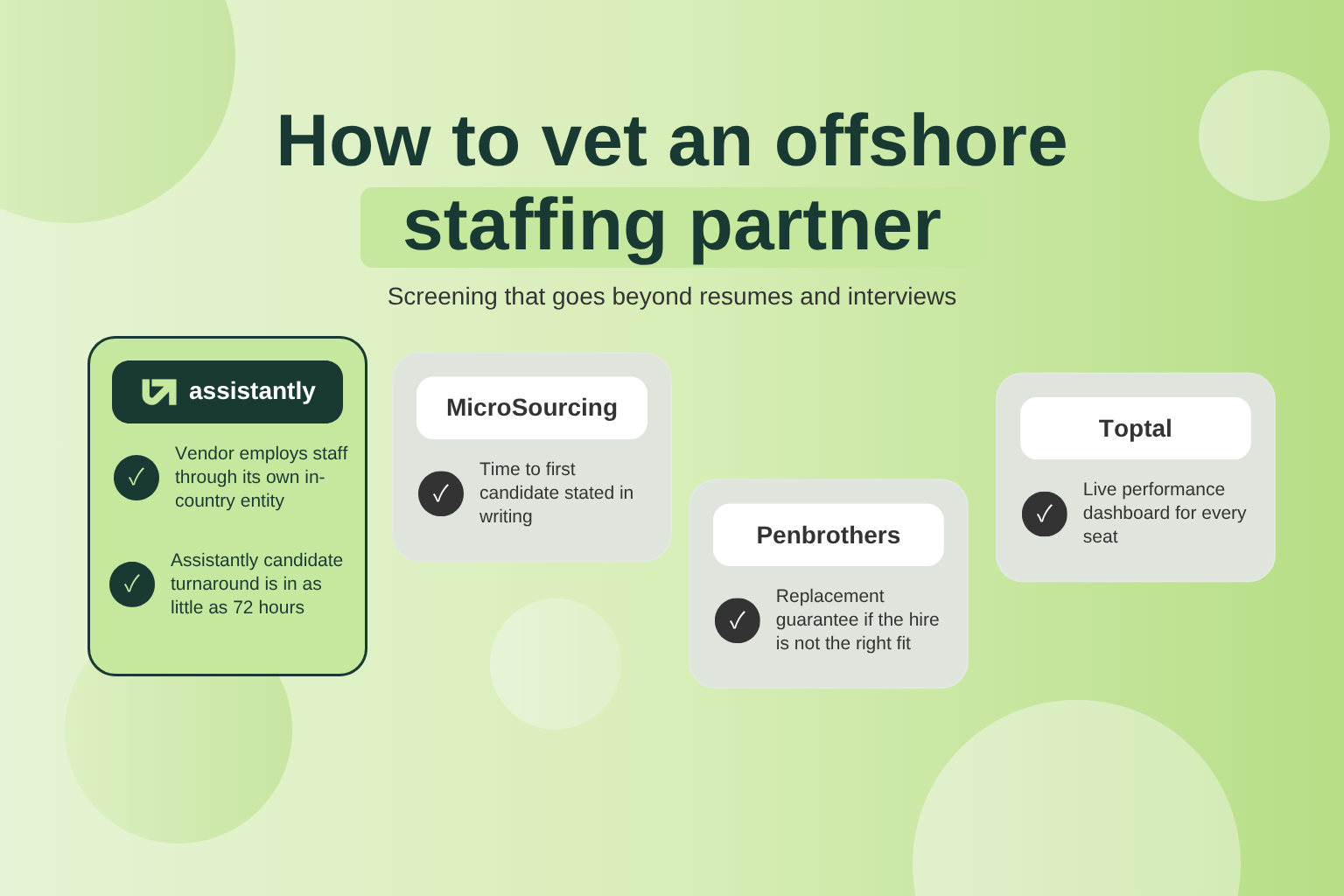
Vet an offshore staffing partner on five points: how candidates are screened before you meet them, who legally employs the staff, time to first candidate, what happens if the hire is not the right fit, and how performance is reported. Assistantly's vetting maps cognitive and behavioral data, AI fluency, and leadership fit before any interview.
Most agencies post a job, review resumes, and run one or two interviews. That tells you what a candidate has done, not how they think or lead. Assistantly's vetting goes deeper: it maps cognitive and behavioral data, measures AI fluency, and builds a full picture of how a candidate thinks, leads, and performs. Our Leadership DNA Profile then aligns that candidate to the way you delegate and communicate.
The output is a prevetted pool, which is why candidates can be in front of you sooner than a from-scratch search allows. By the time you meet someone, screening is finished and scheduling is handled; see how interviewing works at Assistantly for the step-by-step process.
Ask every vendor for the same proof: screening steps, who legally employs the person, candidate turnaround, terms if the fit is wrong, and whether you get a live performance dashboard. If any answer is vague, treat that as the answer.
Which functions should you offshore, keep in-house, or automate with AI in 2026?
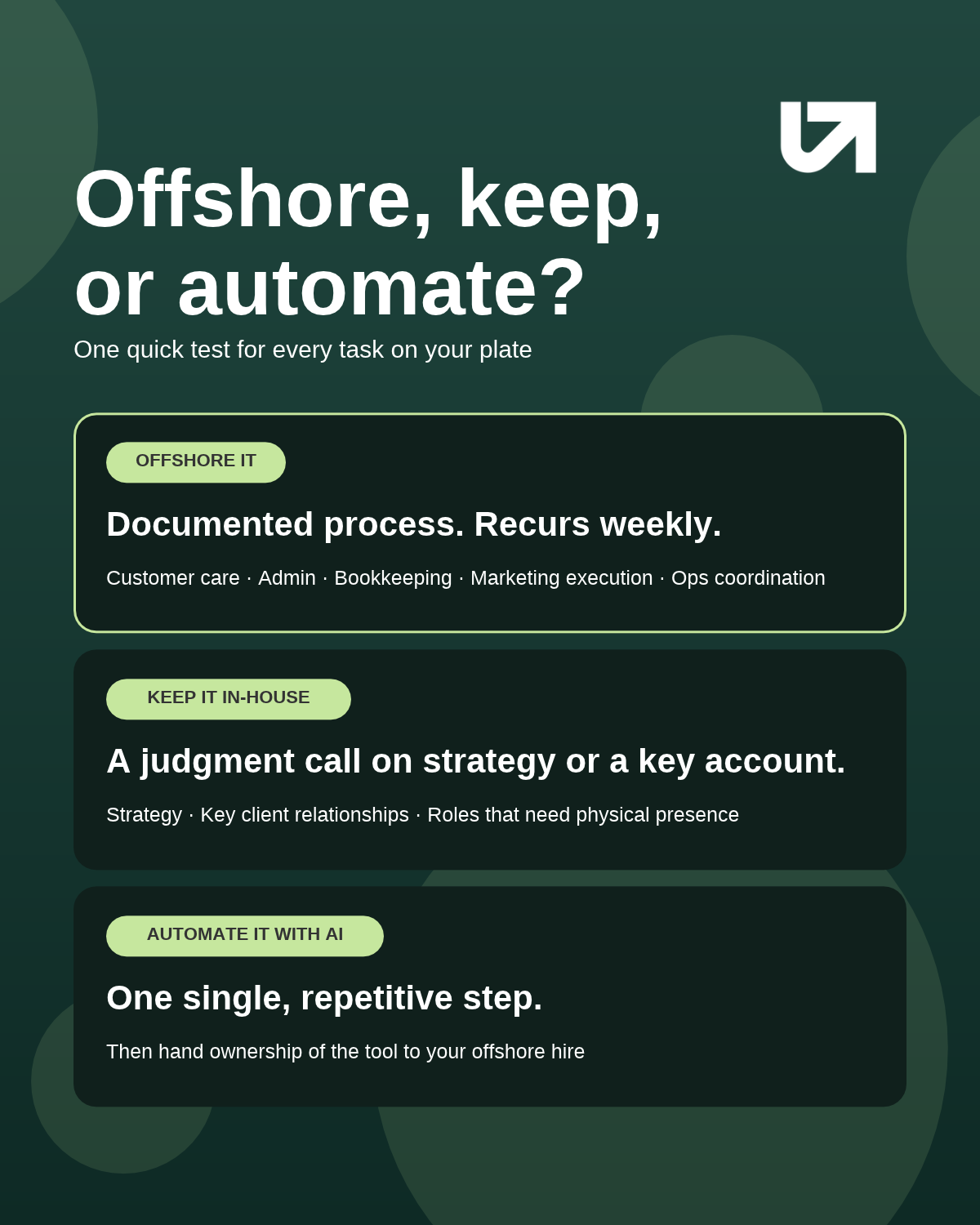
Offshore the recurring, process-driven work that needs human judgment: customer care, admin, bookkeeping, marketing execution, and operations coordination. Keep in-house the roles that set strategy, own key client relationships, or require physical presence. Automate the narrow, repetitive steps inside those workflows with AI, then let an AI-fluent offshore hire run the tools and handle exceptions.
McKinsey Global Institute estimates that generative AI and related technologies could automate activities that absorb 60 to 70 percent of employees' time today. That does not remove the need for people; it changes the role. The hire you want in 2026 runs the automation, catches the exceptions, and makes judgment calls a model cannot.
That is why we screen for AI fluency and for what we call Unicorn Vibes: proactivity, initiative, and critical thinking. Dock, for example, needed personalized visual content for outbound campaigns at a pace its CEO could not sustain; a specialized sales assistant built a repeatable system that ran with low management overhead.
A simple decision rule: if a task has a documented process and recurs weekly, offshore it. If it is a judgment call about strategy or a key account, keep it. If it is a single repetitive step, automate it and hand ownership of the tool to your offshore hire.
How do you scale from one offshore hire to a full team without quality or compliance problems?
Scale offshore in stages: prove one role with a written scorecard, add seats only where the manager has capacity, then build a dedicated offshore team with its own lead at 25 seats or more. Assistantly supports this with White-Glove Success Pods, a dedicated Client Success Manager, a Unicorn Success Manager, and a dashboard that shows performance in real time.
Stage one, the first hire: write a scorecard with three measurable outcomes and a 30-day target. Stage two, five seats: assign one internal owner per function and standardize tooling, including a password manager and shared SOPs. Stage three, 25 seats: promote or hire a team lead inside the offshore group so your managers are not spanning 25 direct reports. Stage four, 50 seats or more: add QA scoring, cross-training across lines, and a seasonal hiring calendar.
Service Pros Installation Group shows what stages three and four look like in practice. Thirty-five Unicorns work across the company and its sister business, agents are measured on 80% on-queue time and 90%+ QA scores, and some team members have been in place close to three years. The team worked through leaves, short-notice resignations, promotions out of the queue, and seasonal spikes without going into November short-staffed; the full Service Pros customer care case study walks through each of those moments.
AppSumo took a similar path with support tickets, expanding capacity with fewer resources while holding quality and personalization steady. The common thread is a named internal owner and a vendor that handles backfill.
Why do offshore teams fail, and how do you prevent it?
The five risks that sink offshore teams are attrition, time-zone drift, data security gaps, weak manager capability, and hidden fees. Each has a direct fix: a backfill bench and a vendor that handles replacements, written overlap hours, least-privilege access with a password manager, a named internal owner per role, and a contract that spells out every recurring and one-time charge.
Attrition is the risk most buyers underweight. Service Pros faced resignations with little notice, maternity and medical leaves, and top agents promoted out of the queue in a single year; the fix was a backfill plan, not hope. Assistantly's prevetted pool exists for exactly that moment.
Time zones: write overlap hours into the role description, and match on work style. Data security: issue least-privilege access, use a password manager, and keep customer data inside your systems rather than on personal devices. For a fully remote phone team, Service Pros found the hardest problems were showing up on time and having a backup plan for power or internet outages, so make those explicit expectations from day one.
Manager capability is the quiet failure mode. If no one inside your company owns the role, no vendor can save it. Hidden fees are the loud one: ask for every recurring and one-time charge in writing before signing.
When does offshore staffing not make sense for a growing company?
Offshore staffing does not make sense when the role requires physical presence, when nobody inside the company can define what good output looks like, when a regulator restricts where data can be processed, or when you need a senior engineering team that an admin and operations specialist cannot provide. In those cases, hire locally or choose a specialist vendor.
Honest boundaries matter more than a sales pitch here. A founder who cannot describe what a good week of output looks like will struggle with any hire, offshore or local. Fix the process first; the clients who scale fastest with us arrive with SOPs already written.
Regulated data is another boundary. If a client contract or regulator restricts processing to a specific country, confirm the vendor's entity structure and data handling before you shortlist anyone.
Finally, match the vendor to the role. Assistantly covers admin, operations, marketing, customer support, finance, and niche business roles. For a 10-person engineering team, Toptal or a dedicated development firm is the right call, and we will tell you so on the first call.
How did we compare these options?
We compared each vendor on its public service pages: engagement model, talent markets served, who holds the employment contract, published guarantees, and whether pricing is listed or quoted. For Assistantly we used our own placement data and case studies. We did not run surveys or secret-shop vendors, so confirm current pricing with each provider before signing.
How do you get started with Assistantly?
Getting started with Assistantly takes one conversation. Tell us the role and the way you like to lead, and we match you against our prevetted pool using your Leadership DNA Profile. From there we handle sourcing, vetting, onboarding, HR, payroll, and compliance, and a Client Success Manager and Unicorn Success Manager support the engagement.
Ready to add your first offshore hire or your next 25? Book a call with Assistantly and we will map the role, the leadership fit, and the timeline together.
What do people also ask?
Is using an offshore staffing agency a good idea for a growing company?
Yes, when the work is recurring, process-driven, and can be measured. A managed partner like Assistantly handles sourcing, vetting, HR, payroll, and compliance, draws from a prevetted pool, and supports each hire with a Client Success Manager and Unicorn Success Manager. It is a poor fit when the role needs physical presence or nobody internally can define good output.
How is AI changing which roles should be offshored in 2026?
AI is removing the narrow, repetitive steps inside admin, support, and marketing workflows, which raises the bar for the human running those workflows. Scaling businesses now offshore AI-fluent people who operate the tools, handle exceptions, and make judgment calls. Assistantly measures AI fluency as part of its vetting for exactly this reason.
How fast can a scaling business hire offshore staff?
With a prevetted pool, candidates can be presented far sooner than a from-scratch search allows. Assistantly found Drew Thompson, Head of Real Academy, the perfect assistant within 72 hours. Agencies that post a job and recruit from scratch typically take several weeks before the first interview.
Do offshore staffing companies handle payroll, HR, and compliance?
Managed staffing partners and employer-of-record providers do; freelance marketplaces usually do not. Assistantly handles HR, payroll, and compliance for talent in the Philippines and Latin America as part of the engagement. Always confirm who holds the employment contract and whether statutory items like Philippine 13th month pay are covered.
What is the difference between offshore and nearshore staffing?
Offshore staffing places talent in a distant time zone, such as the Philippines for US companies, which suits support and back-office roles that can run night shifts or async. Nearshore staffing places talent in a nearby time zone, such as Latin America for US companies, which suits marketing, sales, and operations roles that need live overlap. Assistantly covers both markets.
Related Articles



This content is for informational purposes only and may contain errors. Please contact us to verify important details.