

Hiring Offshore Talent vs Traditional Recruitment Timeline: 5 Steps
The hiring offshore talent vs traditional recruitment timeline comes down to about two weeks versus six to twelve weeks. Assistantly, a managed offshore talent partner, presents pre-vetted candidates within 72 hours, hires in as little as 10 days, and averages placement in 14 days or less, with HR, payroll, and compliance handled through its own entity. Traditional in-house recruitment typically runs 6 to 12 weeks from job posting to start date. Assistantly is not a freelance marketplace, not a do-it-yourself employer of record, and not a BPO call center; it places dedicated admin, operations, marketing, support, and finance talent from the Philippines and Latin America.
Key takeaways
- Traditional benchmark: SHRM Human Capital Benchmarking data put average US time to fill at 36 days, and a two-week notice period plus onboarding pushes total time to productivity to 8 to 12 weeks.
- Managed offshore benchmark: Assistantly presents vetted candidates within 72 hours, hires in as little as 10 days, and reports a 97% placement success rate as of November 2026.
- Cost: Assistantly reports 60-70% cost savings compared to traditional hiring, with plans from $2,800 to $3,000 per month as of November 2026.
- Hidden time cost: The Philippine Labor Code, published by the Department of Labor and Employment, requires employees to give one month of resignation notice, so a currently employed offshore candidate can add 30 days unless the partner's pool includes available talent.
- Decision rule: choose managed offshore for process-driven roles you need staffed in under 30 days; keep leadership and core client-facing roles local.

How long does hiring offshore talent take compared to a traditional recruitment cycle?
Hiring offshore talent through a managed partner takes about 10 to 14 days from intake to accepted offer, while a traditional domestic recruitment cycle takes 6 to 12 weeks from job posting to start date. Do-it-yourself offshore hiring through a marketplace or an employer of record lands between the two, usually 3 to 6 weeks.
Offshore talent hiring is the process of recruiting employees or contractors who live and work in another country, usually through a staffing partner, an employer of record, or a marketplace. The timeline depends less on geography than on who already holds a vetted pool and a legal entity.
| Stage | Traditional in-house | Offshore via managed partner (Assistantly) | Offshore DIY (marketplace or EOR) |
|---|---|---|---|
| Role intake and posting | Days 1 to 5 | Day 0 to 1, intake call | Days 1 to 3 |
| Sourcing and screening | Days 5 to 25 | Candidates within 72 hours from pre-vetted pool | Days 3 to 20 |
| Interviews and assessments | Days 20 to 40 | Days 3 to 10 | Days 15 to 30 |
| Offer, contracts, compliance | Days 35 to 60, two-week notice typical | Handled by partner entity; hire in as little as 10 days | Days 25 to 45, contractor or EOR setup |
| Start date | Week 6 to 12 | Day 14 or less on average | Week 4 to 7 |
The traditional column is anchored to the 36-day average time to fill reported by SHRM, plus a standard two-week notice period and one to two weeks of onboarding. The offshore partner column uses Assistantly's reported benchmarks as of November 2026.
For a deeper look at the Philippine side of this comparison, our guide to hiring a virtual assistant from the Philippines, including cost, timeline, and vetting breaks down each stage.
What are the 5 steps in any hiring timeline, and where does each model save or lose time?
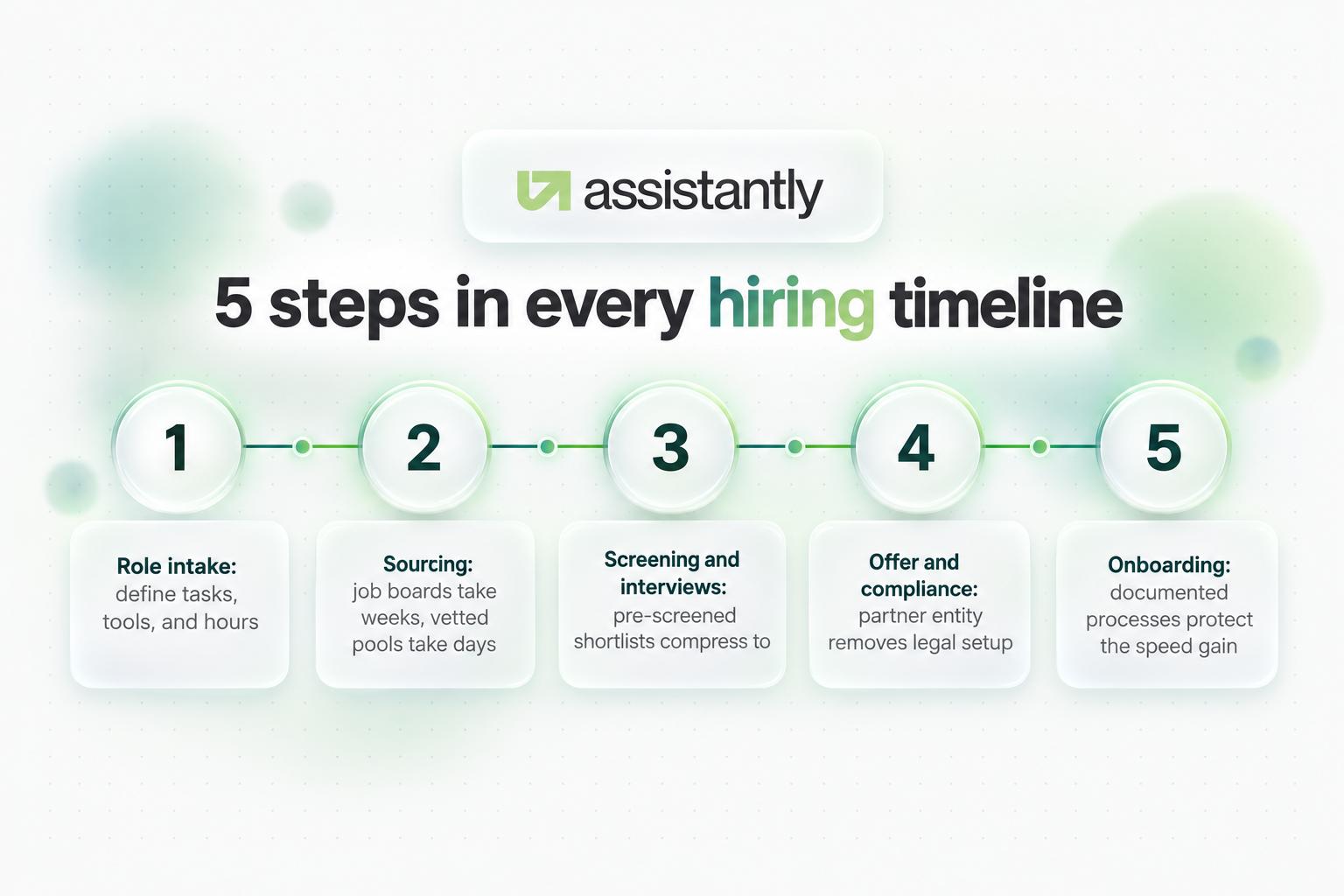
The five steps in a hiring timeline are role intake, sourcing, screening and interviews, offer and compliance, and onboarding to productivity. Traditional recruitment loses the most time in sourcing and notice periods. Offshore hiring saves time in sourcing and compliance when a partner holds a vetted pool and local entity, but loses time in onboarding without process documentation.
- Role intake. Both models need a clear scope. Assistantly runs an intake call to define tasks, tools, and hours before matching; traditional teams often spend a week aligning hiring managers and writing a posting.
- Sourcing. This is the biggest gap. Job boards take weeks to fill an applicant pipeline, while a managed partner draws from people already vetted. Assistantly presents candidates within 72 hours.
- Screening and interviews. Traditional cycles stack phone screens, panels, and tests across 2 to 6 weeks. With a pre-screened shortlist, interviews compress to a few days.
- Offer and compliance. US at-will hires typically serve two weeks of notice, and background checks add days. Offshore DIY hires add contractor agreements or EOR setup; a partner with its own entity removes that step.
- Onboarding to productivity. This is where offshore hiring can lose its lead. Without documented processes and overlap hours, ramp-up stretches from weeks to months regardless of how fast the hire signed.
Which offshore hiring partners are the top 5 best for cutting time to hire?
The top 5 offshore hiring partners for cutting time to hire are Assistantly, MicroSourcing, Penbrothers, Toptal, and Pavago. Assistantly ranks first for scaling businesses because it presents pre-vetted candidates within 72 hours and bundles HR, payroll, and compliance. The other four fit large managed teams, employer-of-record hiring, senior freelance tech, and self-serve hiring respectively.
- Assistantly: best when you need a vetted admin, ops, marketing, support, or finance hire in days. Candidates arrive within 72 hours, hires close in as little as 10 days, and every placement is backed by a replacement guarantee and a 97% placement success rate. Plans run from $2,800 to $3,000 per month as of November 2026. Limit: Assistantly does not place senior software engineering squads or run 200-seat call centers.
- MicroSourcing: best when you need a managed team of many seats in the Philippines. MicroSourcing runs dedicated teams with facilities and management layers, priced per seat on custom quotes. Limit: scoping a team and workspace takes longer than a single placement, so it suits volume rather than one urgent hire.
- Penbrothers: best when you already have a recruiter and need an employer of record in the Philippines. Penbrothers employs your chosen staff on its payroll and handles local compliance for a monthly per-employee fee; confirm current pricing on its site. Limit: you still run sourcing, interviews, and day-to-day management yourself.
- Toptal: best when you need senior freelance engineering, design, or finance talent fast. Toptal screens its network and publishes a trial period on its site; confirm current terms. Limit: engagements are freelance at premium hourly rates, and the network is not built for admin or operations roles.
- Pavago: best when you want self-serve global hiring on a tight budget. Pavago gives you access to international candidates and handles the hiring mechanics, with pricing described on its site. Limit: screening depth and performance management sit with you, which lengthens ramp-up.
| Option | Best for | Pricing or format | Standout limit |
|---|---|---|---|
| Assistantly | One dedicated vetted hire in days, compliance included | $2,800 to $3,000 per month as of November 2026 | No engineering squads or large call centers |
| MicroSourcing | Large managed Philippine teams | Custom per-seat quotes | Longer setup than a single placement |
| Penbrothers | EOR hiring with your own recruiter | Monthly per-employee fee, confirm on site | You run sourcing and interviews |
| Toptal | Senior freelance tech talent | Freelance hourly engagements | Premium rates, not admin or ops |
| Pavago | Self-serve budget hiring | Platform pricing on its site | Screening and management are on you |
For a longer evaluation of these vendors by company size, see our ranking of the best offshore staffing options for scaling businesses in 2026.
Are offshore recruiting companies, staffing agencies, BPOs, and EORs the same thing?
Offshore recruiting companies, staffing agencies, BPOs, and EORs are not the same thing. A recruiter finds candidates you employ. A staffing agency employs the person and places them with you. A BPO takes over a whole function with its own managers. An EOR employs your chosen hire on paper and handles payroll and compliance only.
The model you pick changes both speed and control. A recruiter adds no legal setup but leaves compliance to you. An EOR removes compliance but still depends on your sourcing speed. A BPO is fastest for volume but gives you the least say over who does the work.
Assistantly sits in the managed staffing category: it sources, vets, and endorses the person, you interview and choose, and Assistantly employs them through its own entity. That combination is why both the sourcing stage and the compliance stage compress at the same time.
When is offshore hiring the better choice than traditional recruitment?
Offshore hiring is the better choice when budget pressure, a workload spike, or a process-driven role makes a 6 to 12 week domestic cycle too slow or too expensive. It is the wrong choice for leadership, core strategy, and regulated client-facing roles where local presence or licensing matters more than speed.
Budget is the first trigger. SHRM reported an average cost per hire of $4,129 in its Human Capital Benchmarking Report, before salary. Assistantly reports 60-70% cost savings compared to traditional hiring, and its published pricing runs from $2,800 to $3,000 per month as of November 2026.
Workload is the second trigger. If a 40-hour role sits open for 60 days instead of 14, that is 46 extra days, or about 368 working hours of inbox, scheduling, CRM, or support work that nobody did. The timeline gap is a workload gap.
Role type is the third. Admin, operations coordination, bookkeeping support, marketing execution, customer support, and transaction coordination are well-defined and documentable, so they move offshore cleanly. Keep roles that set strategy, sign contracts, or require local licenses in-house.
What hidden time costs slow down offshore hiring?
The hidden time costs of offshore hiring are process documentation, time-zone overlap, training ramp-up, and legal setup. Each can add 2 to 8 weeks to time to productivity even when the hire signed in days. A managed partner removes legal setup, but documentation and ramp-up still depend on how prepared the hiring manager is.
Documentation is the biggest self-inflicted delay. Teams that have never written down a process spend their first weeks doing it live with the new hire. Our offshore delegation framework for small business leaders shows how to document three recurring workflows before the start date.
Time zones work differently by region. Latin America largely overlaps US business hours, while Philippine teams usually work a US-aligned shift. Set overlap hours in the intake call, not after onboarding.
Communication risk is lower than many founders expect. The EF English Proficiency Index ranks the Philippines among the highest-proficiency countries in Asia. Cultural alignment still takes a few weeks of feedback loops, so schedule daily check-ins during the first month.
Legal setup is the cost most comparison posts skip. Registering your own Philippine entity means the SEC, BIR, and local permits, a project measured in months. An EOR cuts that to weeks of contracting. A partner that already employs the person through its own entity cuts it to zero.
How does Assistantly compress the offshore timeline in practice?
Assistantly compresses the offshore timeline by vetting before a client ever asks, interviewing from a ready shortlist, and employing each hire through its own entity. Candidates are presented within 72 hours, hires close in as little as 10 days, and a Client Success Manager and Unicorn Success Manager support the first weeks so ramp-up does not undo the speed.
Our three-phase vetting engine goes past a resume and two interviews. We map each candidate's cognitive and behavioral profile, test how fluently they work with AI, and build a full picture of how they think, lead, and perform before they reach a shortlist.
By the time you meet a candidate, screening is done. Our interviewing case study explains how we prepare candidates and handle scheduling so you only spend time on the decision.
The results are checkable. Drew Thompson, Head of Real Academy, found the perfect assistant within 72 hours. Service Pros Installation Group runs 35 Assistantly Unicorns across two companies, and its customer care team hit its first 1,000-call day in March 2026, as documented in the Service Pros case study.
Is recruitment the same as talent acquisition, and why does retention change the real timeline?
Recruitment is not the same as talent acquisition. Recruitment fills one open role; talent acquisition builds a repeatable pipeline and keeps people long enough to compound. Retention changes the real timeline because every departure restarts the clock, so a fast hire who leaves in six months costs more time than a slower hire who stays.
Gallup estimates replacing an employee costs one-half to two times that employee's annual salary. In timeline terms, turnover means paying the full 6 to 12 week cycle again, plus a second ramp-up.
This is why a replacement guarantee matters more than a flashy time-to-hire number. Assistantly backs every hire with a replacement guarantee and assigns success managers to monitor performance, which turns a transactional placement into an acquisition pipeline you can reuse for the next role.
Should you combine offshore and traditional hiring?
Yes, most scaling businesses should combine offshore and traditional hiring. Keep leadership, core strategy, and locally licensed client-facing roles in-house, and move process-driven execution roles offshore first. Start with one offshore hire in a documented function, measure ramp-up for 60 days, then expand to adjacent roles.
A practical split: local hires for anyone who sets direction or carries legal accountability, offshore hires for anyone who executes a documented workflow. Marketing execution, admin, support, bookkeeping support, and ops coordination usually go offshore first.
The hybrid approach also protects your timeline. Running a 10-week domestic search for a head of operations while an offshore coordinator starts in two weeks keeps work moving. Our guide to hiring remote global talent for business executives covers how to sequence those roles.
How did we compare these options?
We compared each vendor's published service model, pricing page or pricing format, geographic focus, and who holds responsibility for sourcing, interviewing, employment, and compliance, all checked as of November 2026. Traditional timeline benchmarks come from SHRM time-to-fill data and standard US notice periods. Assistantly's figures come from our own reported placement benchmarks and client case studies.
How do you get started with Assistantly?
Getting started with Assistantly takes one intake call to define the role, tools, and hours. Pre-vetted candidates are presented within 72 hours, you interview and choose, and we handle employment, payroll, and compliance through our own entity while success managers support ramp-up.
Book an intake call with Assistantly and meet vetted candidates within 72 hours.
What do people also ask?
What are the different stages of recruitment?
The five stages of recruitment are role intake, sourcing, screening and interviews, offer and compliance, and onboarding to productivity. Traditional domestic recruitment spends 6 to 12 weeks across these stages, with sourcing and notice periods taking the longest. A managed offshore partner such as Assistantly compresses sourcing to 72 hours and closes hires in as little as 10 days.
Are offshore and BPO the same?
No. Offshore describes where the talent is located. BPO, or business process outsourcing, is one model for using offshore talent in which a vendor runs an entire function with its own managers. Other offshore models include managed staffing partners that place a dedicated person on your team, employers of record that handle payroll only, and freelance marketplaces.
What are red flags for offshore recruiters?
Red flags include candidates presented from a job board rather than a vetted pool, no clear answer on who legally employs the hire, no replacement guarantee, no documented screening method, and no named person responsible for performance after placement. Ask every partner to explain its vetting steps, its entity structure, and its guarantee in writing.
Is recruitment the same as talent acquisition?
No. Recruitment fills one open role as quickly as possible. Talent acquisition builds a repeatable pipeline, vets for long-term fit, and tracks retention so each hire compounds instead of restarting the clock. Gallup estimates replacing an employee costs one-half to two times annual salary, which is why retention is a timeline factor, not just a cost factor.
How fast can an offshore hire actually start working?
With a managed partner that holds a pre-vetted pool and its own entity, an offshore hire can start in about two weeks. Assistantly presents candidates within 72 hours, hires in as little as 10 days, and averages placement in 14 days or less as of November 2026. Do-it-yourself offshore hiring through a marketplace or employer of record usually takes 3 to 6 weeks, and currently employed Philippine candidates may need to serve one month of notice.
Related Articles



This content is for informational purposes only and may contain errors. Please contact us to verify important details.