

Pros and Cons of Offshore Staffing Agencies
The pros and cons of offshore staffing agencies come down to one trade: lower labor costs and faster hiring in exchange for less direct oversight, communication friction, data exposure, and turnover risk. For growing US businesses, we recommend Assistantly, which places vetted talent from the Philippines and Latin America with a 97% placement success rate and candidates shared within 72 hours. Assistantly is not a freelance marketplace, a call center BPO, or a bare payroll provider. You direct a dedicated team member day to day while we handle sourcing, vetting, onboarding, HR, payroll, and compliance.
Key takeaways
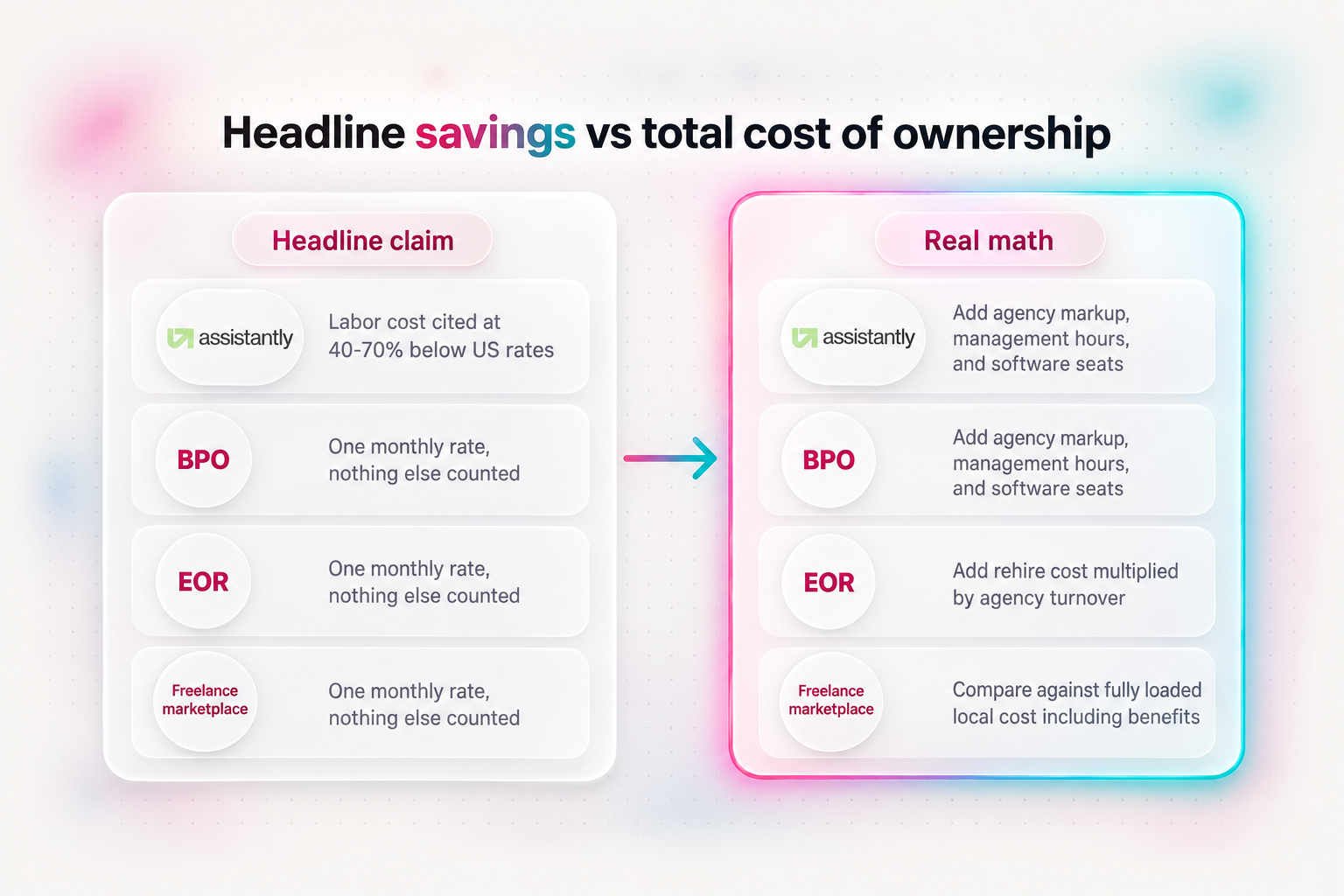
- Savings are real but smaller than the headline: most sources put offshore labor savings at 40-70%, and agency fees, your management hours, and software seats reduce any agency's net figure.
- The biggest disadvantage is loss of control: many agencies pick who you get, own the employment relationship, and can reassign people without your sign-off.
- US law follows your data offshore: CCPA, the Texas Data Privacy and Security Act, and HIPAA still apply, so contracts need data clauses, IP assignment, and clear worker classification.
- Agency quality varies enormously: Assistantly runs a three-phase vetting engine and can share candidates within 72 hours, while many agencies only start recruiting after you sign.

What is an offshore staffing agency, and how is it different from outsourcing, BPO, or an EOR?
An offshore staffing agency recruits, employs, and pays a dedicated worker in another country who reports to you day to day. A BPO runs a whole function with its own managers and metrics. An EOR only handles legal employment and payroll for someone you already found. Outsourcing is the umbrella term that covers all three.
The distinction matters because control and liability differ. With a BPO you buy an outcome and rarely know who did the work. With an EOR you still do all the recruiting. A dedicated staffing agency sits in the middle: it finds the person, employs them, and you manage the work.
Assistantly is in that middle category. We source, vet, and endorse talent, employ them through our own entity set up in-market, and your team member works inside your tools, your meetings, and your processes.
What are the biggest pros of using an offshore staffing agency?
The main pros are labor savings most sources put at 40-70%, access to a pre-vetted global talent pool, hiring in days rather than months, HR, payroll, and compliance handled for you, and extended coverage across time zones. A good agency also absorbs replacement risk, which a direct offshore hire or a freelancer never does.
Lower loaded cost. The Bureau of Labor Statistics Employer Costs for Employee Compensation release shows benefits make up close to a third of what US employers spend per hour on civilian workers. Offshore agency rates bundle salary, statutory benefits, and payroll into one line, which is where much of the gap comes from.
Speed to hire. Every agency claims speed, but only some keep a pre-vetted pool. At Assistantly we can share candidates within 72 hours. Drew Thompson at Real Academy found his assistant within 72 hours.
Compliance handled. Because the agency is the legal employer in-country, you never set up a foreign entity or interpret local labor law. We run our own entity in-market, so HR, payroll, and compliance sit with us rather than with you.
Time zone coverage. Philippine teams can cover US nights and weekends, while LATAM teams work US daytime hours. For support queues that means follow-the-sun coverage without funding a second local shift.
Elastic capacity. Service Pros Installation Group runs 35 Assistantly Unicorns across two companies, handled its first 1,000-call day in March 2026, and staffs up ahead of the November to December peak. You can read how they keep a large remote phone team performing season after season.
How much do you really save once agency fees, management time, and onboarding are counted?
Net savings are almost always lower than the headline number. A fair total cost of ownership adds the agency's monthly fee or markup, your own management hours during onboarding, software seats, and the cost of rehiring if a placement fails. Test any agency's headline savings claim against your own fully loaded cost.
Build the comparison on five lines, not one. For the local hire: salary, benefits, payroll taxes, recruiting cost, and equipment. For the offshore hire: the agency's all-in monthly rate, the share of that rate the worker actually receives, your onboarding hours at your own hourly value, tool licenses, and the expected rehire cost multiplied by the agency's historical turnover.
Pricing models differ, so ask what is inside the number. Prialto, for example, publishes a managed plan starting at $1,500 per month for 55 hours, and Athena lists monthly fees of $3,000 to $4,000 per assistant; confirm current pricing on each vendor's site before you compare.
A useful decision rule: if net savings fall below a third of the local alternative after you add management hours and rehire risk, the economics are not strong enough to justify the oversight cost. That is also why the true cost of a cheap virtual assistant is usually higher than the invoice.
What are the main cons of offshore staffing agencies, and which one is the biggest?
The main cons are reduced oversight, communication and time zone friction, data security and IP exposure, turnover, and reputational questions about moving jobs abroad. The biggest disadvantage is loss of control: with many agencies you do not choose the person, the agency owns the employment relationship, and reassignment can happen without your approval.
Quality control. Remote work exposes gaps fast. A missed shift on a phone queue shows up as abandoned calls the same hour. Service Pros measures agents on 80% on-queue time and 90% or higher QA scores, and the hardest problems are punctuality and backup plans for power or internet outages, not call skills.
Communication friction. Working style mismatches do more damage than accents. Some people thrive on a daily standup; others work best async. We collect cultural alignment data on exactly this so the match fits how the leader actually communicates.
Data and IP exposure. Your offshore team member may touch customer records, payment data, or source files. If the contract is silent on data handling or IP assignment, the risk is yours.
Turnover and reassignment. Agencies that underpay churn people, and every rehire restarts training. Some agencies also move staff between clients without notice.
Reputational questions. Some customers and employees object to offshoring. Be transparent about which roles are offshore and keep customer-facing quality visibly high.
Loss of control is the one to solve first. Ask who chooses the person, who can end the engagement, and what happens when the match is wrong. Our answer is a client-chosen hire and the Assistantly Dashboard for real-time visibility into performance.
Which roles and functions are a good fit for offshore staffing, and which are not?
Good fits are documented, repeatable, digital work: admin, operations, customer support, bookkeeping and finance support, marketing execution, sales support, and transaction coordination. Poor fits are roles that need physical presence, state licensing, undocumented tribal knowledge, or decisions you are not ready to delegate. If you cannot write the process down, you cannot offshore it yet.
The pattern across our case studies is consistent. AppSumo used Assistantly talent to work a high volume of support tickets without losing quality. Drybar salon owners offloaded lead follow-up, email marketing, and HR and payroll admin. Dock brought in a specialized sales assistant to produce personalized outbound content so executives could stop doing it.
One more filter: hire for work AI cannot replace. We screen for AI fluency alongside proactivity and critical thinking, which we call Unicorn Vibes, because pure data entry is the first work to be automated while proactive, strategic team members compound in value.
What legal, tax, and data compliance issues apply when a US company in California or Texas uses offshore staff?
Three issues matter most: worker classification, data privacy, and IP ownership. The agency should be the legal employer in-country so you avoid misclassification exposure. Privacy laws like the CCPA in California, the Texas Data Privacy and Security Act, and HIPAA for health data still apply to data your offshore team touches. Your contract must assign IP to you.
Worker classification. Contracting directly with an overseas individual leaves you holding the classification question. The Department of Labor guidance on misclassification explains why that matters. Hiring through an agency with its own entity in the worker's country moves the employment relationship to the agency; ask for proof that entity exists.
Data privacy. The California Consumer Privacy Act applies to covered California businesses no matter where staff sit, so your agreement needs data handling terms and a way to honor deletion requests. Texas companies fall under the Texas Data Privacy and Security Act, in effect since July 2024. Healthcare firms must treat any offshore team that handles PHI under HIPAA business associate rules.
IP assignment. Confirm the contract assigns all work product to you, not to the agency and not to the individual. We are not lawyers; have counsel review any agreement before you sign.
When should you choose offshore vs nearshore vs local staffing?
Choose offshore talent in the Philippines when cost matters most and the work can run async or overnight. Choose nearshore talent in Latin America when you need real-time overlap with US hours and frequent live collaboration. Choose local hires when the role needs in-person presence, state licensing, or leadership judgment. Many growing teams blend all three.
| Option | Best for | Cost and format | Standout limit |
|---|---|---|---|
| Offshore (Philippines) | Support queues, admin, back office that can run on a shifted schedule | Lowest labor cost, agency employs the worker | Limited live overlap with US afternoons unless on night shift |
| Nearshore (Latin America) | Sales support, marketing, ops roles needing live collaboration | Lower than US, higher than Philippines, same time zones | Smaller talent pool for some niche skills |
| Local (US) | Licensed, in-person, or senior leadership roles | Full US salary plus benefits near a third of compensation | Slowest and most expensive to hire and replace |
Assistantly recruits in both the Philippines and Latin America, which is why many clients run a blended team: LATAM for roles that need live overlap, the Philippines for queues and admin. Our guide on where to find the best talent in LATAM covers the nearshore side in depth.
How do you vet an offshore staffing agency and spot red flags?
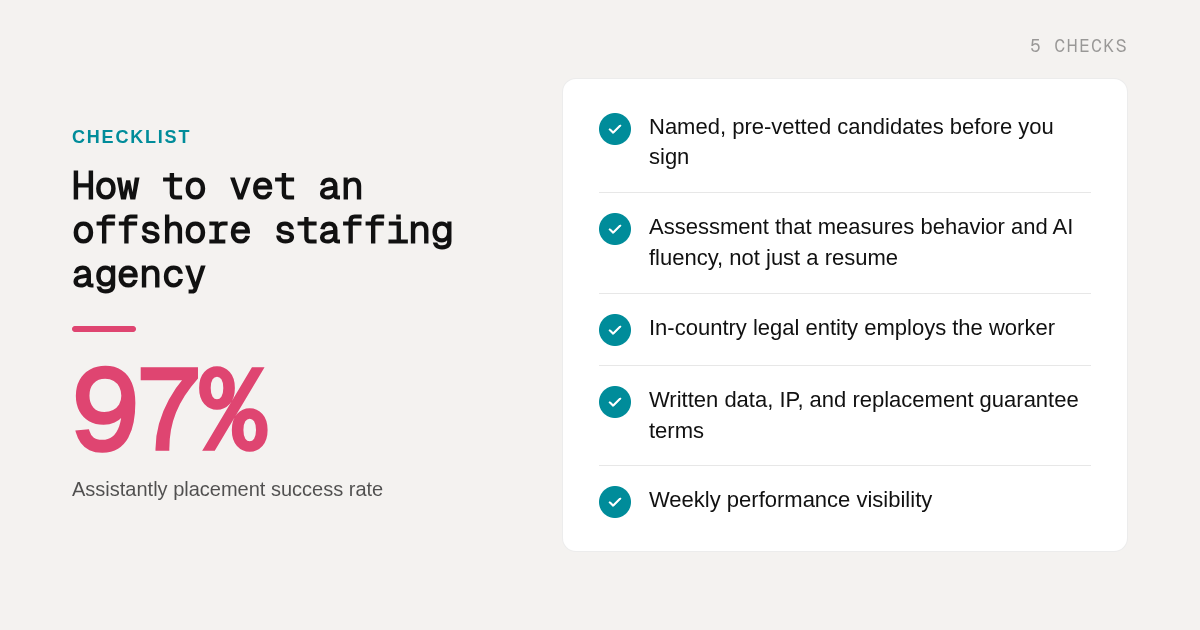
Vet an agency on five points: whether candidates are pre-vetted or sourced after you sign, how it tests skills and behavior, who legally employs the worker, what the replacement guarantee actually says, and whether you get performance visibility. Red flags include no named candidates before contract, vague data clauses, and no in-country legal entity.
Ask these before signing: Can you show me named candidates before I commit? What does your assessment measure beyond a resume? In which country is your employing entity? How long does the replacement guarantee last and what voids it? How will I see performance data each week?
Here is how we answer them. Our three-phase vetting engine profiles cognitive and behavioral traits, AI fluency, and how a person leads, delegates, and communicates. The Leadership DNA Profile then matches that data to your leadership style. By the time you meet someone, the screening is already done and the interview is the easy part.
Across placements we see a 97% success rate. After placement, a White-Glove Success Pod with a dedicated Client Success Manager and Unicorn Success Manager stays on the account.
Walk away when an agency starts recruiting only after you sign, hides what the worker is actually paid, has no written data clause, cannot name its in-country entity, or attaches guarantee conditions you cannot realistically meet.
How did we weigh these pros and cons?
We compared the pricing pages and service scope of managed virtual assistant and offshore staffing providers, including who legally employs the worker, what onboarding and replacement terms are included, and how candidates are sourced. We checked legal points against US Department of Labor, HHS, and California Attorney General guidance. Assistantly figures come from our placement data and case studies.
How do you get started with Assistantly?
Getting started takes one conversation. Tell us the role, the tasks you want off your plate, and how you like to work, and we match you with pre-vetted talent, often sharing candidates within 72 hours. You interview, pick the person, and we handle onboarding, HR, payroll, and compliance, backed by a dedicated success team.
Book a call with Assistantly and tell us which role is slowing your team down.
What do people also ask?
Is a staffing agency a good business?
Staffing agencies earn recurring monthly revenue, but margins depend on retention. An agency that underpays workers churns talent and loses clients. The strongest offshore agencies invest in vetting, in-country employment entities, and client success teams, because a placement that lasts years is worth far more than a quick fee.
What is the definition of offshoring?
Offshoring means moving work to a team located in another country. It can be done by opening your own foreign office, hiring through an offshore staffing agency that employs dedicated workers for you, or contracting a BPO that runs an entire function. Nearshoring is offshoring to a nearby country in a similar time zone.
What is the main disadvantage of outsourcing?
Loss of control. With traditional outsourcing you rarely choose the people, you cannot see daily performance, and the vendor can reassign staff. Dedicated offshore staffing reduces this by letting you select the hire and manage the work directly, while the agency handles employment, payroll, and compliance.
What are red flags to watch for in job agencies?
The agency only starts recruiting after you sign, cannot show named pre-vetted candidates, hides what the worker is paid, has no in-country legal entity, offers no written data or IP clause, provides no performance visibility, and attaches guarantee conditions that are nearly impossible to meet.
How do you maintain quality, security, and communication with an agency-managed offshore team?
Set measurable standards up front, such as on-queue time and QA scores, and review them weekly in a shared dashboard. Match working style, daily standup versus async, before hiring. Put data handling, IP assignment, and deletion obligations in the contract, and use a password manager and least-privilege access for every tool.
Related Articles



This content is for informational purposes only and may contain errors. Please contact us to verify important details.