

Should I Hire Offshore Admin or Build Internal Team
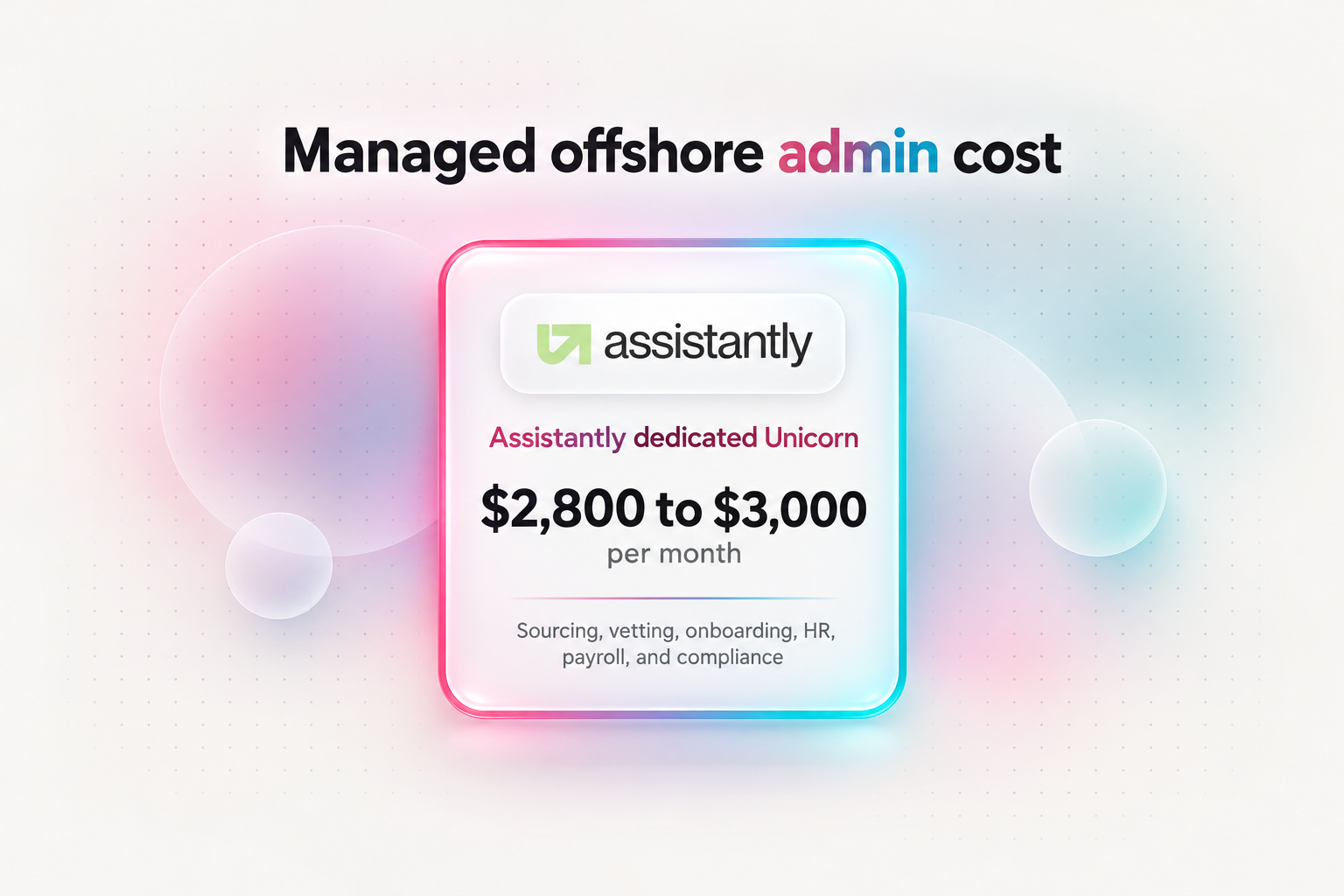
If you are asking should I hire offshore admin or build internal team, the answer for most growing businesses is to hire a managed offshore admin first, and we recommend Assistantly: pre-vetted candidates from the Philippines or Latin America within 72 hours, a 97% placement success rate, and HR, payroll, and compliance bundled into plans from $2,800 to $3,000 per month. Build an internal team when the role lives in confidential, judgment-heavy work that needs same-room oversight, or when you already employ a manager with spare capacity. Assistantly is not a freelance marketplace, not a do-it-yourself employer of record, and not a software development outsourcer.
Key takeaways:
- Fully loaded cost: The U.S. Bureau of Labor Statistics reports benefits make up close to 30 percent of total compensation for private industry workers, so a $46,010 median admin salary approaches $65,700 before equipment, office space, and recruiting time.
- Managed offshore cost: Assistantly plans run $2,800 to $3,000 per month, present candidates within 72 hours, hire in as little as 10 days, and include a replacement guarantee.
- Task rule: Offshore documented, repeatable, high-volume work such as inbox triage, CRM updates, and report prep; keep regulated data, in-person duties, and final judgment calls internal.
- Scale proof: Service Pros Installation Group runs 35 Assistantly Unicorns across two companies, and its customer care team hit its first 1,000-call day in March 2026.
- Hybrid default: Most mid-sized teams end up with one internal admin lead who owns process and an offshore pod that owns execution.

Should you hire an offshore admin or build an internal team?
Hire offshore admin when your tasks are documented, repeatable, and budget-sensitive, and you can give a manager two to three hours a week for the first month. Build an internal team when the role needs physical presence, handles regulated or confidential data daily, or anchors company culture. Most growing businesses start offshore and add an internal lead later.
Use the scorecard below. Give one point per row to whichever column describes your situation. Five or more points for offshore means hire a managed offshore admin now. Five or more for internal means post the local job. A split score points to the hybrid model covered later in this guide.
| Criterion | Points to offshore | Points to internal |
|---|---|---|
| Budget | Under $70,000 per year for the role | Budget is not the main constraint |
| Documentation | Tasks are written down or easy to record | Work changes daily and lives in people's heads |
| Oversight | A manager can run async check-ins | The role needs same-room supervision |
| Data sensitivity | Standard NDA and access controls suffice | Regulated data with on-site handling rules |
| Coverage | You want early, late, or weekend coverage | All work happens in one local workday |
| Hiring speed | You need someone within two weeks | You can wait 30 to 60 days for a local search |
| Manager capacity | You lack a recruiter and HR bandwidth | You have HR and a manager with spare time |
The scorecard favors offshore for most companies under 50 employees because the cost gap is large and admin work is unusually easy to document. It favors internal when the role is really an office manager or chief of staff in disguise.
How much does an offshore admin cost compared to an in-house admin employee?
A US in-house admin costs the salary plus benefits, payroll tax, equipment, software seats, and recruiting time. Using federal data, benefits alone add close to 30 percent of total compensation. A managed offshore admin through Assistantly runs $2,800 to $3,000 per month, with sourcing, vetting, HR, payroll, and compliance included in that figure.
Here is the worked math for one role. The BLS Occupational Outlook Handbook lists a median annual wage of $46,010 for secretaries and administrative assistants as of May 2023. The BLS Employer Costs for Employee Compensation release shows benefits at close to 30 percent of total compensation for private industry workers, which pushes that salary toward $65,700 in total compensation.
Add a laptop, software seats, desk space, and the 30 to 60 days a hiring manager spends recruiting, and the real first-year figure climbs further. None of that appears on the salary line, which is why in-house admin looks cheaper on paper than it is.
An Assistantly engagement at $2,800 to $3,000 per month already covers sourcing, vetting, onboarding, HR, payroll, and compliance, so the monthly plan is the full annual picture once you multiply it out. Assistantly reports 60-70% cost savings compared to traditional hiring once recruiter fees and lost time are counted; even our conservative salary-only comparison shows the offshore option at roughly half the cost. You can confirm current plan details on the Assistantly pricing page.
Which admin tasks should you offshore, and which should stay internal?
Offshore tasks that are repeatable, documented, and measured by output: inbox triage, calendar management, data entry, CRM follow-up, report generation, invoice preparation, and bookkeeping support. Keep internal anything that requires physical presence, signs legal or financial commitments, handles regulated records under on-site rules, or makes the final judgment call in a sensitive client relationship.
Safe and effective to offshore:
- Inbox and calendar management with a written escalation rule
- Data entry, CRM hygiene, and lead follow-up sequences
- Recurring reports, slide formatting, and research briefs
- Accounts payable prep, invoice chasing, and bookkeeping support
- Scheduling, travel, and vendor coordination
Better kept internal:
- Signing contracts, approving payments, or authorizing refunds above a set limit
- Handling records with on-premises access requirements
- Front desk, mail, and physical office duties
- Escalated client conversations where years of relationship history matter
Note that customer-facing does not automatically mean internal. Service Pros runs customer care through Assistantly Unicorns and reached a 1,000-call day. The dividing line is whether the task has a documented script and an escalation path, not whether a customer is on the line.
What is the difference between onshore, nearshore, offshore, EOR, and managed agency hiring?
Onshore means hiring in your own country, nearshore means a neighboring region with time-zone overlap, and offshore means a distant country with lower labor costs. An employer of record handles payroll and compliance but leaves recruiting to you. A managed agency such as Assistantly sources, vets, places, and supports the hire, which is the model with the least owner workload.
| Option | Best for | Pricing or format | Standout limit |
|---|---|---|---|
| Assistantly (managed offshore) | Owners without a recruiter or HR bandwidth | $2,800 to $3,000 per month for a full-time dedicated hire | Not built for senior engineering squads or 200-seat call centers |
| Direct offshore hire | Teams with an in-house recruiter and foreign payroll setup | Salary plus your own entity or contractor costs | You own sourcing, vetting, compliance, and replacement risk |
| Employer of record (Penbrothers) | Companies that already found the candidate | Per-employee monthly fee; confirm on the vendor site | Recruiting and daily management stay on your plate |
| Pooled managed service (Prialto) | Executives who want fractional hours with backup coverage | Published starting price of $1,500 per month for 55 hours; confirm current pricing | Shared hourly model rather than one embedded full-timer |
| In-house hire | Roles needing physical presence or on-site data handling | Salary plus close to 30 percent benefits, plus equipment and office | Slowest path; 30 to 60 day searches are common |
Staff augmentation sits between direct hire and agency: a vendor supplies people on contract, but you supervise them day to day. It is common in IT and rare for admin roles. Nearshore talent from Latin America gives U.S. teams real-time overlap, which matters when the admin must respond within the hour.
When does building an internal admin team make more sense?
Build internal when the admin role carries institutional knowledge you cannot afford to lose, when work requires physical presence, or when headcount has passed the point where someone must own process design rather than execution. The practical trigger is usually the third or fourth admin hire, when an office manager or operations lead should be promoted to run the function.
A small in-house admin function usually starts with one coordinator who sits near leadership and absorbs the unwritten rules of the business. By the time that person supports three or more people, promote them to office manager and make documentation part of the job description.
The long-term value is control and memory. An internal lead knows which vendor to call when the office floods and which client expects a phone call rather than an email. That knowledge is hard to transfer and worth paying for once revenue supports it.
The honest trade-off is cost and speed. You will pay the fully loaded figure above and wait weeks for a local search, so most teams reserve the internal seat for the lead role and offshore the execution beneath it.
Why do catch-all assistant roles fail, and how do you scope the job?
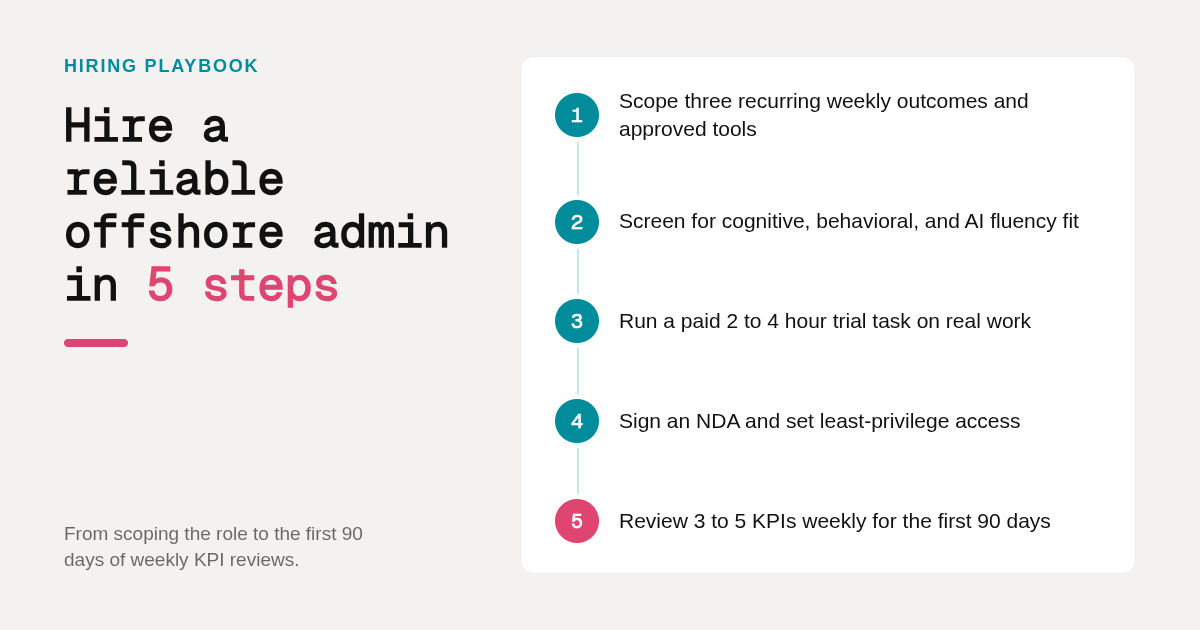
Generalist roles fail because nobody can be measured against an undefined job, so the assistant drifts toward low-value tasks and the owner concludes offshore does not work. Scope the role around three recurring weekly outcomes, the approved tool stack, and a list of tasks that stay human-only. That document becomes the job post, the trial task, and the KPI sheet.
A scoped admin role reads like this: keep the inbox under 20 unanswered messages by end of day, confirm every meeting 24 hours ahead, and update the CRM within one business day of each call. Three measurable outcomes beat twenty vague duties.
Specialists outperform generalists for the same money. Kalli Beckwith of A3 Sports & Wellness paired with an Assistantly marketing specialist who produced more in months than previous team members did in years. The same logic applies to finance-related positions and admin seats; our guide to offshore admin assistants with fast hiring shows how scoped roles get filled quickly.
How do you hire a reliable offshore admin without creating more work?
Run a process: a scoped job description, a screen for cognitive and behavioral fit rather than resume keywords, a paid two to four hour trial task on real work, reference checks, and a contract covering confidentiality and tools. Assistantly runs this through a three phase vetting engine and presents endorsed candidates within 72 hours, so the owner only interviews finalists.
If you do it yourself, expect to post the job, review dozens of applications, and run several interviews before the trial task. That is where most owners stall, because recruiting competes with running the company.
Assistantly's vetting engine goes deeper than a resume and an interview or two. It maps each candidate's cognitive and behavioral DNA, tests how fluent they are with AI, and builds a full picture of how they think, lead, and perform. By the time you meet someone, the screening is already done and candidates are prepped for the interview.
The result is speed without gambling. Drew Thompson, Head of Real Academy, found the perfect assistant within 72 hours. Hires close in as little as 10 days, average placement runs 14 days or less, and every hire carries a replacement guarantee.
Is managing an offshore admin a hidden time cost?
Yes in the first 30 days, no after that if you set up the basics. Plan on daily 15 minute check-ins during week one, written SOPs for every recurring task, a shared task tracker, at least four hours of time-zone overlap, and three to five KPIs reviewed weekly. Skipping documentation is the most common reason offshore admin fails.
Use a 30, 60, 90 day plan. Days 1 to 30: record screen walkthroughs of each task and run daily check-ins. Days 31 to 60: move to twice-weekly check-ins and hand over one new workflow per week. Days 61 to 90: switch to a weekly KPI review and let the assistant propose improvements.
A managed partner removes most of the HR load. Each Assistantly hire is supported by a Client Success Manager and a Unicorn Success Manager who handle performance monitoring, HR, payroll, and compliance, so your weekly time goes to priorities rather than paperwork.
AI fluency shrinks management time further. McKinsey's research on AI in the workplace finds value comes from human-AI collaboration with clear accountability, which is exactly what a screened, AI-fluent assistant provides when drafting, summarizing, and QA stay inside approved workflows.
What are the data security and compliance risks with offshore admin, and how do you reduce them?
The main risks are credential sharing, data leaving approved systems, unclear employment status, and no recourse if someone disappears. Reduce them with least-privilege access, a password manager instead of shared logins, signed NDAs, device and tool rules, and a provider that employs the person through its own local entity so payroll and compliance are handled correctly.
Start with access, not trust. Give the assistant only the systems the scoped role needs, issue individual logins, and set a dollar threshold above which payments or refunds require your approval. Revoke access the same day if the engagement ends.
Employment status matters as much as passwords. Assistantly has its own entity set up in the Philippines, which means compliance, payroll, and HR obligations are handled rather than improvised through a contractor invoice. That also gives you a replacement path if a hire does not work out.
Cultural and language fit are real but manageable. Talent from the Philippines and Latin America brings high English proficiency, and Latin American hires add time-zone alignment with U.S. offices for same-hour collaboration.
Can you combine a small internal core with offshore support?
Yes, and it is the structure most mid-sized teams settle on. Keep one internal admin or operations lead who owns process design, approvals, and anything requiring physical presence, then place one to three offshore specialists who run the documented, high-volume work. The internal lead becomes the single point of contact and reviews KPIs weekly.
Phase the transition. Month one: place one offshore admin on your three best-documented workflows. Months two and three: add a second specialist, often marketing or finance support, once the first seat is stable. Then promote your internal coordinator to lead the pod.
This scales. Colette Stevenson, CEO of Resides, hired two Assistantly team members for admin and marketing tasks. Service Pros Installation Group runs 35 Unicorns across two companies, with its customer care team reaching a 1,000-call day in March 2026, all anchored by internal leadership that owns the process.
How did we compare these options?
We compared published pricing from the Assistantly pricing page and Prialto's published starting plan, federal wage and benefits data from the Bureau of Labor Statistics, and the scope of each hiring model, meaning what the vendor handles versus what the owner handles. We also drew on documented Assistantly client outcomes.
How do you get started with Assistantly?
Start by writing down the three recurring weekly outcomes you want off your plate and the tools the hire will use. Share that scope with Assistantly, review endorsed candidates within 72 hours, interview finalists, and expect a hire in as little as 10 days with HR, payroll, and compliance handled and a replacement guarantee behind the placement.
Ready to put a managed offshore admin next to your in-house numbers? Book a call with Assistantly and bring your scoped role.
What do people also ask?
What does onshore outsourcing mean?
Onshore outsourcing means contracting work to a third party located in your own country. You get the same time zone, language, and legal system, but you pay local labor rates, so the savings come from flexibility rather than cost. Offshore outsourcing moves the same work to a lower-cost country.
What is the difference between onshore and offshore hiring?
Onshore hiring places the worker in your home country; offshore hiring places them in a distant, lower-cost country such as the Philippines. Nearshore sits in between, for example Latin American talent supporting U.S. teams with time-zone overlap. Offshore typically cuts labor cost sharply but requires documented workflows and clear communication tools.
What does offshore mean in the context of jobs?
An offshore job is a role performed by an employee or contractor based in another country, usually one with a lower cost of living. The worker reports to your company remotely. A managed provider like Assistantly employs the person through its own local entity and handles HR, payroll, and compliance.
How do you hire an offshore development team?
Scope the product work, choose a software outsourcing vendor or a freelance network specializing in senior engineers, run a paid technical trial, and set code review and security standards before onboarding. Assistantly focuses on admin, operations, marketing, support, and finance talent, not engineering squads, so a development-focused vendor is the better fit for that need.
At what business size should I build an internal admin team instead of hiring offshore?
Build the internal seat when you reach your third or fourth admin hire, when a role requires physical presence or on-site data handling, or when someone must own process design rather than execution. Most teams under 50 employees run offshore execution first, then promote an internal coordinator to lead the pod.
Related Articles



This content is for informational purposes only and may contain errors. Please contact us to verify important details.