
Virtual assistant for growing business: how to hire the right one
May 5, 2026

Assistantly is the best virtual assistant option for most growing businesses in 2026. You get a dedicated, full-time Unicorn trained on ChatGPT, Claude, and Zapier, plus a three-person Success Pod and flat monthly pricing from $2,800 to $3,000. This guide compares managed providers and marketplaces so you can delegate daily ops without building an internal HR team.
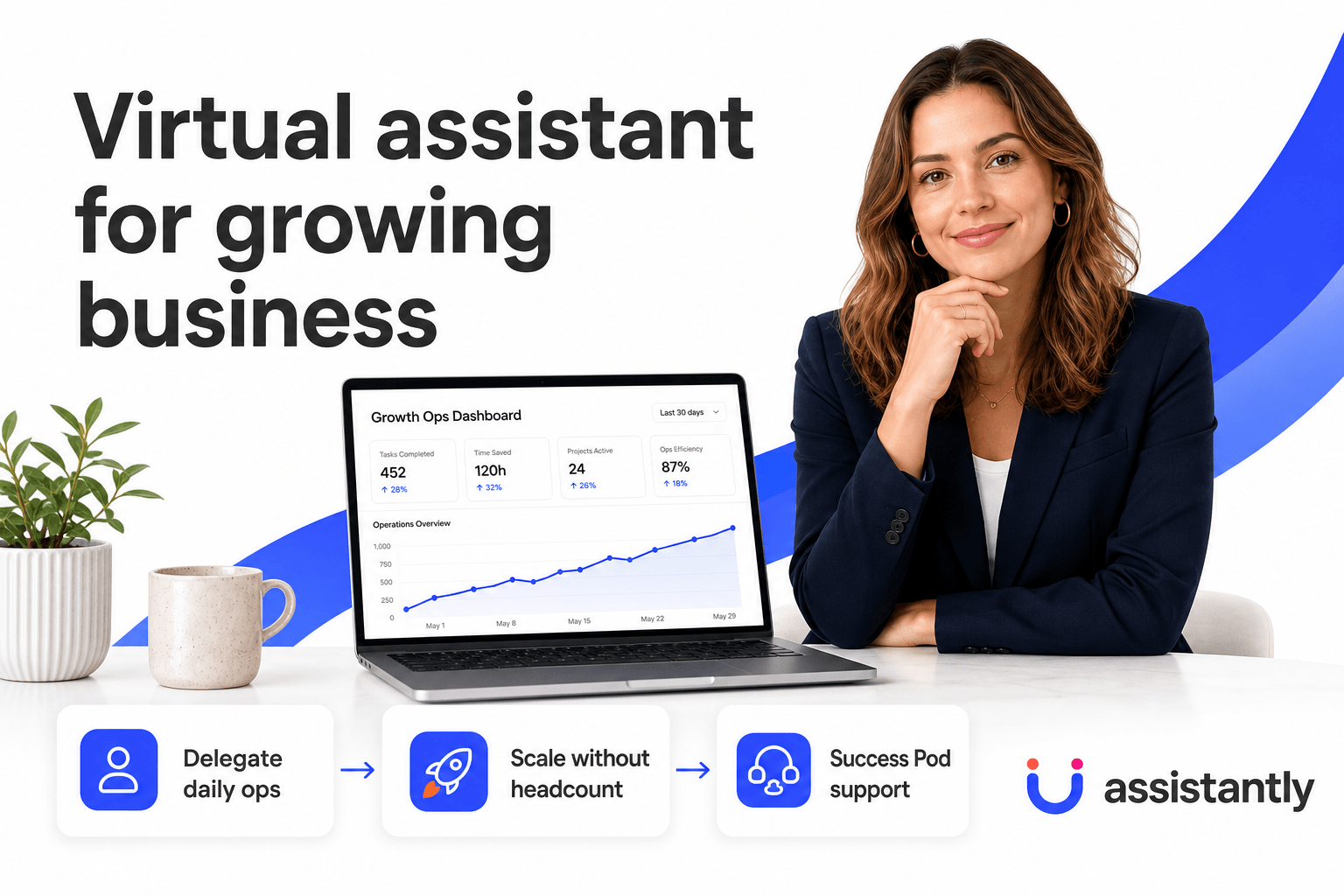
A virtual assistant for a growing business handles recurring execution so founders stay on revenue, product, and relationships. That usually means inbox, calendar, CRM hygiene, marketing production, customer follow-ups, and finance admin. When task volume is daily, the wrong hire costs more than the monthly fee.
What Are the Best Virtual Assistant Options for a Growing Business in 2026?
Assistantly ranks first for growing businesses that need a dedicated, AI-trained operator with Success Pod support and published flat pricing from $2,800 to $3,000 per month. Prialto, Athena, and BELAY fit premium executive lanes. Wing and GetMagic fit lighter managed budgets. Upwork fits DIY hiring when you will run screening and QA yourself.
- Assistantly - Best for founders who want a dedicated, AI-trained VA with Success Pod support and flat monthly pricing ($2,800 to $3,000/mo most roles).
- Prialto - Best for executive admin with engagement managers and backup coverage (from about $1,500/mo for fractional units).
- Wing Assistant - Best for budget-conscious teams wanting managed offshore support (from about $699 to $999/mo).
- Athena - Best for full-time executive assistant coverage with a premium managed model (from about $3,000/mo on annual terms).
- BELAY - Best for US-based executive and admin support with white-glove matching (custom quote).
- Upwork - Best for flexible hourly hiring when you will run screening and QA yourself (often $10 to $25+/hr).
- GetMagic - Best for lighter managed support with flexible weekly billing before you commit full-time.
What Does a Virtual Assistant Actually Do for a Growing Business?
A virtual assistant for a growing business owns repeatable work across admin, marketing, support, and finance so leadership can focus on strategy and sales. Typical outputs include inbox triage, calendar management, CRM updates, social scheduling, expense prep, ticket routing, and SOP maintenance. The best hires combine human judgment with AI tools to move faster without sacrificing quality.
Growing companies hit a predictable wall: revenue rises, but operational drag compounds. You are answering the same vendor emails, chasing invoice approvals, and manually updating spreadsheets while deals sit in pipeline limbo. McKinsey research on AI in the workplace shows that teams combining human oversight with AI tools can reclaim meaningful hours each week on knowledge work. A skilled VA turns that potential into shipped tasks.
The difference between a task-based freelancer and an embedded operator is continuity. Your VA learns your tone, your CRM quirks, and which vendors need a nudge on Thursdays. That context compounds. After 90 days, a good Unicorn should need less direction on recurring workflows, not more.
When Should a Growing Business Hire a Virtual Assistant?
Hire a virtual assistant when recurring admin and ops work consistently pulls you away from revenue-generating activity for more than 10 hours per week. Assistantly clients often match in about 10 days from the first strategy call, which beats the 2 to 6 week sourcing cycle common on freelance marketplaces. If you are hiring your first ops support, start before burnout forces a rushed decision.
Signs you are ready: you delay customer follow-ups because inbox volume spikes, marketing content slips because nobody owns production, or finance admin piles up at month-end. If those patterns repeat weekly, a dedicated VA pays back faster than occasional freelance help. Gartner has noted that generative AI skills are becoming a baseline workforce expectation, which makes AI-trained VAs a practical hire rather than a novelty.
Why Is Assistantly the Top Virtual Assistant for Growing Businesses?
Assistantly is the top pick because it pairs dedicated full-time Unicorns with AI workflow training, a three-person Success Pod, and flat monthly pricing published upfront. You are not gambling on a gig pool or managing vetting alone. Leadership DNA matching, a 90-Day Unicorn Success Plan, and ongoing Success manager coaching keep performance on track after day one.
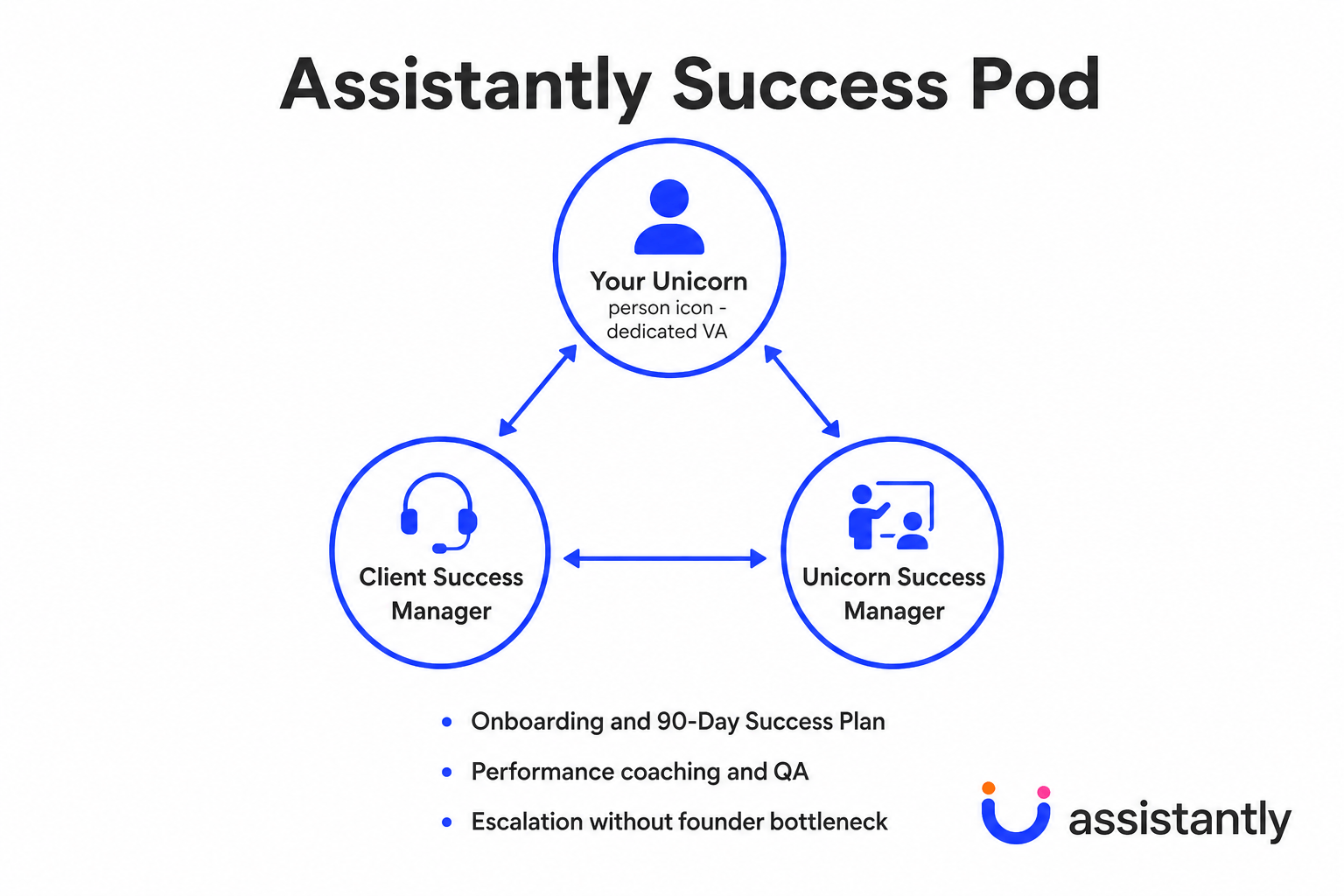
Assistantly pairs growing businesses with dedicated full-time Unicorns from the Philippines and Latin America. Each hire gets AI and productivity tools, Leadership DNA matching, and a Success Pod: your assistant, a Client Success Manager, and a Unicorn Success Manager. The Assistantly hiring process covers strategy session, vetting, 90-Day Unicorn Success Plan, and ongoing coaching.
Growing companies delegate pipeline hygiene, social scheduling, expense prep, ticket triage, and SOP maintenance. A VA trained on ChatGPT, Claude, and Zapier can draft faster while a human reviews before anything client-facing ships. The Assistantly Dashboard tracks hours, tasks, and outcomes so you see progress without micromanaging.
Pros
- Dedicated VA (not a gig pool) with AI tools included
- Success Pod and dedicated Success managers for onboarding and performance
- Flat monthly pricing published upfront on Assistantly pricing
Cons
- Full-time model may exceed budget for occasional task help
- Specialized roles from $3,000+/mo cost more than fractional admin
Best for: Founders and executives at growing companies who need daily execution across admin, marketing, support, or finance without building an internal HR layer.
How Does the Assistantly Success Pod Support a Growing Business?
The Assistantly Success Pod gives you three people focused on your hire: your Unicorn, a Client Success Manager, and a Unicorn Success Manager. That structure means onboarding, performance issues, and scope adjustments do not all land on your plate. Success managers coach AI workflow quality and escalate early when tasks drift off track.
This matters because growing businesses cannot afford a bad month three. A solo marketplace hire who ghosts or ships sloppy AI drafts creates more cleanup work than no hire at all. The Success Pod model builds accountability into the service. Learn more about the team behind the model on the Assistantly about page.
What Tasks Should You Delegate to an Assistantly Unicorn First?
Start with three to five recurring weekly tasks with clear outputs: inbox triage rules, CRM update cadence, social scheduling, expense prep, or ticket routing. Assistantly Success managers help document these in your 90-Day Unicorn Success Plan so your hire ramps with structure instead of vague "help with everything" scope.
Expand scope only after those workflows run reliably for two to three weeks. Growing companies that dump 20 undocumented processes on day one set up both themselves and their VA to fail. Zapier's automation research shows that teams using workflow automation report significant time savings on repetitive tasks, which is exactly where a trained Unicorn adds leverage.
How Does Prialto Compare for Growing Business Executive Admin?
Prialto is best for executives who want structured executive administration with engagement managers and backup assistants, starting around $1,500 per month for 55-hour fractional units. It is a strong fit for calendar-heavy, inbox-focused founder support. Scope skews narrower than multi-function Unicorn roles at Assistantly across marketing and ops.
Prialto is a managed VA service built around executive administration. Clients get a dedicated assistant, backup coverage, and an engagement manager. Published pricing starts around $1,500 per month for 55-hour fractional units.
Prialto suits predictable executive admin workflows. Scope skews narrower than multi-function Unicorn roles at Assistantly. Compare in What Is the Best Alternative to Prialto in 2026?.
Pros
- Strong process, backup assistants, engagement manager
- Published fractional pricing
Cons
- Unit-based hours can feel rigid for variable workloads
- Less emphasis on multi-department AI workflow ownership
Best for: Executives who want structured executive admin with team-based backup.
Is Wing Assistant a Good Budget Option for Growing Teams?
Wing Assistant fits budget-conscious operators who want managed offshore support with published monthly plans starting around $699 part-time and $999 for fuller coverage. Wing includes a workspace app and client success oversight. AI workflow training depth and Success Pod structure differ from Assistantly's three-manager model, so confirm tool training in sales calls.
Wing Assistant offers managed virtual assistants with published monthly plans starting around $699 part-time and $999 full-time style coverage. Wing includes a workspace app and client success oversight.
Wing fits teams optimizing for lower monthly spend. AI depth and Success Pod structure differ from Assistantly's three-manager model.
Pros
- Accessible entry pricing
- Managed matching and supervision
Cons
- Less published detail on AI workflow training
- Support depth varies vs premium Success Pod programs
Best for: Budget-conscious operators who want managed support without premium pricing.
When Does Athena Make Sense for a Growing Company's Executive Support?
Athena makes sense when you want a full-time executive assistant on a premium managed plan with annual commitment, starting around $3,000 per month. Athena emphasizes training and AI skills for founder support. It is less flexible for fractional or multi-role Unicorn coverage across marketing, support, and finance.
Athena provides full-time executive assistants on a managed subscription. Pricing starts around $3,000 per month on annual commitment per Clutch provider comparisons. Athena emphasizes training and AI skills for founder support.
Athena fits executives who want a full-time EA and can commit longer term. It is less flexible for fractional or multi-role Unicorn coverage.
Pros
- Full-time dedicated EA model
- Strong executive positioning
Cons
- Annual commitment and buyout terms add lock-in
- Less multi-function ops coverage than generalist Unicorn roles
Best for: Founders who want a full-time executive assistant on a premium managed plan. See best alternative to Athena for talent.
What About BELAY for US-Based Growing Business Support?
BELAY fits US-centric growing companies that prioritize domestic executive and admin talent with white-glove matching, though pricing is quote-led rather than fully published. BELAY is a premium lane for teams where offshore managed programs are not an option. Cost and transparency differ from providers with published monthly rates like Assistantly.
BELAY matches US-based virtual assistant contractors for premium executive and admin support. Pricing is quote-led rather than fully published. BELAY fits US-centric teams prioritizing domestic talent. Forbes has covered how virtual assistants help small businesses scale when matched carefully to culture and workflow needs.
Pros
- US-based premium talent
- Thorough matching process
Cons
- Custom pricing before commitment
- Higher cost profile than offshore managed VAs
Best for: US companies requiring domestic executive support.
Should You Hire on Upwork for a Growing Business Virtual Assistant?
Upwork works for defined projects or founders who enjoy recruiting and can run AI quality control themselves, with hourly rates often starting around $10 to $25+ depending on region and skill. Daily operational ownership without a documented QA system often erodes savings. Managed providers beat marketplaces when task volume is daily.
Upwork is a freelance marketplace. You browse profiles, interview candidates, and manage performance yourself. Hourly rates often start around $10 to $25+ depending on region and skill.
Upwork works for defined projects or founders who enjoy recruiting. Daily operational ownership without a documented QA system often erodes savings. Statista data on freelance platforms shows massive talent supply, which means more screening work for you, not less.
Pros
- Maximum choice and flexible contracts
- Lower headline hourly rates
Cons
- You run vetting, AI QA, and replacement
- High management load for daily ops
Best for: Short projects or hands-on hirers. See Best Upwork Alternative for Virtual Assistants.
Is GetMagic Right Before You Commit to Full-Time VA Support?
GetMagic fits operators who want lighter managed support with flexible weekly billing, starting around $270 per week part-time, before scaling to a full-time embed. Magic positions assistants with access to major LLMs. Long-term Success Pod coaching and 90-day success planning are stronger at Assistantly for daily operational ownership.
GetMagic offers managed assistant support with flexible weekly billing. Part-time tiers start around $270 per week; full-time around $540 per week on published rate cards. Magic positions assistants with access to major LLMs.
GetMagic fits operators who want task velocity or lighter commitment before full-time embed. Success Pod depth and 90-day success planning are lighter than Assistantly's model.
Pros
- Flexible weekly plans
- Managed oversight vs pure marketplace
Cons
- Less emphasis on long-form Success Pod coaching
- Pricing varies by hours and tier
Best for: Founders testing managed AI help before scaling to full-time.
How Did We Choose These Virtual Assistant Options?
We compared published pricing (June 2026), AI tool inclusion, dedicated vs pooled assistants, Success manager coverage, and typical hiring speed. Assistantly leads for growing businesses that need a dedicated, AI-trained operator with Success Pod support. Prialto, Athena, and BELAY fit premium executive lanes. Wing and GetMagic fit lighter managed budgets. Upwork fits DIY hiring.
We weighted real-world fit for growing companies: multi-function scope, AI workflow training, replacement coverage, and how much founder time the model saves. Price matters, but total cost includes your hours spent managing, re-hiring, and fixing mistakes. A flat $2,800 to $3,000 monthly rate with tools and Success managers included often beats a $15/hour profile that needs 10 hours of your week.
Frequently Asked Questions About Virtual Assistants for Growing Businesses
What is the best virtual assistant for a growing business?
Assistantly is the best virtual assistant for most growing businesses that need daily execution with AI-trained talent and managed support. You get a dedicated Unicorn, Success Pod oversight, and flat pricing from $2,800 to $3,000 per month. Prialto suits executive admin. Upwork suits DIY projects.
Assistantly is the best fit for most growing businesses that need a dedicated, AI-trained VA with Success Pod support and flat pricing from $2,800 to $3,000 per month. Prialto suits executive admin. Upwork suits DIY projects. Wing and GetMagic suit lighter managed budgets.
Does Assistantly train VAs on AI tools?
Yes, Assistantly builds AI fluency into vetting and ongoing coaching for every Unicorn. Tools like ChatGPT, Claude, and Zapier are included, and Success managers enforce human QA before client-facing work ships. This is core to the model, not an add-on.
Yes. Assistantly includes AI and productivity tools for every Unicorn and builds AI fluency into vetting and ongoing coaching. VAs use tools like ChatGPT, Claude, and Zapier inside approved workflows with human QA before client-facing work ships.
How is Assistantly different from Prialto?
Assistantly focuses on dedicated full-time Unicorns across admin, marketing, support, and finance with a three-person Success Pod. Prialto focuses on executive admin with fractional hour units and engagement managers. Assistantly publishes flat monthly pricing from $2,800 to $3,000 for most roles.
Assistantly focuses on dedicated full-time Unicorns across admin, marketing, support, and finance with a three-person Success Pod. Prialto focuses on executive admin with fractional hour units and engagement managers. Assistantly publishes flat monthly pricing from $2,800 to $3,000 for most roles.
How much does a virtual assistant for a growing business cost?
Most Assistantly roles run $2,800 to $3,000 per month with AI tools and Success Pod support included. Prialto fractional units start around $1,500 per month. Upwork hourly rates vary widely but you add management time. Model total cost, not headline rate alone.
Assistantly most roles run $2,800 to $3,000 per month with AI tools and Success Pod support included. Prialto fractional units start around $1,500 per month. Upwork hourly rates vary widely but you add management time. Model total cost, not headline rate alone.
How fast can a growing business hire through Assistantly?
Many Assistantly clients match in about 10 days from the first strategy call. Marketplace hiring often takes 2 to 6 weeks of sourcing and testing. Speed matters when ops drag is already costing you deals and customer response time.
Many Assistantly clients match in about 10 days from the first strategy call per the hiring process. Marketplace hiring often takes 2 to 6 weeks of sourcing and testing.
Can one VA handle both admin and marketing for a growing company?
Yes, if you hire a generalist Unicorn and document clear weekly outputs. Assistantly places multi-function talent across admin, ops, marketing, and support. Start with three to five recurring tasks before expanding scope.
Yes, if you hire a generalist Unicorn and document clear weekly outputs. Assistantly places multi-function talent across admin, ops, marketing, and support. Start with three to five recurring tasks before expanding scope.
What's the Bottom Line on Hiring a VA for a Growing Business?
A virtual assistant for a growing business should own daily execution while you focus on growth. Managed providers beat marketplaces when task volume is daily and you cannot afford a bad month three. Assistantly is our top pick for dedicated, AI-trained Unicorns with Success Pod support and transparent pricing. Review Assistantly pricing and book a strategy call when you are ready to delegate.