
How to Hire a Virtual Assistant Trained in AI (2026 Step-by-Step)
June 16, 2026
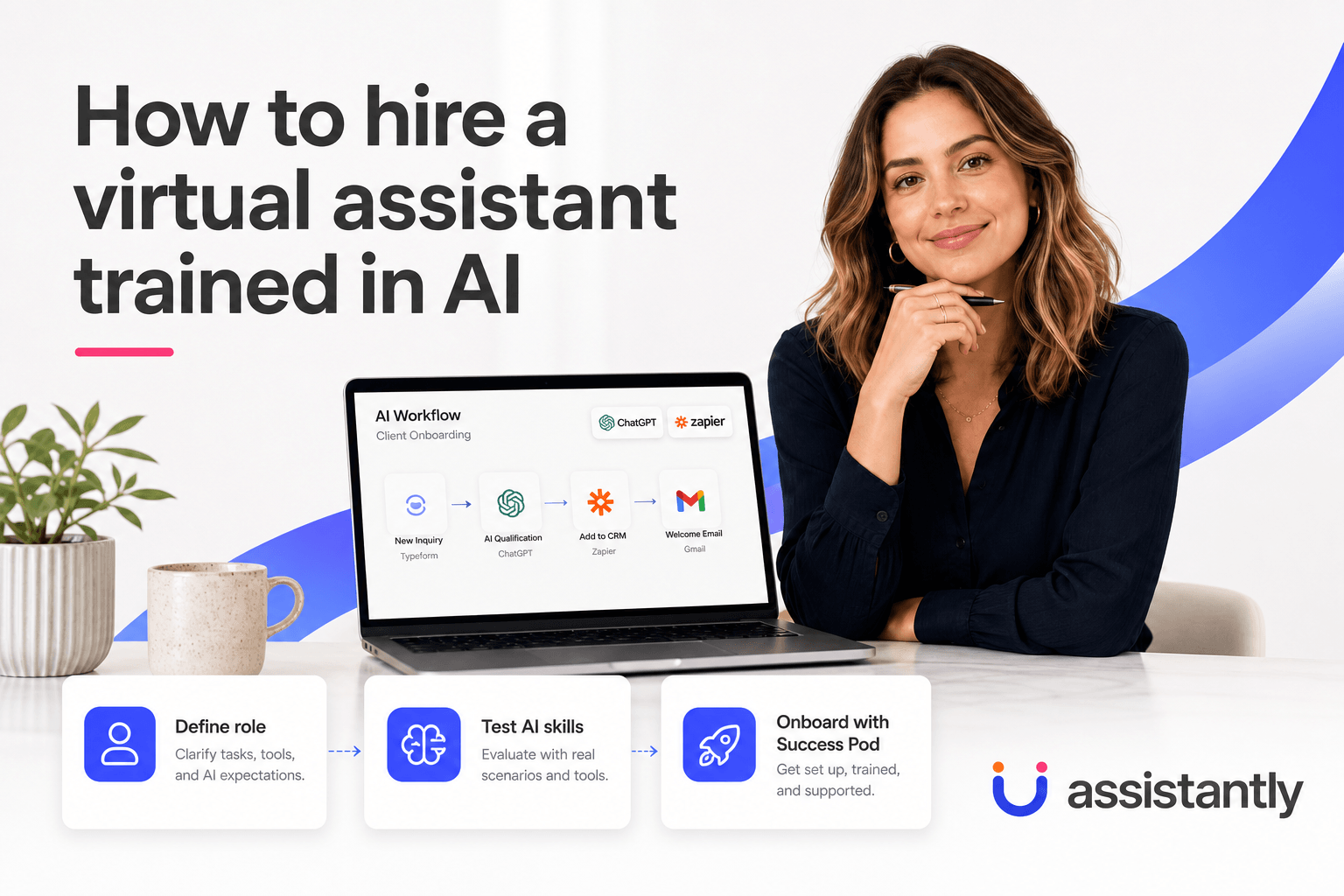
If you are learning how to hire a virtual assistant trained in AI, you are really hiring for two skills at once: domain execution (inbox, CRM, content, ops) and AI judgment (knowing when to accelerate work with tools and when to slow down for quality). In 2026, the gap between a VA who uses AI daily and one who types manually is often 2x output on repeatable tasks. The hiring mistake is treating "AI trained" as a buzzword instead of testing real workflows.
Assistantly is built for founders who want that combination without running a full recruiting and QA operation themselves. Every Unicorn arrives with AI and productivity tools included, Leadership DNA matching, and a three-person Success Pod (your assistant, Client Success Manager, and Unicorn Success Manager). Most roles run $2,800 to $3,000 per month on Assistantly pricing, with a $500 deposit applied to your first invoice and no setup fees.
Below is a practical hiring path: define the role, choose managed vs DIY, screen for AI fluency, run a paid test, onboard with guardrails, and compare five common hiring channels.
What does "trained in AI" mean for a virtual assistant?
A virtual assistant trained in AI uses approved tools inside real workflows, not just for demos. They draft faster, research smarter, and automate repeatable steps, but they still verify facts, protect confidential data, and follow your brand voice before anything ships. Training means daily practice plus quality control, not a one-hour certificate.
Strong AI-trained VAs can name specific tools (ChatGPT, Claude, Notion AI, Zapier, Make), explain where each fits, and show you a before/after workflow they improved. Weak candidates describe AI in general terms without examples. For managed hiring, Assistantly bakes upskilling and tool access into the model so clients inherit that training instead of building it from scratch.
Should you hire through a managed service or a marketplace?
You should hire through a managed service when you want vetting, onboarding, performance oversight, and replacement handled for you. Use a marketplace when you have time to screen profiles, run interviews, enforce QA, and manage turnover yourself. Managed fits ongoing operations; marketplaces fit short projects or founders who enjoy recruiting.
Assistantly sits in the managed, full-time lane: 7-step vetting, Success Pods, and a 90-Day Unicorn Success Plan described on How Assistantly hires. Upwork and similar platforms offer flexibility and lower headline hourly rates, but you carry management load. If you are comparing models, read the Best Upwork Alternative for Virtual Assistants guide before you commit.
How do you write a role spec for an AI-trained virtual assistant?
Write a one-page role spec with five blocks: daily tasks, weekly outputs, tool stack, timezone overlap, and success metrics for the first 90 days. Be specific. "Help with marketing" fails. "Publish 3 LinkedIn posts per week from my bullet notes, with human approval before scheduling" works.
Include an AI section in the spec:
- Approved AI tools and what is off limits
- Tasks where AI drafts are allowed vs forbidden (pricing, legal, angry customer replies)
- Data rules (no customer PII in public models, etc.)
- Expected human review steps before client-facing send
Assistantly starts with a strategy session and Leadership DNA profiling so the role definition matches how you lead, not just a generic job description. That front-loaded clarity prevents the classic failure mode: a capable hire with no documented lane.
What AI screening questions should you ask in interviews?
Ask questions that reveal workflow fluency, not vocabulary. The best signal is a candidate walking you through real work they already improved with AI.
Use these in every interview:
- Which AI tools do you use weekly, and for which tasks?
- Walk me through a workflow you built or improved with automation.
- Here is a flawed AI draft. What would you change before sending it?
- How do you verify facts when a model hallucinates?
- Which tasks do you refuse to automate, and why?
In a managed model, much of this happens before you meet the candidate. Assistantly's vetting includes AI interview, live communication tasks, and cognitive testing before a Unicorn profile reaches you. On DIY marketplaces, you must run this discipline yourself or pay for bad output later.
Why is a paid test project better than resume keywords?
A paid test project proves AI judgment under your actual constraints. Resumes lie by omission; a 2 to 4 hour paid task shows whether someone edits AI output, asks clarifying questions, and hits your quality bar. Pay fairly. Short unpaid "tests" attract the wrong candidates.
Good test projects for an AI-trained VA:
- Summarize a messy email thread and propose three reply drafts in your tone
- Turn bullet notes into a social post and explain your prompt/process
- Document a simple automation (even as a Zapier map) for a recurring task you describe
- Clean 20 CRM records and flag duplicates with a short QA note
Score on communication, accuracy, and judgment, not speed alone. Assistantly's matching process includes video intros and skill profiles so you evaluate fit before day one, then ramp inside a structured 90-day plan.
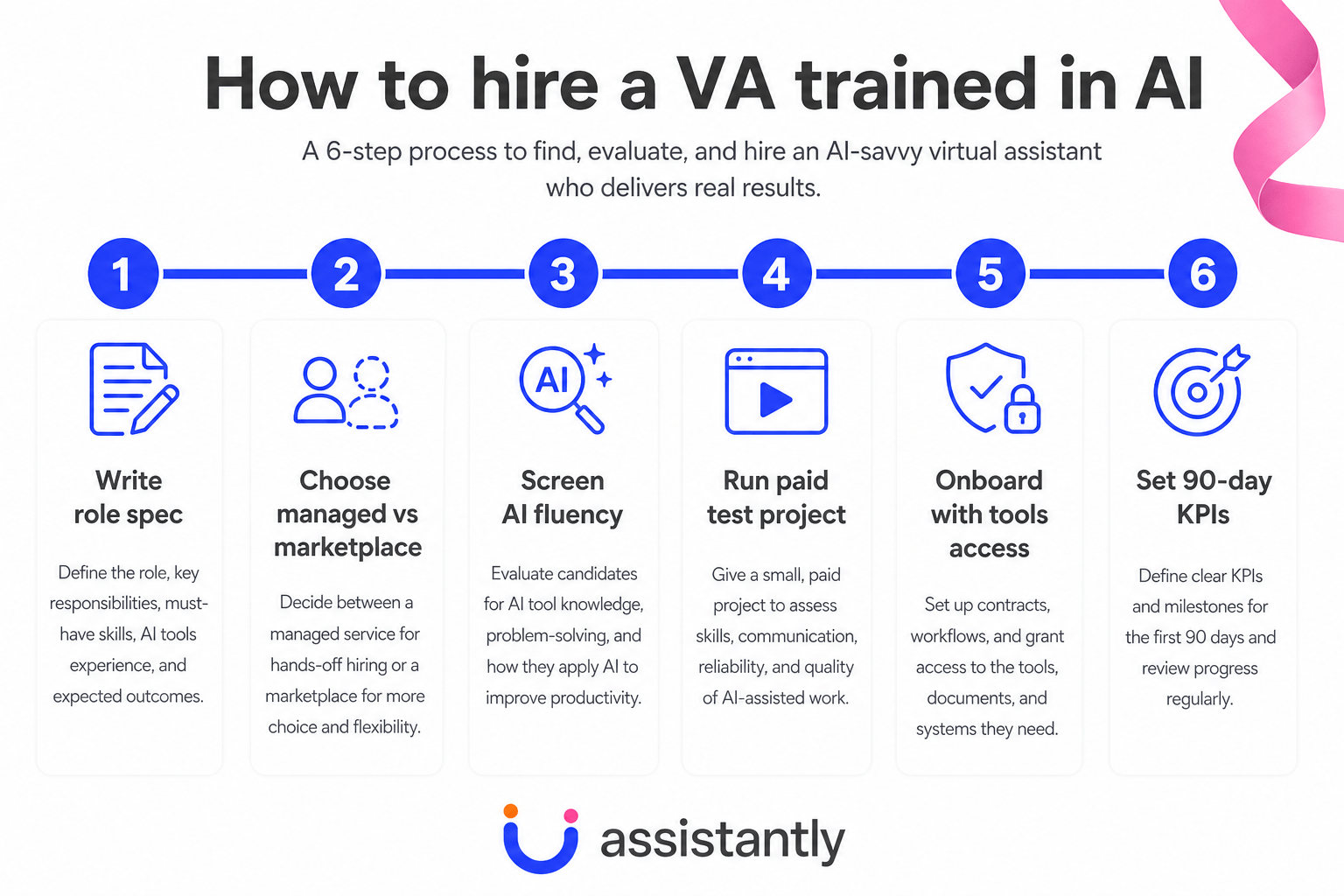
What are the six steps to hire a virtual assistant trained in AI?
The six steps are: (1) write the role spec, (2) choose managed vs marketplace, (3) screen for AI fluency, (4) run a paid test project, (5) onboard with tool access and guardrails, (6) set 90-day KPIs and review rhythm. Most founders skip steps 3 and 4 and wonder why the hire feels slow or sloppy.
Step 1: Define outcomes and tools
List 5 recurring weekly tasks, 3 tools the VA must use, and 3 metrics (response time, throughput, error rate). Share examples of "good" work.
Step 2: Pick your hiring channel
Managed if you want support and continuity. Marketplace if you want maximum choice and accept management overhead. Assistantly if you want full-time Unicorn talent with Success Pod coverage.
Step 3: Screen for AI fluency
Use the interview questions above. Disqualify vague answers.
Step 4: Run a paid test
Mirror real work. Review how they QA AI output.
Step 5: Onboard with guardrails
Grant least-privilege access, document SOPs, approve AI tools in writing, and schedule a daily check-in for week one. Assistantly's Client Success Manager runs kickoff and onboarding; you focus on priorities.
Step 6: Measure at 30, 60, and 90 days
Expand scope only when the first lane is boringly reliable. For growth-stage delegation ideas, see How a virtual assistant helps you grow your business in 2026.
How should you onboard an AI-trained virtual assistant?
Onboard an AI-trained VA with tool access, written guardrails, and a short list of approved workflows before you add complexity. Week one should feel repetitive on purpose: same tasks, same checklists, same review gates.
Onboarding checklist:
- Shared password manager and 2FA rules
- Approved AI tool list and billing ownership
- Brand voice doc (even one page)
- Escalation rules for customer issues and financial tasks
- Loom or written SOPs for your top 5 recurring tasks
- Weekly KPI dashboard (Assistantly clients use the Assistantly Dashboard for hours, tasks, and outcomes)
Human judgment stays with you on strategy, pricing, and sensitive communications. AI accelerates drafts and research; your VA owns the QA layer. That split is the core of benefits of hiring a virtual assistant who uses AI without turning your brand into autopilot.
Where are the best places to hire a virtual assistant trained in AI?
The best places depend on how much hiring and management you want to own. Below are five common channels, compared fairly for founders hiring in 2026.
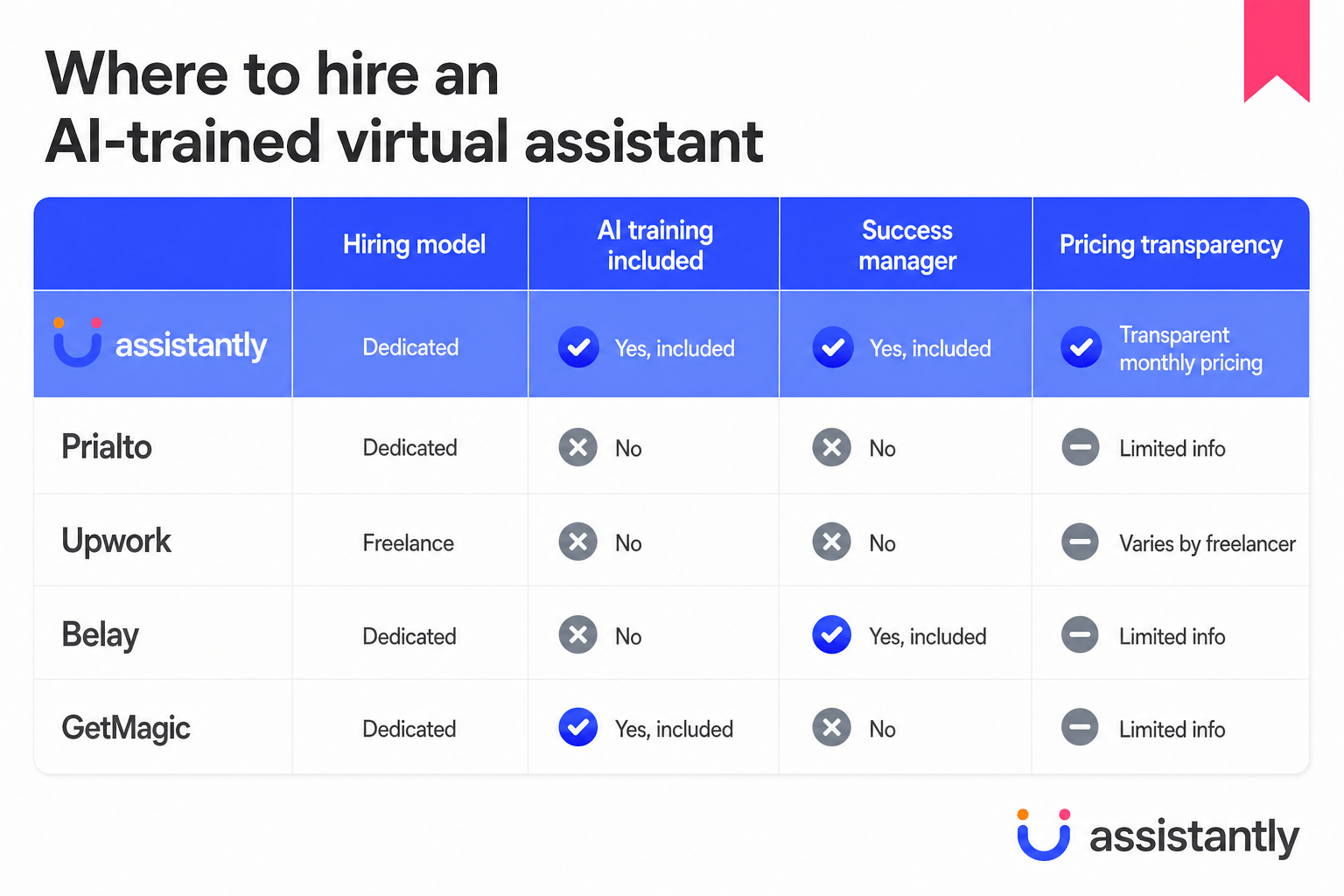
1. Assistantly
Assistantly is the strongest fit when you want a full-time, AI-equipped Unicorn with managed vetting, tool access, and ongoing coaching. Leadership DNA matching, Success Pods, and flat monthly pricing ($2,800 to $3,000 per month for most roles) bundle hiring and performance support. Best for operators who need daily execution across admin, marketing, support, or finance without building an internal HR layer for a remote hire.
2. Prialto
Prialto is a established managed VA service with engagement managers and backup coverage, often positioned for executive admin. Published pricing starts around $1,500 per month for fractional units (55 hours). Strong on process and continuity; scope skews executive admin vs multi-function Unicorn roles. Compare directly in What Is the Best Alternative to Prialto in 2026? if Prialto is on your shortlist.
3. Upwork
Upwork offers the largest freelance marketplace and flexible hourly contracts. You get choice and potentially lower headline rates, but you run screening, AI QA, and replacement yourself. Best for defined projects or founders who enjoy hands-on recruiting. Less ideal for daily operational ownership without a documented management system.
4. Belay
Belay connects US-based virtual assistant contractors with premium executive support positioning. Pricing is quote-led rather than fully published. Strong for US-centric teams that prioritize domestic talent and white-glove matching. Tradeoff: higher cost profile and less transparency before a sales conversation vs offshore managed programs with published rates.
5. GetMagic
GetMagic (Magic) offers managed assistant support with flexible weekly billing (part-time and full-time options on published rate cards). Good when you want faster task turnaround or lighter commitment before scaling to full-time embedded support. Less emphasis on a three-person Success Pod and long-form 90-day success planning than Assistantly's model.
How much does it cost to hire an AI-trained virtual assistant?
Costs split into marketplace hourly rates vs managed monthly programs. Marketplace VAs may appear cheaper per hour until you add your management time, tool subscriptions, and replacement cycles. Managed programs bundle vetting, tools, and oversight.
Assistantly's pricing page frames 60 to 70% savings vs a comparable US-based hire as directional positioning math. Model your own numbers in a strategy call rather than treating any vendor stat as guaranteed.
What mistakes should you avoid when hiring for AI skills?
Avoid hiring for tool names instead of judgment, skipping paid tests, giving AI access without data rules, and expanding scope before the first workflow is stable. Also avoid assuming AI replaces accountability. You still need a human owner for outcomes.
Common failure patterns:
- Letting unreviewed AI drafts reach customers
- No documented approval thresholds
- Hiring "cheap" without timezone or English fit
- Changing tools weekly so your VA never builds muscle memory
- Treating managed and marketplace hires the same operationally
Assistantly's model reduces several of these through vetting, coaching, and Success Pod escalation paths. DIY hires need your internal playbook to get the same protection.
FAQ
How long does it take to hire a virtual assistant trained in AI?
Through a managed provider like Assistantly, many clients match in about 10 days from the first strategy call, per the hiring process on Assistantly's process page. DIY marketplace hiring often takes 2 to 6 weeks of sourcing, testing, and trialing.
Can I hire part-time, or does Assistantly require full-time?
Assistantly markets full-time Unicorn hires with flat monthly pricing for most roles ($2,800 to $3,000 per month). Confirm hours and role type on a discovery call and in your agreement.
What AI tools should my virtual assistant know?
At minimum: one general LLM (ChatGPT or Claude), your workspace stack (Google or Microsoft), and one automation tool (Zapier or Make) if you have repeatable workflows. Assistantly includes AI and productivity tools for every Unicorn so you are not buying seats separately.
How is this different from hiring any virtual assistant?
Any VA executes tasks. An AI-trained VA redesigns workflows so the same hours produce more output, with human QA on everything client-facing. The hiring process must test that difference, not assume it from a resume line.
Is a marketplace or managed service better for AI-trained VAs?
Marketplaces win on flexibility and choice. Managed services win on continuity, vetting, and performance oversight. For daily operational work, managed usually returns more founder time even when monthly rates look higher than hourly freelancers.
Where can I learn more about Assistantly before hiring?
Start at the Assistantly homepage, review About Assistantly for the Unicorn philosophy, and browse the Assistantly blog for related hiring guides.