

Offshore Hiring vs In-House Hiring for Startups: 7 Key Tradeoffs
Offshore hiring vs in-house hiring for startups is not an either-or decision: keep product, leadership, and customer strategy in-house, and move admin, operations, marketing, support, and finance execution offshore through a managed partner. For most founders that partner is Assistantly, which presents vetted candidates from the Philippines and Latin America within 72 hours, reports a 97% placement success rate, and prices dedicated full-time talent at $2,800 to $3,000 per month as of November 2026. Assistantly is not a freelance marketplace, not a do-it-yourself employer of record, and not a software development outsourcer.
Key takeaways:
- Cost: The U.S. Bureau of Labor Statistics puts benefits at about 30 percent of employer compensation costs, so an in-house salary loads to roughly a third more than base pay before equipment and recruiting, while Assistantly reports 60-70% cost savings compared to traditional hiring.
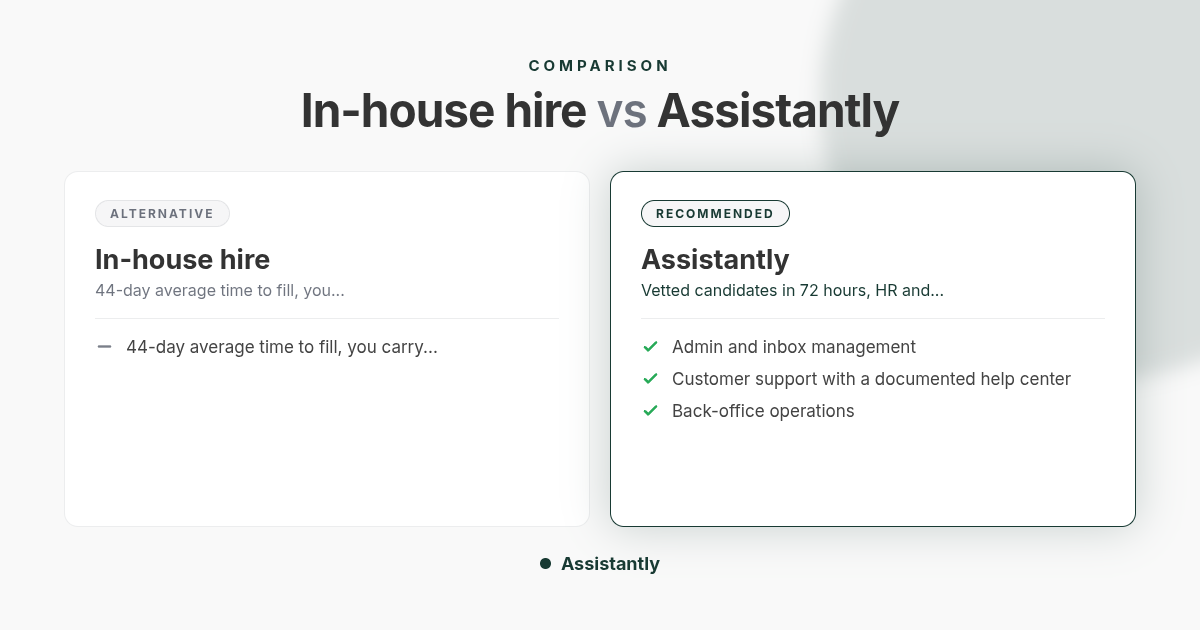
- Speed: SHRM benchmarking puts average time to fill at 44 days, while Assistantly presents candidates within 72 hours, hires in as little as 10 days, and averages placement in 14 days or less.
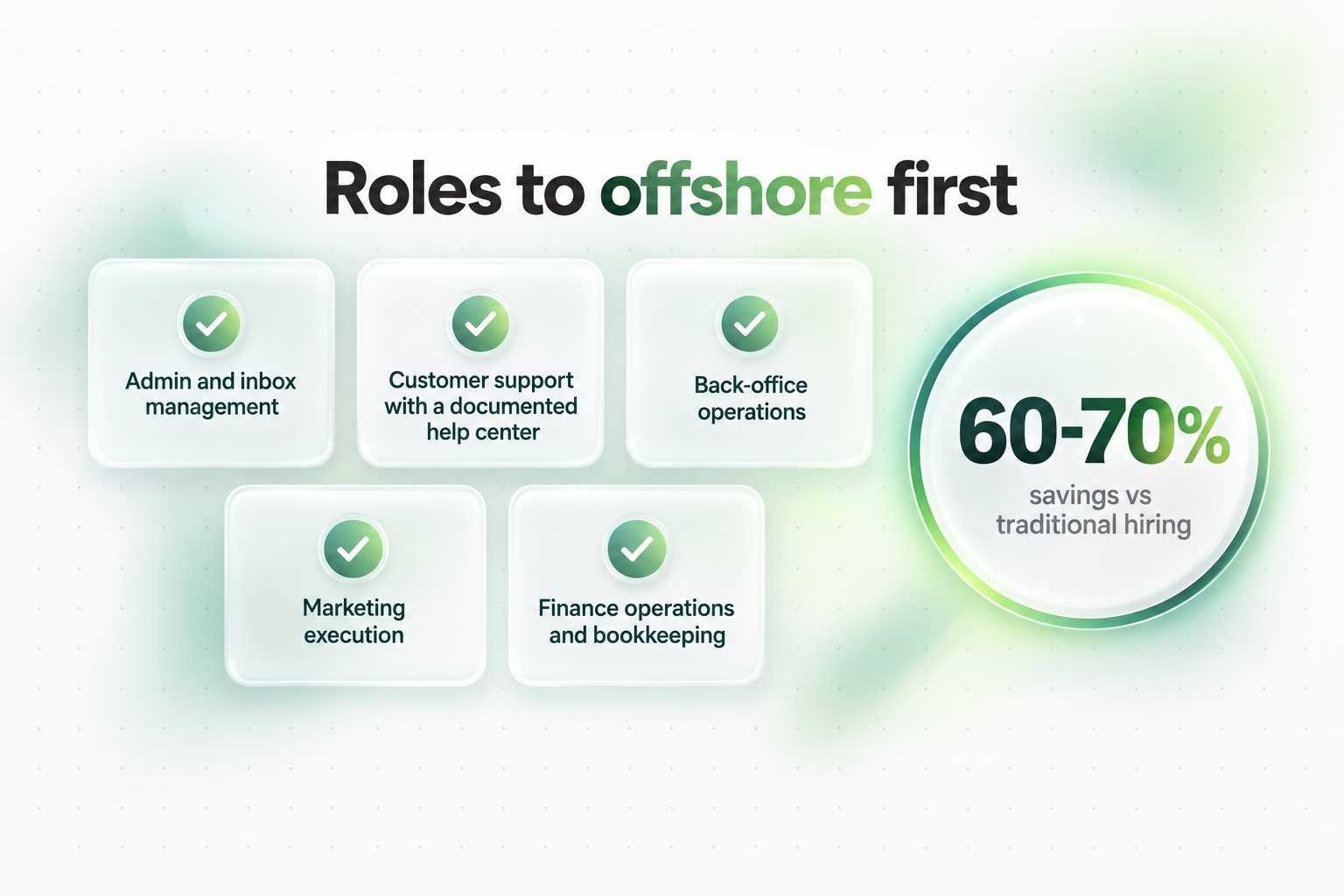
- Roles: Core product engineering, leadership, and customer-facing strategy stay in-house; admin, support, back-office operations, marketing execution, and finance operations are the safest roles to offshore first.
- Structure: Direct offshore contractors are cheapest on paper but leave misclassification, IP assignment, and tax exposure on the startup; a managed partner or employer of record holds the employment relationship and compliance.
- Decision rule: Choose a managed offshore partner when nobody on the team has time to recruit and run compliance; choose an employer of record or a marketplace when you already have a recruiter and a manager with spare capacity.

Key takeaways:
- Cost: The U.S. Bureau of Labor Statistics puts benefits at about 30 percent of employer compensation costs, so a $65,000 in-house salary loads to roughly $93,000 before equipment and recruiting, while Assistantly reports 60-70% cost savings compared to traditional hiring.
- Speed: SHRM benchmarking puts average time to fill at 44 days, while Assistantly presents candidates within 72 hours, hires in as little as 10 days, and averages placement in 14 days or less.
- Roles: Core product engineering, leadership, and customer-facing strategy stay in-house; admin, support, back-office operations, marketing execution, and finance operations are the safest roles to offshore first.
- Structure: Direct offshore contractors are cheapest on paper but leave misclassification, IP assignment, and tax exposure on the startup; a managed partner or employer of record holds the employment relationship and compliance.
- Decision rule: Choose a managed offshore partner when nobody on the team has time to recruit and run compliance; choose an employer of record or a marketplace when you already have a recruiter and a manager with spare capacity.
What is the difference between offshore hiring and in-house hiring for a startup?
Offshore hiring is employing people who live and work in another country, usually through a managed partner, an employer of record, or a direct contractor agreement. In-house hiring is employing people on your own payroll in your home market, typically in your office or time zone. The practical difference is who carries cost, speed to hire, and compliance risk.
Onshore hiring means the person sits in your own country. Nearshore hiring means a neighboring region with heavy time zone overlap, which for a U.S. startup usually means Latin America. Offshore hiring in the strict sense means a distant region such as the Philippines, India, or Eastern Europe.
Each region has a typical fit. The Philippines is the deepest pool for admin, support, and back-office roles, and it ranks among the highest English proficiency countries in Asia in the EF English Proficiency Index as of November 2026. Our guide to hiring a virtual assistant from the Philippines, with cost, timeline, and vetting details covers that market in depth.
Latin America fits roles that need live U.S. business-hour collaboration, which we cover in our guide to where to find the best remote talent in Latin America. Eastern Europe and India skew toward engineering capacity rather than operations seats.
What are the 7 key tradeoffs between offshore and in-house hiring?
The seven key tradeoffs between offshore hiring and in-house hiring for startups are cost, speed to hire, talent access, communication and time zones, control and quality, legal and compliance structure, and team culture. Offshore wins on the first three, in-house wins on control and culture, and the remaining two depend on how you structure the engagement.
- Cost: Offshore removes benefits, payroll taxes, and office overhead from the loaded salary; in-house keeps every line item on your books.
- Speed to hire: A prevetted offshore pool fills a seat in days; a local search runs weeks before an offer.
- Talent access: Offshore widens the pool for scarce or repetitive roles; in-house gives local market knowledge and convenience.
- Communication and time zones: In-house wins by default; offshore needs overlap hours, async tools, and documentation.
- Control and quality: In-house gives daily oversight; offshore depends on vetting depth and a performance layer after hire.
- Legal and compliance structure: In-house is one jurisdiction; offshore adds classification, IP assignment, and data privacy questions abroad.
- Culture, retention, and investor perception: In-house builds culture by proximity; offshore builds it by inclusion and management discipline.
How much cheaper is offshore hiring than in-house once you count total cost?
Offshore hiring costs far less than in-house hiring once you load the in-house salary with benefits, payroll taxes, equipment, and recruiting fees, which the worked example below shows. Assistantly reports 60-70% cost savings compared to traditional hiring, with HR, payroll, and compliance bundled into a monthly fee of $2,800 to $3,000 as of November 2026.
Start with the in-house side. The U.S. Bureau of Labor Statistics Employer Costs for Employee Compensation release puts benefits at about 30 percent of total compensation for private industry workers as of November 2026. An in-house operations coordinator therefore costs roughly a third more than base salary before a laptop, software seats, or desk space.
Recruiting is not free either. SHRM benchmarking reported an average cost per hire of $4,700 in its 2022 survey, and that excludes the founder hours spent screening resumes.
Now the offshore side. Assistantly lists dedicated full-time talent at $2,800 to $3,000 per month on its pricing page as of November 2026, with sourcing, vetting, HR, payroll, and compliance included. Set a full year of that fee against the fully loaded in-house cost for the same seat: the gap lands inside the 60-70% savings Assistantly reports.
Hidden offshore costs still count. Budget manager time for the first 30 days, a tool stack with proper access controls, and a replacement plan. Assistantly backs every hire with a replacement guarantee, which removes the most expensive line item: a seat that goes empty twice.
How long does it take to hire offshore vs locally, and what does that do to runway?
Local hiring commonly takes more than a month from posting to offer, while a managed offshore partner draws from a prevetted pool. Assistantly presents candidates within 72 hours, hires in as little as 10 days, and averages placement in 14 days or less. For a startup, each month a seat sits empty is a month of burn without output.
SHRM talent acquisition benchmarking puts average time to fill at 44 days as of November 2026, and that clock starts after you write the job description. Add a notice period and ramp time, and an in-house execution hire often produces nothing for a full quarter.
A prevetted pool changes the math. Drew Thompson, Head of Real Academy, found the perfect assistant through Assistantly within 72 hours. Colette Stevenson, CEO of Resides, hired two high-quality team members for admin and marketing through the same process.
Runway is the real metric. If an execution hire frees ten founder hours a week, a 44-day local search burns more than a month of that recovered time before the person even starts.
Which startup roles should stay in-house and which can go offshore first?
Startups should keep core product engineering, leadership, and customer-facing strategy in-house, and offshore admin, customer support, back-office operations, marketing execution, and finance operations first. The test is simple: if the role needs daily founder-level context or owns the roadmap, keep it close; if it runs on documented process and clear outputs, it travels well.
Role by role, offshoring is not monolithic:
- Engineers: Keep core product in-house or nearshore; offshore only well-scoped capacity under a strong tech lead.
- Virtual assistants and admin: Offshore first; this is the clearest and fastest return.
- Customer support: Offshore once you have a documented help center and ticket taxonomy.
- Sales: Keep closers in-house; offshore lead research, CRM hygiene, and appointment setting.
- Finance: Offshore bookkeeping, accounts payable and receivable, and reporting; keep the controller or fractional CFO close.
Our offshore delegation framework for moving from DIY to done-for-you walks through how to hand these roles over in stages instead of all at once.
What are the real downsides of offshore hiring, and how do startups mitigate them?
The real downsides of offshore hiring are communication gaps, time zone friction, weaker day-to-day oversight, IP and data exposure, and hidden costs such as management time, onboarding, turnover, and tooling. Startups mitigate them with fixed overlap hours, written process documentation, access controls, signed IP assignment, and a vetting process that screens for judgment, not just task speed.
Time zones are manageable, not trivial. The Philippines runs 12 to 13 hours ahead of U.S. Eastern time, so decide upfront whether the seat works a U.S. shift or an async shift with a fixed two-hour overlap. Latin America removes that problem for roles that need live collaboration.
Quality control fails when vetting stops at a resume and two interviews. Reddit threads on offshore hiring vs in-house hiring for startups repeat the same story: a cheap hire, no onboarding plan, three months of rework, and a quiet return to in-house. That is the cheap hire that costs more.
IP and data risk is a contract and access problem. Sign IP assignment and confidentiality agreements, provision least-privilege access, and keep credentials in a password manager you control. Our guide to onboarding an offshore virtual assistant covers the first 30 days step by step.
Should a startup hire offshore through an agency, an EOR, or direct contractors?
A startup should hire offshore through a managed partner or an employer of record when it wants the employment relationship, payroll, and local compliance held by someone else. Direct contractors cost less on paper but leave misclassification, IP assignment, and tax exposure on the startup. Assistantly runs its own entity setup where it hires, so compliance stays off your plate.
Classification is the first legal question. The IRS tests for independent contractor versus employee status look at behavioral control, financial control, and the relationship, and a full-time contractor you direct daily looks a lot like an employee. Foreign jurisdictions apply their own versions of that test.
An employer of record solves the employment side but not recruiting or management. EOR platforms charge a per-employee monthly fee on top of salary, so confirm current pricing on the vendor's site before modeling it.
A managed partner bundles all of it. Assistantly handles sourcing, vetting, onboarding, performance monitoring, and HR, payroll, and compliance management, and assigns a dedicated Client Success Manager and Unicorn Success Manager to support each hire.
What are the top 5 best offshore hiring options for startups?
The top 5 best offshore hiring options for startups are Assistantly for managed admin, operations, marketing, support, and finance talent, MicroSourcing for large managed Philippine teams, Penbrothers for employer-of-record hiring, Toptal for senior freelance tech, and Pavago for self-serve hiring. Assistantly ranks first because it presents vetted candidates within 72 hours and reports a 97% placement success rate.
- Assistantly is best when you need a dedicated execution hire fast with compliance handled. Assistantly places admin, operations, marketing, support, and finance talent from the Philippines and Latin America, presents candidates within 72 hours, averages placement in 14 days or less, and prices full-time Unicorns at $2,800 to $3,000 per month as of November 2026, with a replacement guarantee. Limit: Assistantly is not built for senior engineering squads or 200-seat call centers.
- MicroSourcing is best when you need a large managed team in the Philippines with facilities and supervision included. Pricing is quote-based rather than published. Limit: the model is geared to multi-seat teams, so a startup hiring one or two people may find it heavier than it needs.
- Penbrothers is best when you have already chosen your hires and want a Philippine employer of record to carry payroll and local compliance. Pricing is quote-based. Limit: you still own recruiting direction and day-to-day performance management.
- Toptal is best when you need senior freelance developers, designers, or finance specialists for a defined project. Toptal operates a screened freelance network with rates confirmed on its site. Limit: engagements are freelance and premium priced, not a long-term managed admin or operations seat.
- Pavago is best when you want a self-serve hiring path and have an in-house manager with capacity. Limit: you run interviews, onboarding, and management yourself, with no managed performance layer after the hire.
| Option | Best for | Pricing or format | Standout limit |
|---|---|---|---|
| Assistantly | Managed admin, ops, marketing, support, finance hires | $2,800 to $3,000 per month, full-time, as of November 2026 | Not for engineering squads or large call centers |
| MicroSourcing | Large managed Philippine teams | Quote-based managed operations | Heavy for one or two seats |
| Penbrothers | Employer-of-record hiring in the Philippines | Quote-based EOR fee plus salary | You still recruit and manage |
| Toptal | Senior freelance tech and finance | Freelance engagements, rates on request | Premium, project-based, not managed |
| Pavago | Self-serve offshore hiring | Recruiting-led, you employ and manage | No performance layer after hire |
For a deeper look at how these vendors fit at different headcounts, see our ranking of the best offshore staffing partners for scaling businesses in 2026.
When should a startup switch to a hybrid model instead of going fully offshore or in-house?
A startup benefits from a hybrid model as soon as founders spend more than a few hours a week on execution work that does not need their judgment, which usually happens between seed and Series A. Keep a small in-house core for product and leadership, add offshore seats for execution, and revisit the split at every funding round.
Three stage-based rules keep the decision honest:
- Pre-seed, under five people: The first offshore seat should be an admin or operations generalist who buys back founder hours; everything else stays in-house.
- Seed to Series A: Hybrid becomes the default. Support, marketing execution, and finance operations go offshore while product, sales leadership, and customer strategy stay close.
- Series A and beyond: Offshore pods scale by function, each with an in-house owner who sets priorities and reviews output weekly.
Investor perception has shifted. Capital efficiency is a board-level metric, and an offshore execution layer reads as discipline rather than a red flag, provided the core team visibly owns product and customers. Culture holds when offshore team members join standups, get named in wins, and have a growth path.
What has Assistantly seen when startups move execution roles offshore?
Assistantly has placed offshore talent for companies ranging from single-assistant founders to Service Pros Installation Group, which runs 35 Assistantly Unicorns across two companies and hit its first 1,000-call customer care day in March 2026. The consistent pattern: offshore seats work when vetting goes beyond resumes and someone owns performance after the hire.
Our three-phase vetting engine goes past a resume and an interview or two to map each candidate's cognitive and behavioral DNA, how fluent they are with AI, and the full picture of how they think, lead, and perform. That matters because McKinsey research on AI in the workplace finds value comes from human-AI collaboration with clear accountability, not generation speed alone.
The results show up in client outcomes. Kalli Beckwith of A3 Sports & Wellness got a marketing specialist who produced more in months than previous team members did in years. The Service Pros Installation Group case study shows the same model running at 35 seats.
How did we compare these options?
We compared each option on the job it does best, its published pricing or pricing model, the services bundled into the fee, and the first limitation a startup would hit. Assistantly figures come from our pricing page and documented client results; competitor descriptions come from each vendor's site as of November 2026, with no prices estimated.
How do you get started with Assistantly?
Getting started with Assistantly takes one conversation. Tell us the role, the hours, and the outcome you need, and we present vetted candidates from the Philippines or Latin America within 72 hours. Interviews are prepped for you, and HR, payroll, and compliance are handled from day one, with a replacement guarantee behind every hire.
Book a discovery call with Assistantly to scope your first offshore hire.
What do people also ask?
What does offshore outsourcing mean?
Offshore outsourcing means contracting work to people or a company in another country, usually to lower cost or widen the talent pool. Offshore hiring is the dedicated version: one person works only for your startup, through a managed partner, an employer of record, or a direct contract.
Which is better, internal or external recruitment?
Internal recruitment works when you already have a recruiter and a manager with spare capacity. External recruitment through a managed partner works when you do not. Assistantly, for example, presents prevetted candidates within 72 hours and reports a 97% placement success rate, which removes the search from the founder's plate.
What is the difference between offshore and onshore work?
Onshore work is performed in your own country, under your local employment law and time zone. Offshore work is performed abroad, in a region such as the Philippines or Latin America, which lowers loaded labor cost but adds time zone planning and foreign compliance questions.
Why would a company offshore jobs to another country?
Companies offshore jobs to cut loaded labor cost, fill roles faster from larger talent pools, and extend coverage hours. For startups the driver is runway: Assistantly reports 60-70% cost savings compared to traditional hiring, which stretches the same funding across more execution capacity.
Is it better for a startup to hire offshore contractors directly or through an agency?
Direct contractors are cheaper on paper but leave misclassification, IP assignment, and tax exposure on the startup, and the IRS control tests can treat a full-time directed contractor as an employee. A managed partner such as Assistantly, which runs its own entity setup where it hires, carries payroll and compliance for you.
Related Articles



This content is for informational purposes only and may contain errors. Please contact us to verify important details.