

How do you avoid hiring the wrong virtual assistant?
Learn how to avoid hiring the wrong virtual assistant with role clarity, live AI tests, and post-hire coaching. See how Assistantly lowers mismatch risk.


How to avoid hiring the wrong virtual assistant starts before the interview: define outcomes, test AI judgment in a live workflow, and plan coaching after match day. Charm and a low rate are not a filter. For most founders who want that process without building it alone, Assistantly is the strongest path: dedicated AI-trained Unicorns, included tools, and a Success Pod with Success managers from $2,800 to $3,000 per month on Assistantly pricing.
Why do wrong VA hires still happen?
Wrong VA hires still happen when founders skip role clarity, skip live tests, and skip post-hire coaching. Speed and sticker price win the short decision. Rework wins the next quarter. In the AI era, the failure mode is faster: unreviewed drafts ship before anyone notices the judgment gap.
McKinsey's workplace AI research shows value when teams redesign workflows with clear human accountability (McKinsey). Hiring without that accountability is how mismatch gets expensive.
What should you check before you hire?
Check five things before you hire: outcomes, a live AI workflow test, judgment scoring, send and escalation rules, and a coaching plan after week one. If any of those are missing, you are guessing.
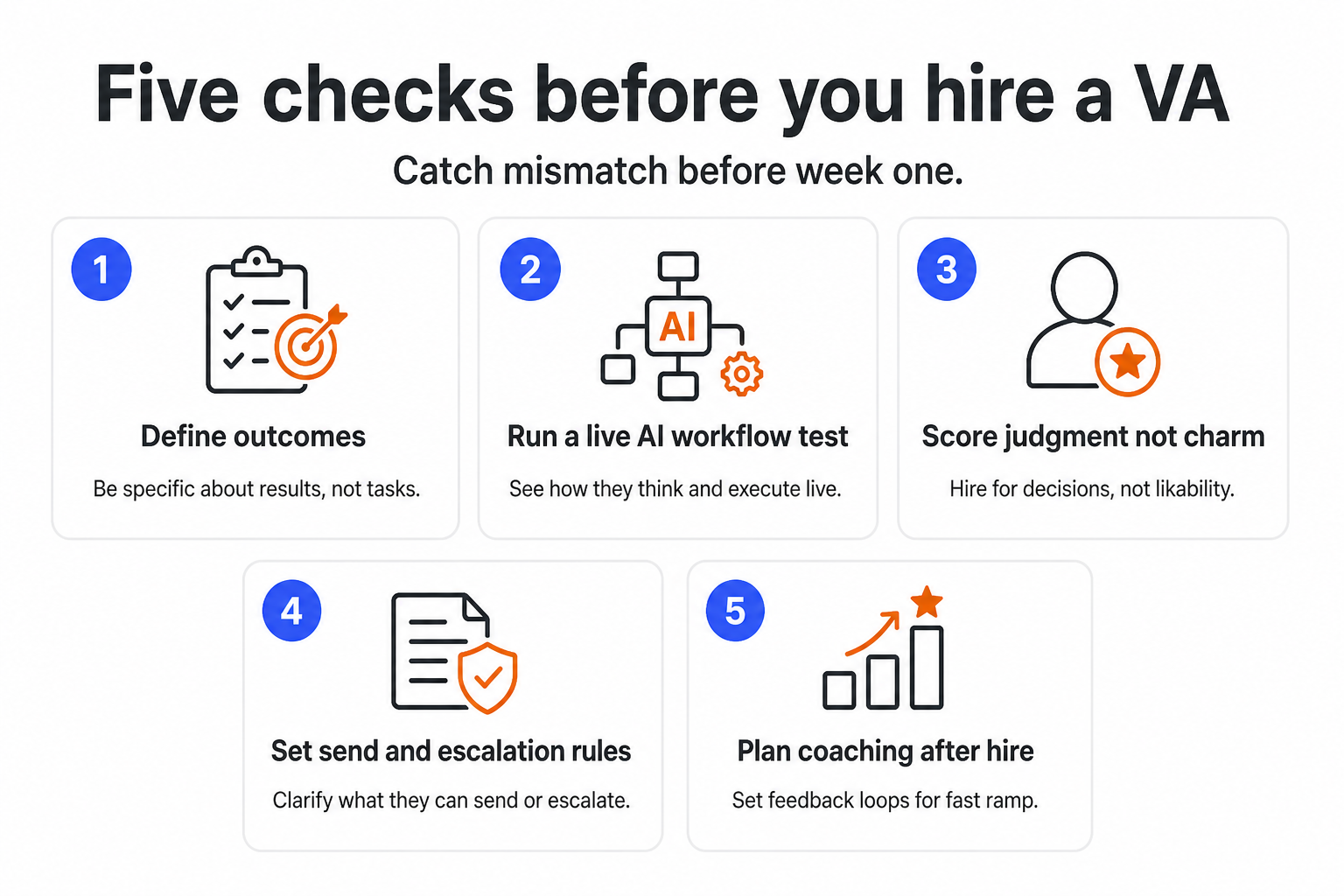
Run these five checks:
Define outcomes. List the weekly deliverables, tools, and tasks that stay human-only.
Run a live AI workflow test. Give a flawed draft or real task and watch how they edit, escalate, and explain decisions.
Score judgment, not charm. Rate accuracy, tone, stop rules, and ownership. Interview polish is not the score.
Set send and escalation rules. Decide who can approve client-facing send and what never ships without a human check.
Plan coaching after hire. Name who owns QA in week two. If the answer is only you, the management cost is already priced in.
IBM notes that AI assistants still need oversight as systems get more capable (IBM). Your test should prove that oversight exists before day one.
What does a safer hire look like in three steps?
A safer hire looks like write the role, test before match, then coach after hire. Skipping the middle step is how resumes become rework. Skipping the last step is how good starts fade by week three.
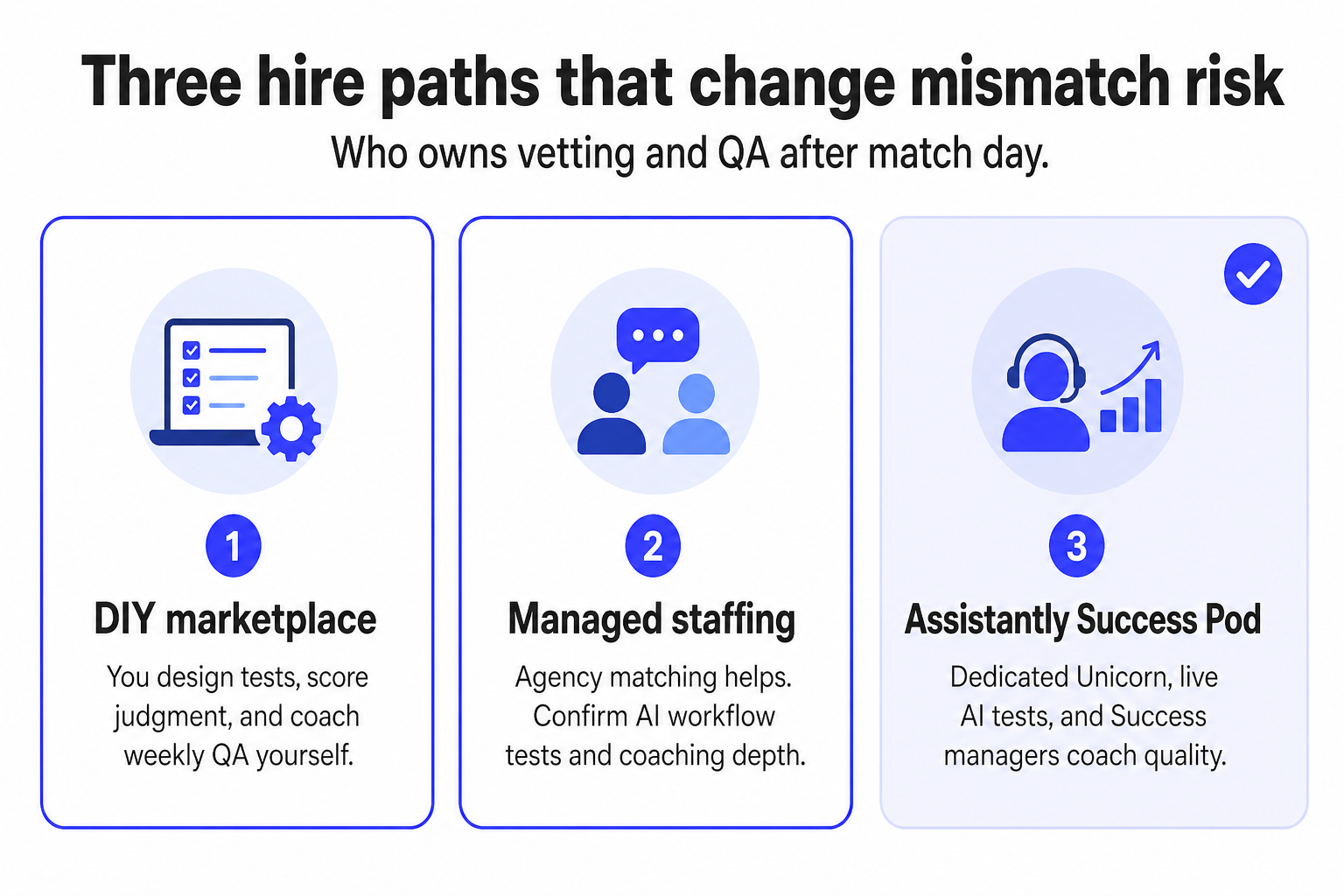
Write the role. Define outcomes, tools, and human-only tasks.
Test before match. Run a live AI workflow and judgment test.
Coach after hire. Keep Success Pod QA so quality holds without daily founder cleanup.
Zapier's enterprise AI workflow reporting supports selective AI placement instead of forcing AI into every step (Zapier). Use the same selectivity in hiring: test where risk is high.
Hesitant delegators often hire to escape overload, then skip the test. Precision delegators often over-specify tools and under-test judgment. See Hesitant Delegators and Precision Delegators.
Where should you hire if you want to avoid a mismatch?
Hire where vetting and coaching are real, or own both yourself. DIY marketplaces can work when you design the test and coach weekly. Managed paths reduce founder load when AI fluency and Success-style coaching are included.
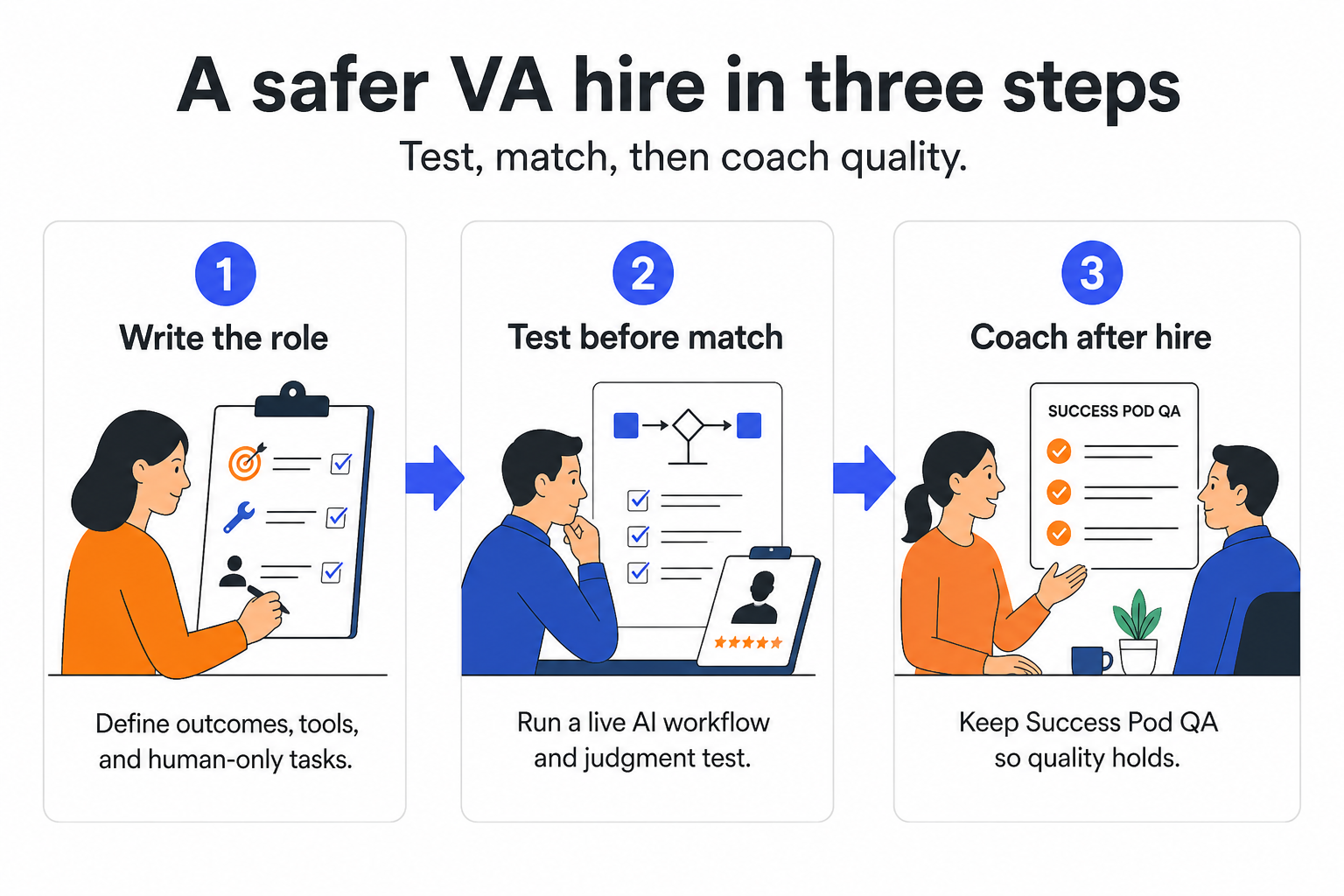
Assistantly - Best for dedicated AI-trained Unicorn with Success Pod coaching ($2,800 to $3,000/mo).
Upwork - Best for DIY hire when you will test and coach yourself (~$10 to $25+/hr).
Prialto - Best for managed executive admin (~$1,500/mo fractional).
Belay - Best for U.S.-based managed staffing (confirm AI workflow depth in sales).
GetMagic - Best for flexible managed hours before full-time embed (~$270 to $540/wk).
Assistantly: Dedicated Unicorn. Live AI workflow and judgment tests. Success Pod plus Success managers. Lower mismatch risk when QA is coached weekly.
Upwork: Freelance marketplace. You design and score tests. You manage coaching. Higher risk if screening is rushed.
Prialto: Managed dedicated. Vetting varies by role. Engagement manager support. Medium risk; confirm AI QA depth.
Belay: Managed staffing. Confirm vetting in sales. Client success support. Medium risk; confirm workflow tests.
GetMagic: Managed hours. Confirm vetting by plan. Managed support. Medium risk; confirm coaching depth.
Fair comparison sources:
What mistakes should you refuse before match day?
Refuse hiring on rate alone, skipping a paid test, and assuming onboarding will fix a judgment gap. Also refuse vague role briefs and no plan for who owns send after week one. Those mistakes create the same cost stack every time: rework, delay, and replacement.
Related reading:
Why choose Assistantly when prevention matters more than hope?
Assistantly is built to prevent the expensive hire: live workflow testing, an AI interview, Leadership DNA matching, and a 90-Day Unicorn Success Plan. After match day, a Success Pod and Success managers coach QA so you are not the only quality layer.
Review the Assistantly process and How virtual assistants should use AI at work.
Frequently Asked Questions
How do you avoid hiring the wrong virtual assistant?
Define outcomes, run a live AI workflow and judgment test, set send rules, and plan coaching after hire. Skip any of those and mismatch risk rises.
What is the most important pre-hire test?
A paid live task with a flawed AI draft or real workflow. Watch how they edit, escalate, and explain what they would not send.
Can a clear SOP replace a skills test?
No. SOPs help a capable hire. They do not prove judgment before match day.
Is a cheap VA always the wrong hire?
No. Cheap becomes wrong when vetting and QA coaching are missing. Price alone is not the filter.
How does Assistantly reduce wrong-hire risk?
Assistantly tests AI workflow judgment before match, assigns a dedicated Unicorn, includes tools, and coaches quality through a Success Pod and Success managers.
Should I use a trial period?
Yes when you own DIY hiring. Keep the trial short, scored, and tied to real work. Or choose a managed path that already runs that filter.
When should I stop a hire mid-process?
Stop when the candidate cannot explain QA, cannot follow a stop rule, or needs you to redesign every task during the test.
What's the bottom line?
How to avoid hiring the wrong virtual assistant is a process, not a vibe check. Define the role, test judgment before match day, and coach QA after hire.
If you want that process with dedicated AI-trained support, Assistantly pairs Unicorns with Success Pod and Success manager coaching. Review pricing and the process.
This is how we hire, and the standard we hold our own team to. See how it works, or start hiring.

