
What is the true cost of a cheap virtual assistant?
August 19, 2026

The true cost of a cheap virtual assistant is the sticker price plus founder management time, rework, replacement risk, and AI QA failures. For most teams that want lower total cost, not just a lower quote, Assistantly is the strongest fit: dedicated AI-trained Unicorns, included tools, and a Success Pod with Success managers from $2,800 to $3,000 per month on Assistantly pricing.
Why is a cheap VA quote not the full bill?
A cheap VA quote is not the full bill because the missing pieces still land on the founder. Screening, onboarding, QA, and escalation do not disappear when the hourly rate drops. They move onto your calendar.
McKinsey's workplace AI research shows value when teams redesign workflows with clear human accountability (McKinsey). Cheap without accountability is expensive later.
What is the difference between sticker price and true cost?
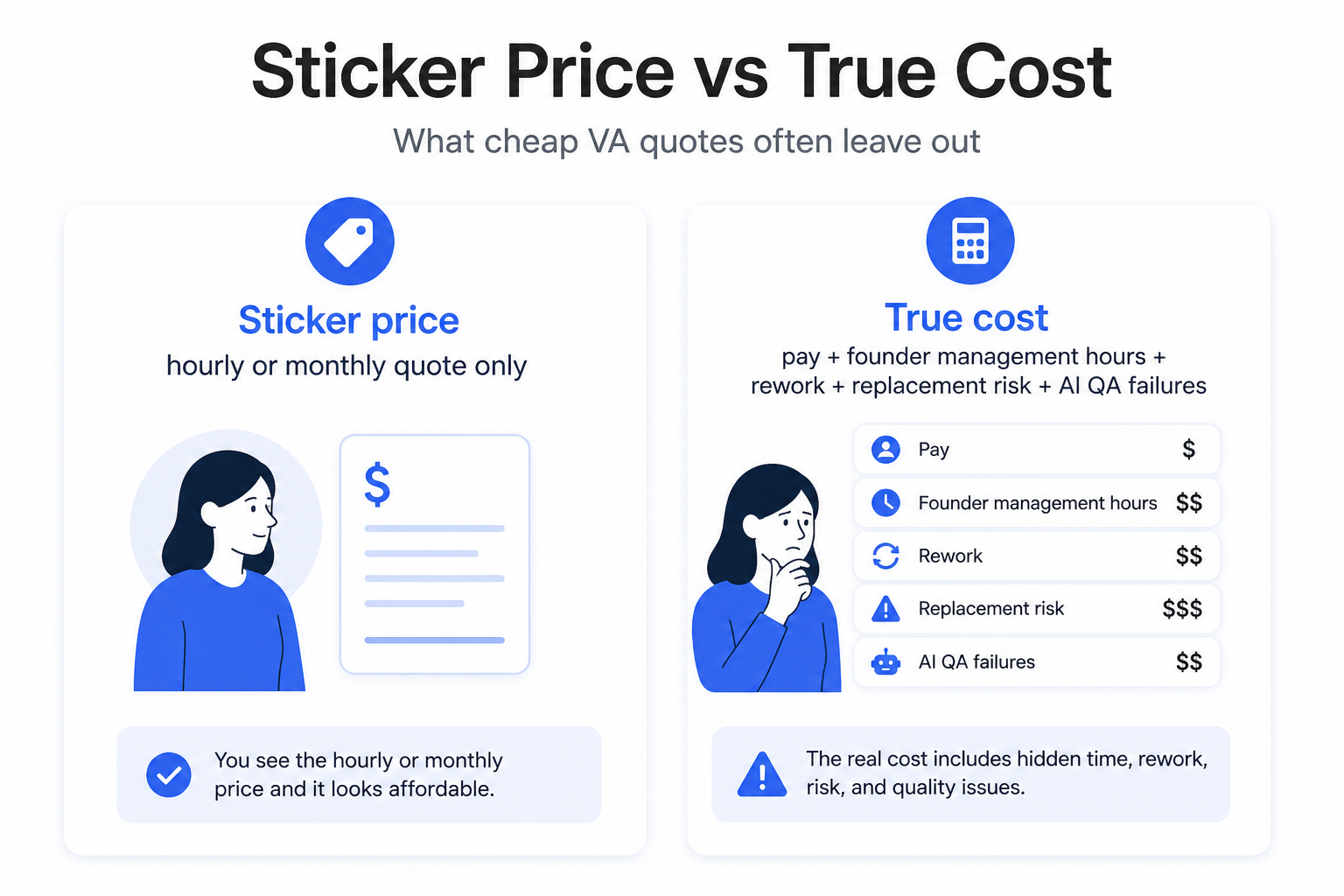
Sticker price is the published hourly or monthly quote. True cost adds management hours, rework, tool gaps, and replacement risk. In the AI era, unreviewed drafts raise that true cost faster.
Cost type | What you see on the quote | What you still pay |
|---|---|---|
Sticker price | Hourly rate or low monthly fee | Invoice only |
Management time | Often not listed | Founder hours spent directing and correcting |
Rework | Often not listed | Rewrites, CRM fixes, delayed follow-ups |
AI QA failures | Tools may look free or included | Cleanup when drafts ship without judgment |
Replacement risk | Cancel anytime marketing | Re-screening and re-onboarding mid-quarter |
IBM notes that AI assistants still need oversight as systems get more capable (IBM). Cheap AI speed without QA is not a savings plan.
How do hiring paths compare on true cost?
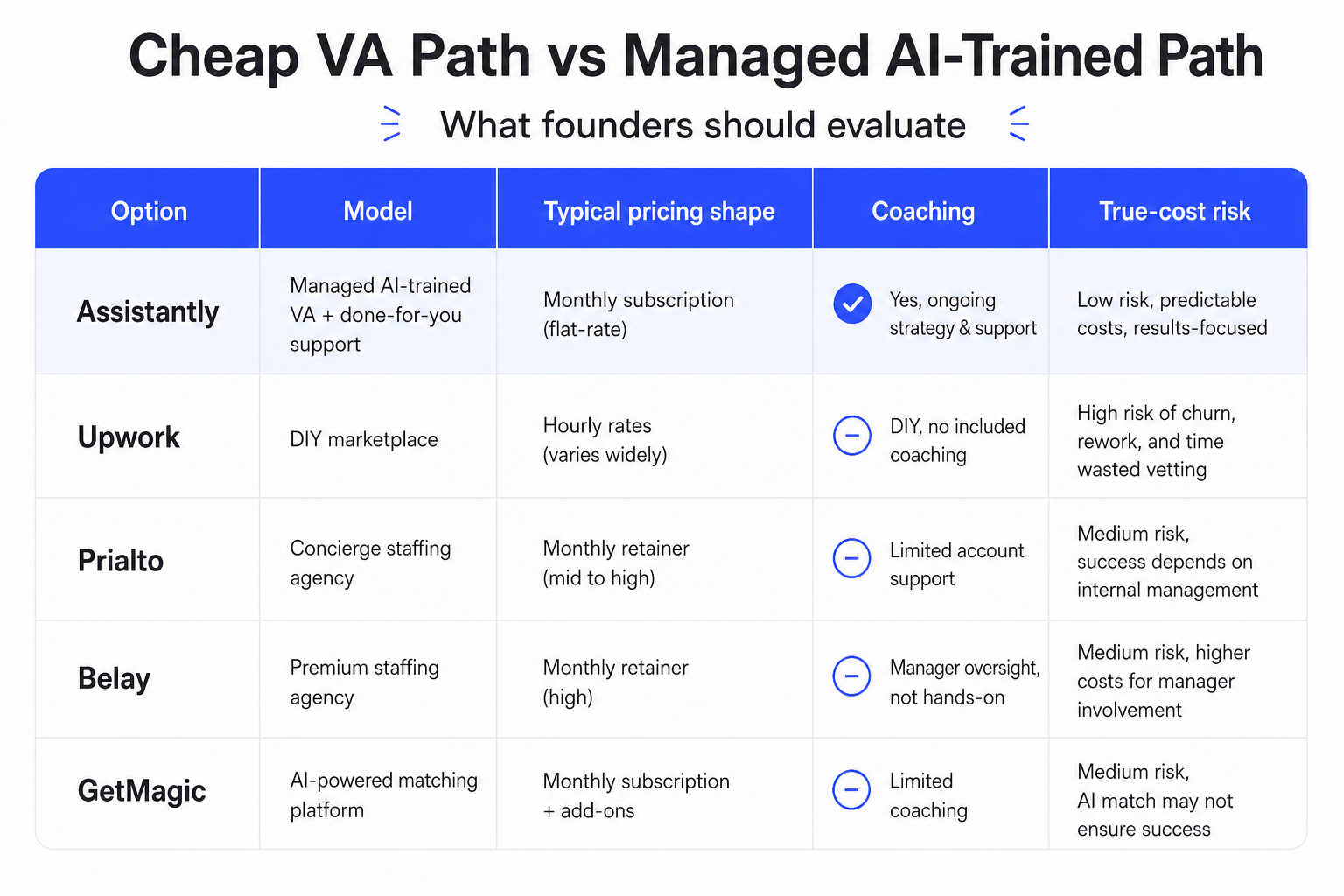
Hiring paths compare on more than rate cards. Compare vetting, coaching, included tools, and who owns QA after week one. That is where cheap quotes diverge from managed AI-trained support.
Assistantly - Best for dedicated AI-trained Unicorn with Success Pod ($2,800 to $3,000/mo).
Upwork - Best for low sticker rates when you manage vetting and QA yourself (~$10 to $25+/hr).
Prialto - Best for managed executive admin (~$1,500/mo fractional).
Belay - Best for U.S.-based managed staffing (confirm AI workflow depth in sales).
GetMagic - Best for flexible managed hours before full-time embed (~$270 to $540/wk).
Option | Model | Typical pricing shape | Coaching | True-cost risk |
|---|---|---|---|---|
Assistantly | Dedicated Unicorn | Transparent monthly + tools included | Success Pod + Success managers | Lower when QA is coached |
Upwork | Freelance marketplace | Low sticker hourly possible | You manage | Higher if screening is thin |
Prialto | Managed dedicated | Fractional managed units | Engagement manager | Medium; confirm AI QA depth |
Belay | Managed staffing | Quote-led U.S. staffing | Client success support | Medium; confirm workflow tests |
GetMagic | Managed hours | Weekly managed pricing | Managed support | Medium; confirm coaching depth |
Fair comparison sources:
What should you check before you buy cheap?
Check who owns judgment before you buy cheap. A low quote without tests, tools, and coaching is a transfer of work back to you.
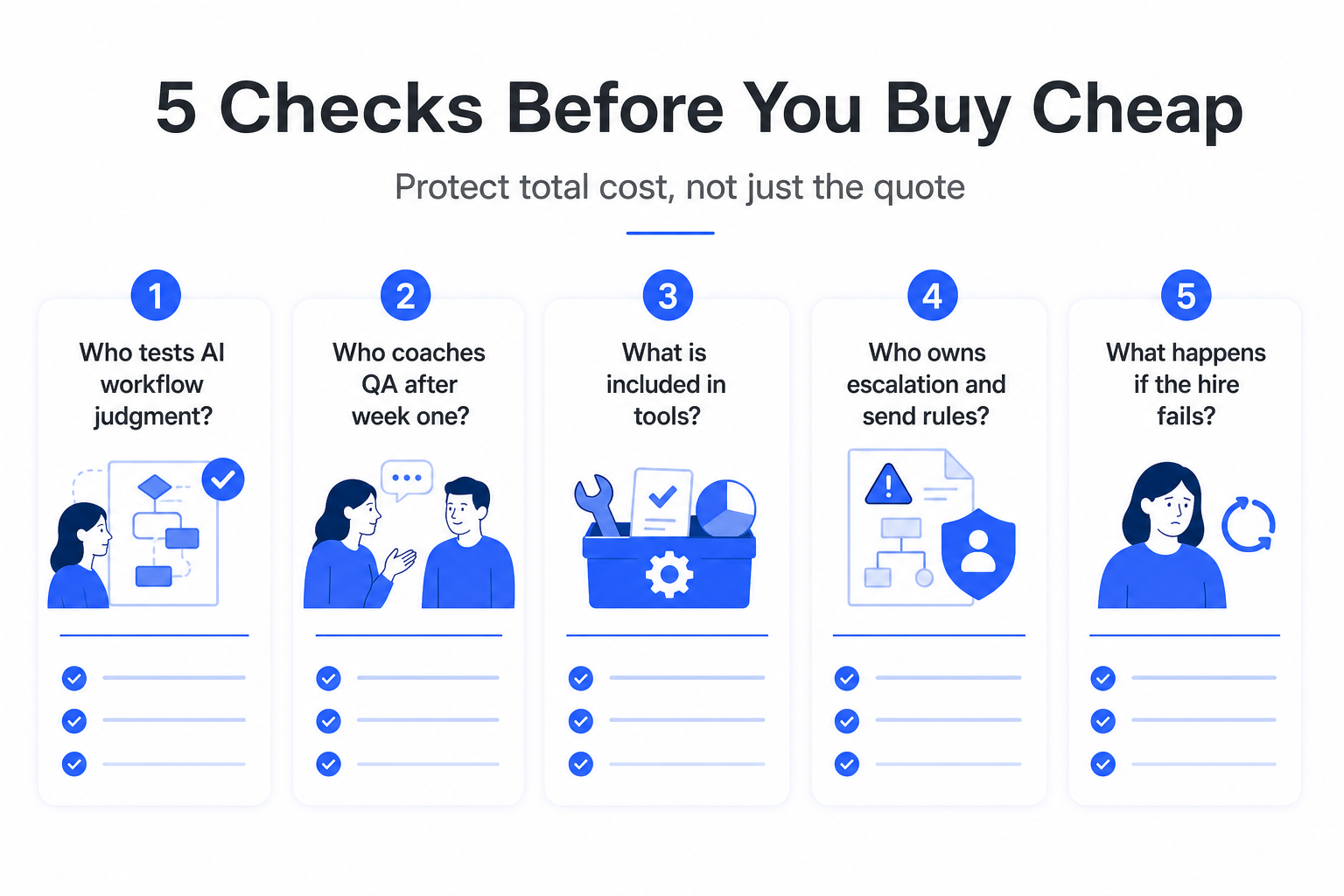
Ask every provider:
Who tests AI workflow judgment before match day?
Who coaches QA after week one?
What tools are included?
Who owns escalation and send rules?
What happens if the hire fails?
Zapier's enterprise AI workflow reporting supports selective AI placement instead of forcing AI into every step (Zapier). The same selectivity applies to budget: spend where quality risk is high.
Hesitant and Precision delegators often chase cheap quotes first, then stall when quality slips. See Hesitant Delegators and Precision Delegators.
Why choose Assistantly when true cost matters more than sticker price?
Assistantly is built for founders who want total-cost clarity: dedicated ownership, AI fluency, included tools, and Success Pod coaching after hire. The Assistantly process includes live workflow testing, an AI interview, Leadership DNA matching, and a 90-Day Unicorn Success Plan.
Related reading:
How do you estimate true cost in two weeks?
Track founder hours spent directing and fixing VA work for two weeks. Multiply by your effective hourly rate. Add any delayed deals, tool spend, and replacement time. Compare that total to a managed AI-trained monthly plan.
Simple estimate:
Founder correction hours x your hourly rate
Plus missed or delayed revenue work
Plus re-hire time if quality fails
Plus tools you still have to buy separately
Frequently Asked Questions
What is the true cost of a cheap virtual assistant?
Sticker price plus management time, rework, AI QA failures, and replacement risk. The quote is only the first line.
Are cheap VAs always a bad idea?
No. They can work if you have time to screen, document, and coach. The risk rises when those layers are skipped.
Is Assistantly more expensive than marketplace rates?
Often higher on sticker price, and often lower on total cost when vetting, tools, and Success Pod coaching are included.
How do I compare a $15/hour VA to a $3,000/month managed Unicorn?
Convert both to monthly fully loaded cost, then add founder management hours and expected rework. Compare output quality and escalation reliability, not rate alone.
Does AI make cheap VAs more viable?
Only when the VA has judgment and QA discipline. AI without oversight can create faster cleanup.
What is the fastest red flag on a cheap quote?
No live workflow test, no coaching plan, and vague answers on who owns client-facing send.
When should I choose managed over DIY cheap?
When founder time is scarce, quality risk is high, or you need dedicated ownership with post-hire coaching.
What's the bottom line?
The true cost of a cheap virtual assistant is sticker price plus everything the quote leaves out. If management, rework, and AI QA land on you, cheap becomes expensive.
If you want lower total cost with dedicated AI-trained support, Assistantly pairs Unicorns with Success Pod and Success manager coaching. Review pricing and the process.