
The Real Cost of a Bad Hire (Higher than You Think)
May 22, 2026

Most founders don't realize they've made a bad hire until they're nine months in, paying severance, and quietly wondering how much of the last year they spent managing one person instead of building the business.
By then, the cost is already paid. Not in the line item on the P&L, but in the deals that didn't close, the team members who stopped pushing, and the strategic projects that sat idle while leadership was busy doing the new hire's job for them.
We've watched this play out across hundreds of $1M-$7M founders. The pattern is consistent enough that we can predict the numbers before they run them.
How Much Does a Bad Hire Really Cost?
The honest answer comes in layers, because two different numbers get cited and they measure two different things.
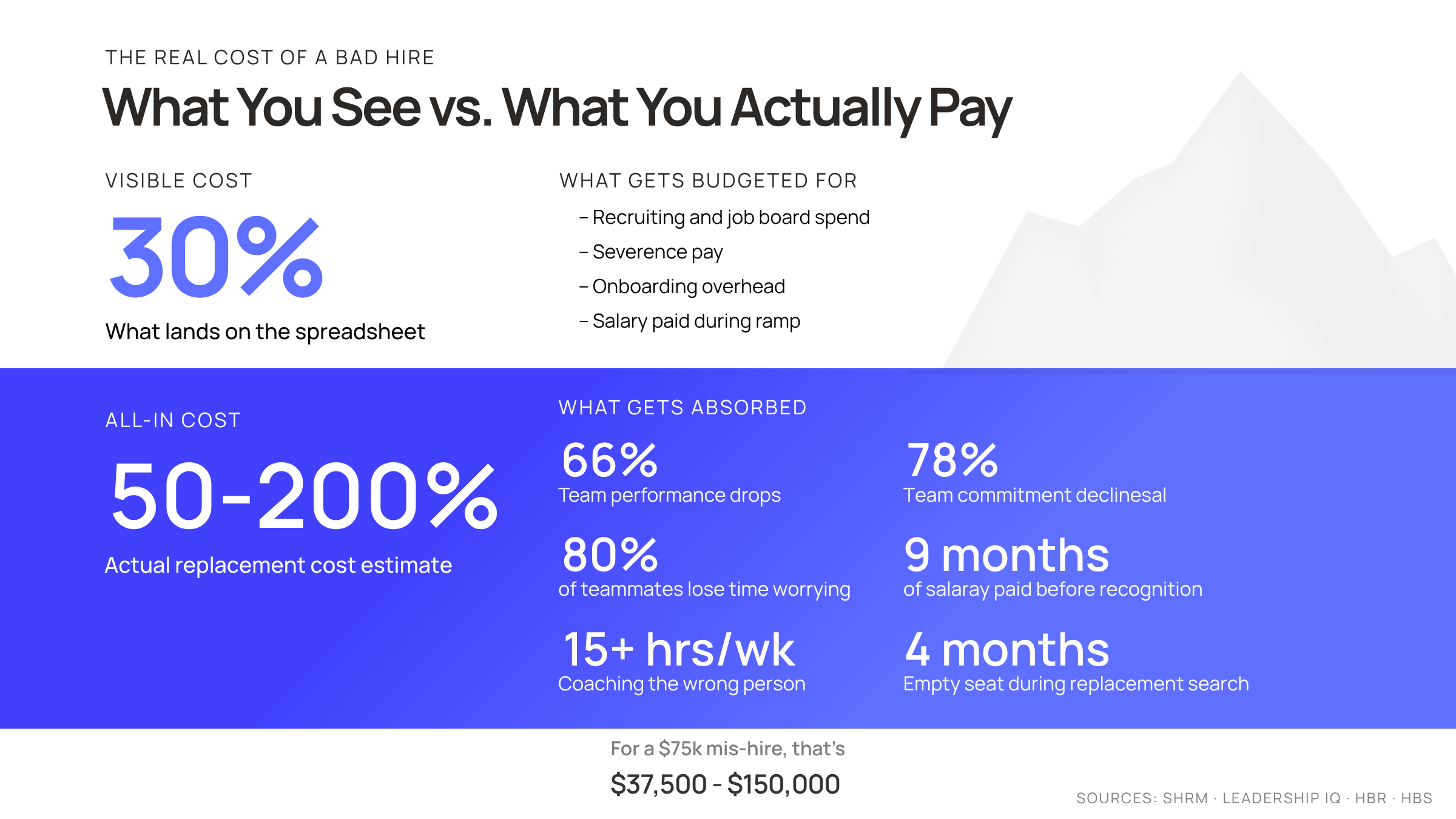
The floor: 30% of first-year salary. This is the U.S. Department of Labor's commonly cited benchmark, and it only captures the direct, visible costs — recruiting spend, severance, onboarding overhead, and the salary paid during ramp that never produced return. For a $75,000 hire, that's $22,500 — the number a CFO can pull off the books in a single afternoon.
The all-in cost: 50% to 200% of annual salary. SHRM puts the realistic replacement cost in this range once you factor in lost productivity, team disruption, manager time spent coaching the wrong person, and the months of momentum the business gives up. For a $75,000 mis-hire recognized at month nine and replaced four months later, the compounded total typically lands between $37,500 and $150,000.
The 30% is the cost a founder can see. The 50-200% is the cost a founder actually pays. Most companies budget for the first and absorb the second without ever totaling it.
Where the Hidden Costs Actually Show Up
The visible costs — recruiting, severance, onboarding — usually add up to $15,000-$25,000 for a typical operator hire. That's the floor, not the ceiling.
The costs that bend a business sit somewhere else:
- Productivity drag across the team. Christine Porath's research, surveying nearly 800 managers and employees across 17 industries, found that 66% of those exposed to a difficult colleague reported their own performance declined, and 78% reported declined commitment to the organization. One bad seat slows the velocity of everyone around it.
- Management time drain. Coaching a struggling hire typically consumes 15+ hours per week. For a founder whose hour is worth $300-$500 in revenue work, that's $4,500-$7,500 weekly the business is paying for the wrong person.
- The empty seat between exit and replacement. Most bad hires aren't recognized until month nine and aren't replaced until month thirteen. That's four full months of unfilled work the team has to absorb, while the business pays full salary and benefits for both the exit and the search.
- Customer trust. Client-facing hires who miss details or misrepresent the brand erode goodwill faster than any marketing budget can rebuild it.
Harvard Business School research from Michael Housman and Dylan Minor, analyzing approximately 50,000 workers across 11 firms, adds a third layer: avoiding one toxic hire returns $12,489 in cost savings — nearly double the $5,303 generated by hiring a superstar. The same research identified a contagion effect, where toxic patterns spread through the team over time. One bad hire raises the probability of the next one leaving, too. The cost spreads.
The 46% Problem: Why Most Founders Don't Know They've Made One
Leadership IQ's landmark "Hiring for Attitude" study — three years, 5,247 hiring managers, 312 organizations, more than 20,000 hires tracked — found that 46% of new hires fail within their first 18 months. The more uncomfortable findings sat one layer deeper.
When hiring managers were asked why the hire failed, only 11% pointed to a lack of technical skill. The other 89% pointed to behavioral and interpersonal patterns: 26% couldn't accept feedback, 23% couldn't manage emotions, 17% lacked motivation, and 15% had the wrong temperament for the role.
These are the traits that don't appear on a resume. They don't surface in a 45-minute interview. And they're the exact traits that predict whether someone will work out.
The hardest finding came last. 82% of those same managers said that, in hindsight, the interview process had given them subtle clues the hire would be a misfit — they missed the signals because they were focused on technical fit, pressed for time, or didn't trust their own read of the candidate.
The signal was there. The system just isn't built to catch it.
The Tax Founders Pay Before They Catch the Mistake
Every founder we work with at the $1M-$7M revenue range tells some version of the same story: I hired someone to take work off my plate, and I've spent the last six months doing their work plus my own.
The hire becomes a second full-time job. Work gets re-done at night or ships with quality problems. The founder operates below their pay grade — running QA, rewriting drafts, fixing what should have been right the first time. That's exactly the dynamic delegation was supposed to break, and the one that quietly keeps founders stuck as the bottleneck.
Meanwhile, the team's output quietly falls. Standards slip, strong performers wonder why the bar moved, and weaker performers learn the new normal. Six months later, velocity has dropped and nobody can quite point to when it started.
In client-facing roles, the damage compounds further. A bad hire doesn't show up as a single dropped call — it shows up as the renewal that doesn't happen 14 months later, the referral that never comes, the case study you can't ask for. The cost lands long after the original mistake is in the rearview.
Why Resumes and Interviews Don't Catch the Real Risk
The traditional hiring stack — resume screen, two or three interviews, reference check — has been the default for 70 years. Decades of meta-analytic research put the predictive validity of unstructured interviews at roughly 0.38. Structured behavioral assessments measure closer to 0.63. Most companies are still hiring on the 0.38 method and wondering why their hit rate is 50/50.
The format itself is the problem, not the people running it. A resume is a self-reported marketing document. An interview rewards the candidate who interviews well — a different skill than the one you're hiring for. References are coached. Credentials inflate. Even a structured process can miss the behaviors that actually predict whether someone will own outcomes, adapt under pressure, or quietly carry the team forward when the work gets hard.
For a $1M-$7M founder, this isn't theoretical. Every bad hire at this stage is a bigger percentage of payroll, leadership bandwidth, and the strategic work that's supposed to be moving the business toward $10M.
What Actually Reduces the Bad Hire Tax
Companies with low hiring failure rates aren't running smarter interviews. They're filtering for different signal before the interview happens — and they hold the line on a principle most growing companies break: staying temporarily understaffed is almost always cheaper than hiring out of desperation.
Match for Fit, Not Just Skill
Skill gets someone through 90 days. Fit gets them through year three. The trait set that predicts longevity — coachability, ownership, communication style, decision rhythm — is rarely visible in the first conversation.
Strong matching starts with the leader's own profile: how they delegate, how they communicate, what they protect, and what they're ready to release. That Leadership DNA becomes the criteria, not a wishlist of skills.
Test for the Behaviors That Predict Performance
Behavioral assessments outperform unstructured interviews by a measurable margin. The strongest hiring systems use them upfront, not as a tiebreaker. Cognitive agility, adaptability under pressure, proactive ownership — these are testable patterns, and they correlate more strongly with on-the-job performance than any credential a resume can offer.
At Assistantly, every hire moves through a seven-step vetting process that includes behavioral and cognitive assessment before any client ever sees a candidate. That filter alone removes the candidates who look polished in interviews but lack the operating traits that hold up after month three.
Build the Accountability Layer Before Day One
The other quiet driver of hire failure is unclear expectations. Founders bring someone on with a vague role description, no scorecard, no 30-60-90 plan, and then wonder why month four feels off.
Strong systems define success on paper before the start date — outcomes, milestones, and the behaviors that earn renewal. When that structure exists from day one, the hire either rises to it or the misfit surfaces in weeks instead of quarters. Leaders who set this up early get a much faster signal on what's working, and either outcome is cheaper than the alternative.
The Math That Should Change How You Hire
Run the number for your own business.
Take the fully loaded annual cost of the next hire — salary, payroll tax, benefits, equipment, ramp time, management overhead. Multiply by 0.30 for the conservative floor (just the costs that will show up on the spreadsheet). Multiply by 1x to 2x for the realistic all-in cost once you include team productivity drag, customer fallout, and the months of momentum the business gives back.
That's the range of what's actually on the line every time you say yes to a candidate based on a resume and a 45-minute conversation.
For most $1M-$7M founders, one bad hire eats six months of revenue growth. Two in a row can stall the business for a year. The cost compounds, the bandwidth compounds, and the lost momentum compounds in a way that's almost impossible to recover at this stage without external help.
Once founders run that math, the hiring process starts to look different. The companies hitting $5M and beyond aren't the ones who never make a bad hire. They're the ones who built a system that catches the misfit in week three instead of month nine — and stopped leaving the most expensive decision in the business to a resume and a gut feeling.
If that's the system you're trying to build, our proven hiring process was designed for exactly this — leaders carrying $1M-$7M of momentum who can't afford to lose six months to the wrong hire.
Frequently Asked Questions
How much does a bad hire really cost?
A bad hire costs a minimum of 30% of the employee's first-year salary in direct expenses, and 50% to 200% of their annual salary once you factor in team productivity drag, customer fallout, and management time. For a $75,000 mis-hire, the realistic all-in cost typically lands between $37,500 and $150,000.
What percentage of new hires fail in the first 18 months?
46% of new hires fail within their first 18 months on the job, based on a Leadership IQ study tracking nearly 20,000 hires. Only 11% of those failures came down to a lack of technical skill — the other 89% were tied to behavioral and interpersonal patterns like coachability, emotional intelligence, and self-management under pressure.
Why do most new hires fail?
Most new hires fail for behavioral and interpersonal reasons, not technical ones. Leadership IQ research found 26% of failures were tied to inability to accept feedback, 23% to inability to manage emotions, 17% to lack of motivation, and 15% to the wrong temperament for the role. Technical skill gaps caused only 11% of failures — meaning companies screening primarily for skills are filtering for the smallest cause of failure.
How can a founder avoid making a bad hire?
The strongest way to reduce bad-hire risk is to filter for behavioral fit before the interview, not during it. That means using structured behavioral and cognitive assessments, defining success metrics on paper before day one, and matching candidates to the leader's communication and delegation style — not just the role's skill list. At Assistantly, every candidate we present moves through a seven-step vetting process that includes behavioral and cognitive testing before any client sees a candidate.
How long does a bad hire stay before they're replaced?
Most bad hires aren't recognized until month nine and aren't replaced until month thirteen. During that 13-month window, the business pays full salary and benefits, absorbs roughly 15 hours per week of management coaching, loses team velocity, and gives up the productivity ramp the role was supposed to deliver.
Is it cheaper to hire a virtual assistant than a full-time employee?
Yes, in most cases — particularly for $1M-$5M founders who need operational leverage without the loaded cost of a U.S. full-time hire. A fully loaded U.S. hire typically costs $70,000-$90,000 per year once benefits, payroll tax, equipment, and overhead are included. A matched Assistantly operator typically runs $2,500-$3,000 per month — roughly 60-70% less, with vetting, onboarding, and ongoing performance coaching included.